
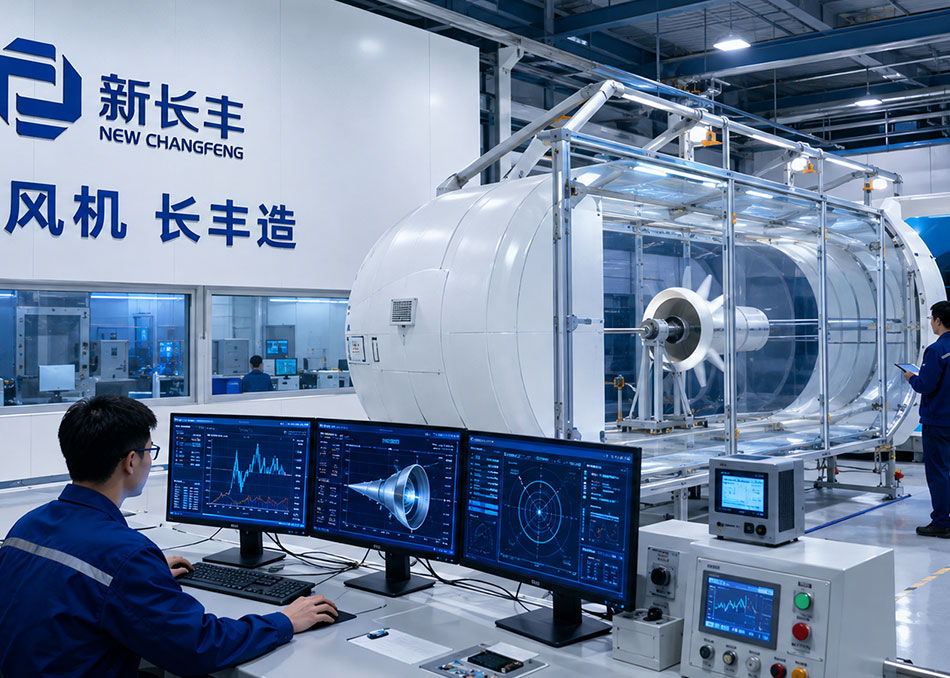
Small restaurants often have compact kitchens packed with woks, grills, and fryers. When the lunch rush hits, the kitchen fills with smoke, grease coats the walls, cooks squint through the haze, and diners in the front of house catch the smell. The instinct is to blame the fan and buy a bigger one. But upsizing alone rarely fixes the problem — it often just adds noise and energy cost. The real issue is usually system balance: hood capture, duct routing, makeup air, and how the exhaust fan works with the purification equipment. Axial fans are a common, versatile component in these systems, but they play a specific role. Understanding how they work helps you place them correctly — and avoid using them where they don't belong.
How an Axial Fan Works: Air Moves Along the Axis
The name says it all: in an axial fan, airflow runs parallel to the rotating shaft. Air enters along the axis, gains energy from the spinning blades, and exits along the same axis. Think of a propeller pushing air forward. This design is compact, moves a high volume of air relative to its size, and is easy to mount — which is why axial fans are everywhere in ventilation, from wall-mounted exhaust to duct booster applications.
Technically, each blade is shaped like a small airfoil. As the impeller spins, a pressure difference forms between the leading and trailing faces of the blade, pushing air toward the discharge side. The result is a fan that performs well when it faces low resistance — short ducts, few bends, and minimal static pressure. That last point matters enormously in kitchen exhaust, where grease filters, long duct runs, and pollution control devices all add resistance.
Compared with centrifugal fans, axial fans generally deliver higher airflow at lower static pressure. They are not inherently better or worse — they are suited to different jobs. In a small restaurant exhaust system, an axial fan is often best used as a makeup air fan or a duct booster, not as the primary exhaust workhorse pulling through a long, greasy duct network.
Why “Not Enough Suction” Is Usually a System Problem
When a small restaurant kitchen feels smoky, the fan is rarely the only culprit. The exhaust system is a chain: hood, filters, duct, fan, pollution control device, and discharge point. If any link is undersized, clogged, or misaligned, the whole system underperforms. A common mistake is replacing the exhaust fan with a higher-power unit while ignoring the rest of the chain. The result is more noise, higher energy bills, and little improvement in air quality.
Several factors commonly cause poor exhaust in small kitchens:
- Hood capture failure: The hood is too small, mounted too high, or lacks sufficient overhang, so smoke escapes before it can be captured.
- Duct restrictions: Long runs, sharp elbows, undersized duct, or accumulated grease reduce airflow and increase static pressure.
- Insufficient makeup air: If the kitchen is tightly sealed, the exhaust fan fights against negative pressure. Without a dedicated makeup air path, airflow drops and doors become hard to open.
- Poor coordination with purification equipment: Electrostatic precipitators and grease filters add resistance. The fan must be selected to handle the total system pressure, not just the duct.
In other words, the question is not simply “is the fan big enough?” but “does the fan match the system’s actual resistance and airflow demand?” That is where axial fans have a clear, limited, and useful role.
Where Axial Fans Fit in Small Restaurant Kitchen Exhaust
In a small restaurant, the primary exhaust fan usually needs to overcome significant static pressure from hood filters, ductwork, and a fume purifier. That job typically calls for a centrifugal fan, which handles higher resistance more effectively. Axial fans, by contrast, excel in two supporting roles: makeup air supply and duct boosting.
Makeup air supply. Every cubic meter of air exhausted must be replaced. If it isn't, the kitchen becomes depressurized, exhaust performance collapses, and doors may be difficult to open. An axial fan mounted in a wall or ceiling intake can bring in outdoor air efficiently and quietly. In many small restaurants, this is the single most cost-effective improvement — it restores balance without changing the main exhaust fan.
Duct boosting. In some layouts, an axial fan can be installed inline to assist airflow in a branch duct or to push air toward the main exhaust riser. This works best when the duct segment is short and relatively free of grease buildup. It is not a substitute for a properly sized main exhaust fan, and it should never be placed where heavy grease or high static pressure will cause it to stall or clog.
For kitchens that also need cooling, evaporative air coolers or water-cooled fresh air units can be integrated with the makeup air strategy. This approach improves working conditions while maintaining the pressure balance the exhaust system needs.
Practical Selection and Installation Guidelines
Choosing an axial fan for a small restaurant kitchen is not about grabbing the biggest model on the shelf. It is about matching the fan to the specific task — makeup air or boosting — and ensuring it operates within its performance range. The following guidelines help avoid common pitfalls.
- Confirm the role: Decide whether the fan is for makeup air, duct boosting, or general ventilation. Each application has different pressure and airflow requirements.
- Calculate system resistance: Account for filters, grease, duct length, bends, and any pollution control device. Axial fans lose effectiveness quickly as static pressure rises.
- Match fan performance to the system curve: Use performance data tested in accordance with GB/T 1236 to verify the fan will operate near its best efficiency point.
- Check energy efficiency: Fans that meet GB 19761 energy efficiency grades can reduce operating costs over the long run, especially in facilities running many hours a day.
- Plan for makeup air: Provide a dedicated intake path. In heating or cooling seasons, consider tempering the incoming air with a water-cooled fresh air unit or similar equipment.
- Ensure accessibility for cleaning: Kitchen exhaust is greasy. Fans and ducts must be reachable for regular cleaning and maintenance.
- Address noise: Axial fans can be noisy at high speeds. Mount them with vibration isolation and consider duct silencers where noise is a concern.
- Coordinate with purification: If a fume purifier is installed, verify that the fan can handle the added pressure drop. Electrostatic purifiers and baffle filters both add resistance.
In many small restaurant projects, the best configuration is a centrifugal fan as the main exhaust unit, paired with an axial fan for makeup air. This division of labor keeps each fan operating in its efficient range and avoids the common mistake of forcing an axial fan to do a centrifugal fan's job.
Maintenance and Compliance Considerations
Even a well-designed system degrades without maintenance. Grease accumulation on fan blades reduces airflow, increases vibration, and can create fire risk. In commercial kitchens, exhaust systems are subject to fire safety and environmental regulations. In China, GB 18483 sets limits for kitchen fume emissions, and GB 51251 addresses smoke and heat exhaust ventilation in buildings. Similar codes exist in many countries. Regular inspection and cleaning are not optional — they are part of keeping the system compliant and safe.
For axial fans used as makeup air units, filters should be checked regularly, and the fan should be inspected for dust buildup, corrosion, and bearing wear. For duct booster fans, grease cleaning is especially important because these units are often installed in areas that are easy to forget. A simple maintenance schedule — monthly visual checks, quarterly cleaning, and annual performance verification — can prevent most problems.
It also helps to document the system design: fan model, airflow, static pressure, and the basis for selection. When something changes — a new menu item, a longer duct run, or a new purifier — you can refer back to the original design and adjust accordingly rather than guessing.
Frequently Asked Questions
Q: Can I use an axial fan as the main exhaust fan for a small restaurant kitchen?
A: It depends on the system resistance. Axial fans work best with low static pressure and short duct runs. If your kitchen has a long duct, grease filters, and a fume purifier, a centrifugal fan is usually the better choice for the main exhaust. An axial fan is more commonly used for makeup air or duct boosting.
Q: Why does my kitchen still feel smoky after installing a bigger fan?
A: Increasing fan power alone rarely solves the problem if the rest of the system is unbalanced. Check hood capture, duct restrictions, makeup air supply, and whether the fan is matched to the total system pressure. In many cases, adding a proper makeup air fan improves exhaust more than upgrading the exhaust fan.
Q: How do I know what size axial fan I need for makeup air?
A: Start by determining the exhaust airflow of your main system. Makeup air should roughly match exhaust volume to maintain pressure balance. Then account for the resistance of the intake path, filters, and any tempering equipment. Use fan performance data tested to GB/T 1236 and select a model that operates efficiently at your required airflow and pressure. When in doubt, consult a ventilation engineer.
Q: Are there energy efficiency standards for axial fans?
A: Yes. GB 19761 specifies energy efficiency grades for fans. Choosing a fan that meets a higher efficiency grade can reduce electricity use, especially in kitchens that operate long hours. Efficiency should be considered alongside performance and noise.
Summary
Axial fans are compact, efficient, and well-suited to moving large volumes of air at low pressure. In small restaurant kitchens, they are most valuable as makeup air fans or duct boosters — not as a substitute for a properly sized centrifugal exhaust fan. The key to a smoke-free kitchen is system balance: effective hood capture, clean and adequately sized ducts, sufficient makeup air, and a fan selected to match the actual resistance of the entire exhaust train. When these elements work together, the kitchen stays comfortable, the dining area stays odor-free, and the equipment runs efficiently.
If you are planning a kitchen ventilation upgrade or need help selecting the right axial fan for your makeup air or boosting application, XCFFJ offers a range of industrial and commercial ventilation equipment, including axial fans, centrifugal fans, and fresh air units. Visit www.xcffj.com to explore solutions for restaurant kitchens, factory floors, and commercial spaces.