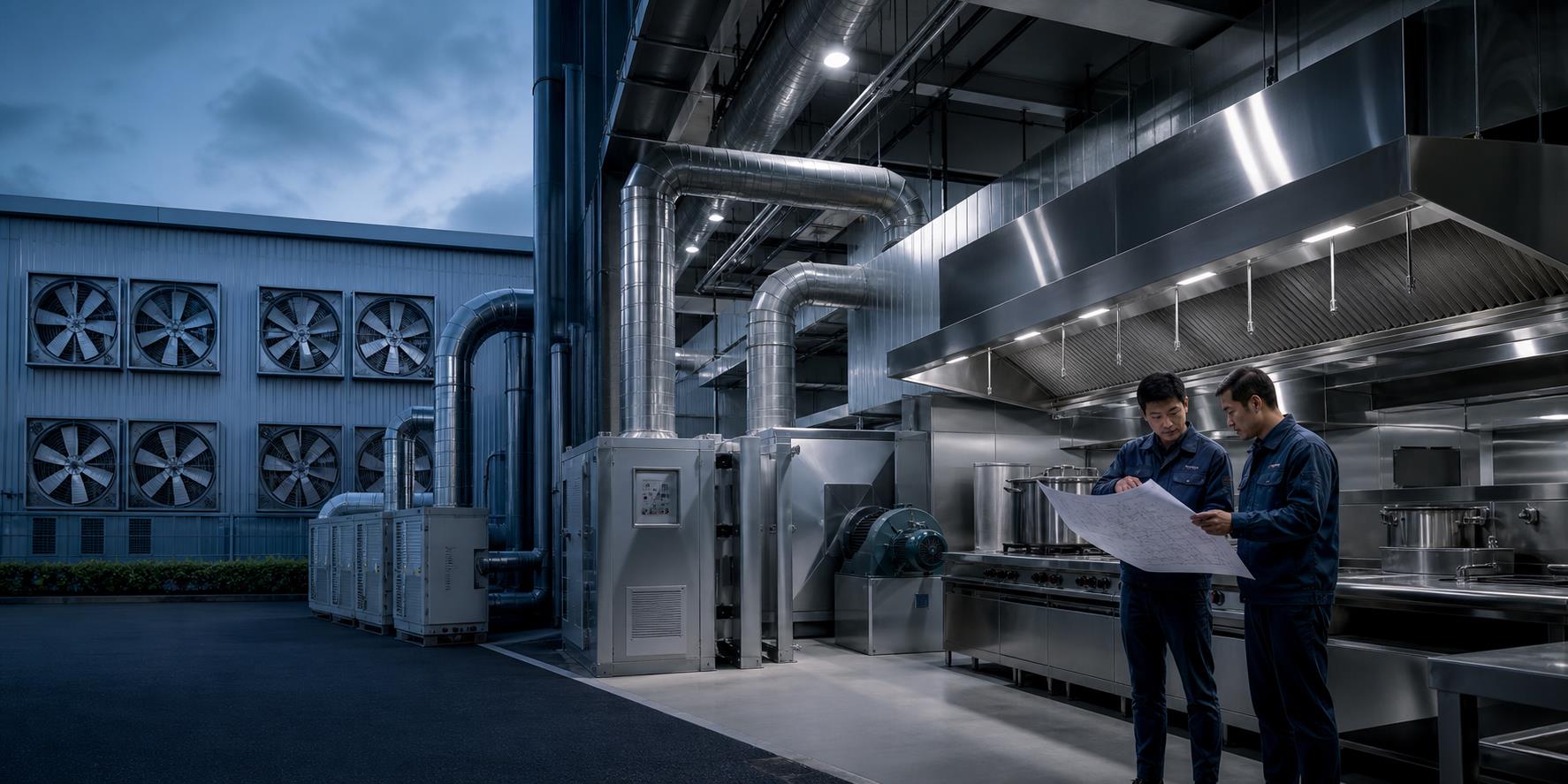
A commercial kitchen must handle fume collection, duct transport, fan exhaust and purification together. Xin Changfeng helps confirm the equipment combination and air organization around cookline and hood layout, exhaust duct routing, system resistance and purification requirements.
The hood is where fume collection begins and must cover the cookline with adequate capture. Hood style, mounting height and cookline type together determine local exhaust performance, forming the basis for fan and purification selection.
02
Exhaust Ducting & System Resistance
Duct routing, cross-section, elbows and purifiers all add system resistance. Ducted equipment such as cabinet centrifugal fans and centrifugal fans must be selected by actual exhaust volume and total pressure, not airflow alone.
03
Purification & Air Balance
Exhaust removes air and creates negative pressure, so make-up air must be planned in parallel. Purifiers work with the exhaust fan and ducting; their rated airflow must match the exhaust volume, with service access reserved.
Yes. Exhaust creates negative pressure; without enough make-up air, hood capture drops and it may affect cooking and air balance. Make-up air is usually estimated as a proportion of exhaust volume.
Provide cookline type and count, hood length, duct routing and purifier resistance, then size the fan by exhaust volume and total system pressure to confirm model and motor power.
The purifier’s rated airflow should match the exhaust fan airflow, and access for plate cleaning and service must be reserved.
Kitchen plan and cookline layout, hood dimensions, duct routing, floor height, discharge requirements and purification grade, to confirm equipment and installation interfaces.