
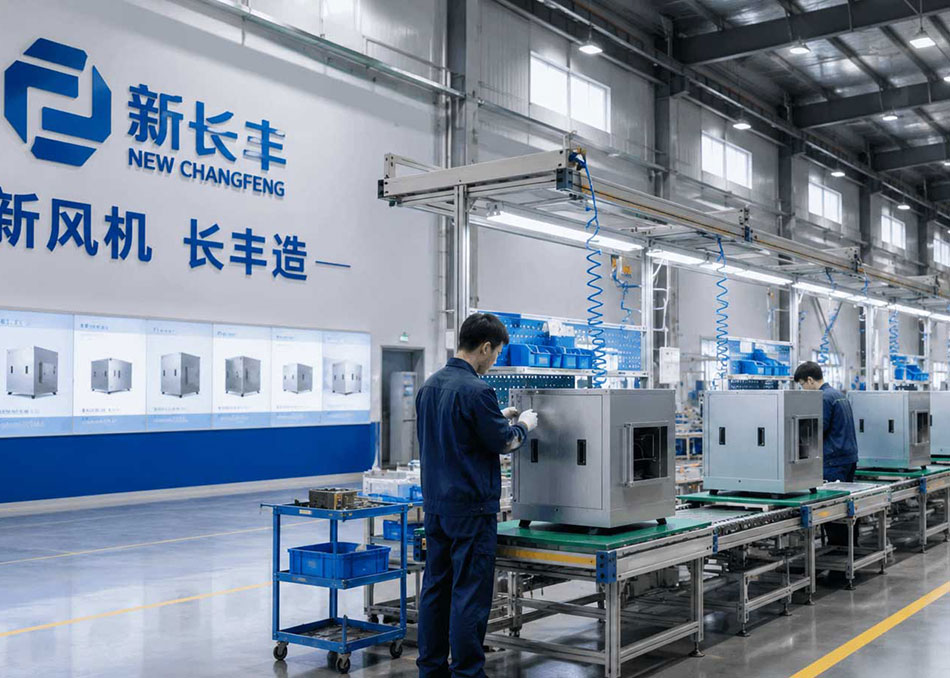
Walk through almost any manufacturing plant and you can feel the difference ventilation makes. Workshops that move air properly stay cooler, employees breathe easier, and equipment lasts longer. Yet plenty of facility managers face the same frustrating scenario: the shop floor is stuffy, welding fumes and dust seem to hang in the air, and certain workstations carry a stubborn odor — even though fans have already been installed. More often than not, the issue isn't the number of fans. It's whether the right fan type was selected and whether anyone understood how it actually works. Centrifugal fans sit at the heart of industrial ventilation and fume purification systems, and their operating principle makes them especially well suited to medium- and high-pressure duties with long duct runs. This article starts from that principle and works through what it means for real factory ventilation and fume extraction.
What Happens Inside a Centrifugal Fan
The core components of a centrifugal fan are the impeller and the volute (spiral) casing. When the motor drives the impeller at speed, the blades push the air between them into rotation. Centrifugal force throws that air outward toward the rim of the impeller, where it enters the expanding volute. As the casing widens, the air slows down and its pressure rises before it discharges through the outlet. At the same time, a low-pressure zone forms at the center of the impeller, and outside air is continuously drawn in through the inlet to fill it. The result is a steady, self-sustaining stream of moving air.
Two energy conversions take place in this process. The mechanical energy delivered by the motor first becomes kinetic energy in the moving air, and then the volute's diffusing action converts part of that kinetic energy into static pressure. This is why centrifugal fans are characterized by relatively high pressure with moderate airflow. Axial fans do the opposite — large volumes at low pressure — and the two types complement each other in a well-designed system rather than competing.
In practical terms, that pressure capability is what lets a centrifugal fan push air through filters, long duct networks, elbows, and purification stages without losing its ability to exhaust at the far end. It is also why the same machine can serve both supply and exhaust roles, depending on how the system is configured.
Why Factories Choose Centrifugal Fans for Fume and Dust Extraction
Factory air problems rarely come from a single source. Welding stations release fine metallic particulate, painting booths emit solvent vapor, machining lines throw off oil mist, and general production areas generate heat and dust. What these have in common is that the contaminated air usually needs to travel some distance — across a bay, up a wall, through a purification unit, and out to atmosphere. That journey creates resistance, and resistance is exactly what centrifugal fans are built to overcome.
Negative-pressure ventilation is the standard strategy here. Rather than blowing clean air at workers, the system extracts contaminated air from the source and lets replacement air flow in naturally through doors, louvers, or dedicated intakes. Centrifugal fans are frequently the extraction engine in this arrangement because they can maintain suction across a ducted network while still delivering enough static pressure at the discharge.
When the exhaust stream contains oil mist, smoke, or grease — as in commercial kitchens, school canteens, and food processing plants — the fan is typically paired with a purification stage such as an electrostatic precipitator or baffle filter. Placement matters: the fan should be positioned so that it draws air through the purification unit rather than pushing it, which keeps the airstream controlled and reduces the chance of fume leakage at joints and seals.
Matching the Fan to the Duty: Key Selection Points
Understanding the working principle is only half the job. The other half is matching the machine to the specific duty. A centrifugal fan that is oversized, undersized, or installed in the wrong orientation will underperform regardless of its build quality. The following points cover the decisions that matter most.
- Airflow and pressure requirements: Estimate both the volume of air that must be moved and the total system resistance, including ducts, fittings, filters, and purification equipment. A fan selected on airflow alone will often fall short once real-world resistance is added.
- Duct layout: Long runs, sharp elbows, and abrupt transitions all add pressure loss. Smooth, gradual transitions and properly sized ducts let a centrifugal fan work closer to its best efficiency point.
- Contaminant type: Grease-laden kitchen exhaust, corrosive chemical fumes, and abrasive dust each call for different impeller materials and casing treatments. Standard fans may corrode or clog quickly in aggressive environments.
- Noise control: Centrifugal fans generally run quieter than comparable axial units at the same duty, but installation still matters. Vibration isolation, flexible connectors, and correct duct sizing all help keep noise within acceptable limits for the surrounding area.
- Energy efficiency: Fan energy consumption accumulates over years of continuous operation. Selecting a model that operates near its peak efficiency point and using a properly matched motor can substantially reduce running costs.
It also helps to think about the system as a whole rather than the fan as a standalone product. A centrifugal fan working with well-designed ductwork, appropriate purification stages, and adequate makeup air will outperform a larger fan installed in a poorly planned system every time.
Standards, Testing, and What They Mean for Buyers
In China and many export markets, fan performance is evaluated against recognized standards. GB/T 1236 covers aerodynamic performance testing and provides the basis for published airflow and pressure curves. GB 19761 addresses fan energy efficiency and sets minimum thresholds for different fan categories. For fire safety applications, GB 51251 governs smoke and heat exhaust systems, which impose additional requirements on fan construction and temperature resistance. Kitchen exhaust systems fall under GB 18483, which sets emission limits for cooking fume and effectively defines how well the purification and extraction chain must perform.
For buyers, these standards are more than compliance checkboxes. They provide a common language for comparing products and a benchmark for verifying that a supplier's performance claims are meaningful. When evaluating a centrifugal fan for a factory ventilation or fume purification project, ask for performance data referenced to these standards and confirm that the testing conditions match your intended application.
It is also worth noting that efficiency regulations continue to tighten across the industry. A fan that was considered efficient a decade ago may no longer meet current expectations. Choosing a model with documented efficiency performance helps future-proof the installation against rising energy costs and evolving requirements.
Common Pitfalls in Factory Ventilation Projects
Even well-intentioned projects run into trouble when a few fundamentals are overlooked. One frequent mistake is treating the fan as a standalone purchase rather than part of a system. Without adequate makeup air, for example, a powerful exhaust fan will struggle against the vacuum it creates, and airflow will drop well below expectations.
Another common issue is neglecting maintenance access. Centrifugal fans handling dusty or greasy air need periodic cleaning and inspection, and a design that makes this difficult will eventually lead to reduced performance or premature failure. Impeller balance, bearing condition, and belt tension (where applicable) should all be part of a routine service schedule.
Finally, it is easy to underestimate the importance of correct installation orientation and support. Centrifugal fans are sensitive to how they are mounted, and improper support can introduce vibration, noise, and accelerated wear. Following the manufacturer's installation guidance is not optional — it directly affects both performance and service life.
Frequently Asked Questions
Q: What is the main difference between a centrifugal fan and an axial fan for factory ventilation?
A: Centrifugal fans generate relatively high pressure with moderate airflow, making them suitable for ducted systems with filters and long runs. Axial fans move large volumes of air at low pressure and are better suited to open spaces or short, unobstructed paths. Many factories use both types in different parts of the same facility.
Q: Can a centrifugal fan be used for kitchen fume purification as well as factory exhaust?
A: Yes. Centrifugal fans are widely used in commercial kitchen exhaust and school canteen systems, often in combination with electrostatic or baffle-type purification units. The key is selecting a model with appropriate corrosion resistance and grease tolerance, and positioning it to draw air through the purification stage.
Q: How can I tell if my current ventilation system is underperforming?
A: Common signs include persistent odors, visible haze or dust in the air, condensation on surfaces, and workers complaining of stuffiness even when fans are running. These usually indicate insufficient airflow, excessive system resistance, or a mismatch between the fan and the duct network. A professional assessment of the system can identify the specific cause.
Q: Does fan energy efficiency really make a noticeable difference in operating costs?
A: For fans running continuously, yes. Energy consumption accumulates over thousands of operating hours per year, so even modest efficiency improvements can translate into meaningful savings. Selecting a model that operates near its best efficiency point and using a properly sized motor are the two most effective steps.
Getting the System Right from the Start
Centrifugal fans are not complicated machines, but their performance depends on being matched to the job. The working principle — converting rotational energy into pressure and flow — explains why they excel at ducted exhaust and fume purification tasks where resistance is high and reliability matters. When the fan, ductwork, purification stages, and makeup air are designed as one system, factory ventilation stops being a recurring headache and becomes a dependable part of daily operations.
If you are planning a new ventilation or fume purification project, or trying to diagnose why an existing system is underperforming, it is worth talking to a supplier who understands both the equipment and the application. XCFFJ manufactures a range of centrifugal fans and related ventilation equipment for factories, commercial kitchens, and logistics facilities, and can help you match the right model to your specific requirements.