
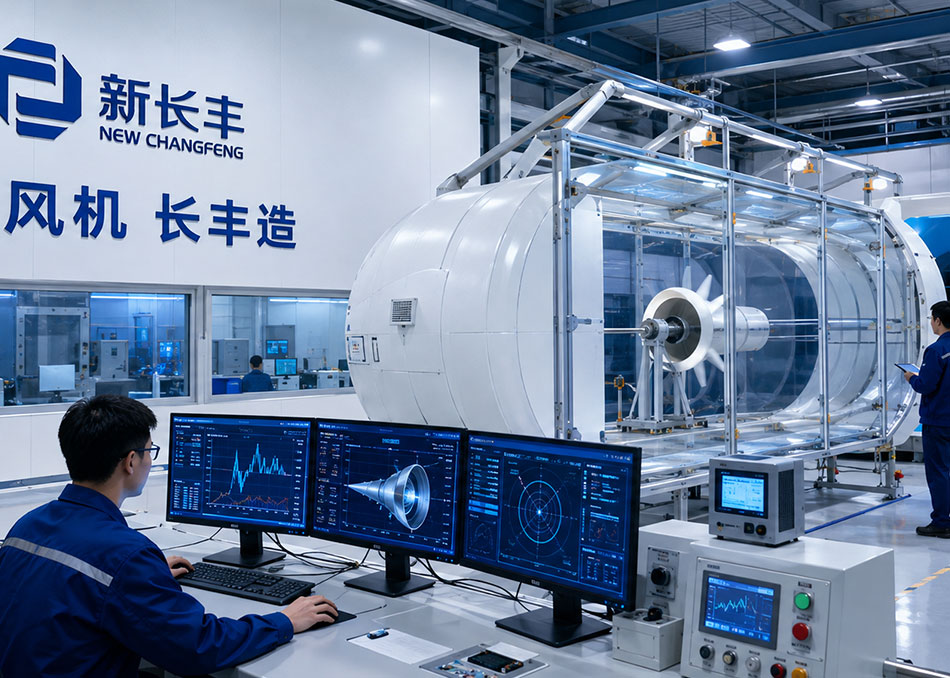
In factories, commercial kitchens, warehouses, and similar environments, ventilation is often overlooked—yet it directly affects safety, comfort, and operational efficiency. Many managers face common issues: stuffy workshops, lingering odors, kitchen fume spillage, insufficient make-up air causing poor exhaust, excessive noise, and high energy bills. The root cause often lies not in the exhaust purification equipment itself, but in the selection and matching of the fan—the "power source" of the supply and exhaust system. Axial fans, with their compact structure, flexible installation, and direct airflow direction, are widely used in ventilation systems. This article focuses on the application of axial fans in fume exhaust purification and ventilation make-up air scenarios, outlining selection strategies and practical implementation points.
1. Working Principle and Ventilation Suitability of Axial Fans
Axial fans move air parallel to the fan shaft: air enters axially, is pressurized by the impeller, and exits axially. This structure gives them natural advantages in "straight-through" supply and exhaust applications: simple duct routing, short airflow paths, and small installation footprint. They are suitable for direct installation in walls, window openings, roofs, or duct ends.
In ventilation, axial fans primarily serve two functions: exhaust—removing hot air, odors, and dust-laden air from the workshop to the outside; and make-up air—supplying fresh air to balance exhaust from kitchen hoods, purifiers, and other equipment, maintaining proper indoor pressure. Exhaust and make-up air are two sides of the same coin: exhausting without make-up air creates negative pressure, reducing hood capture efficiency and causing fume spillage.
2. Key Selection Considerations for Axial Fans
Proper selection ensures efficient operation and energy savings. Consider the following factors:
- Air volume and pressure requirements: Calculate required exhaust or supply air volume based on space size, heat load, and pollutant generation. Account for system resistance (ducts, fittings, hoods, filters) to select a fan with adequate static pressure. Refer to GB/T 1236 for fan performance testing standards.
- Energy efficiency: Choose fans compliant with GB 19761 energy efficiency grades. Higher efficiency reduces operating costs.
- Noise control: Axial fans can be noisy at high speeds. Select low-noise models or add silencers, especially in noise-sensitive areas.
- Installation flexibility: Consider wall-mounted, roof-mounted, or duct-mounted configurations. Ensure easy access for maintenance.
- Environmental conditions: For kitchen exhaust, choose fans resistant to grease and moisture; for dusty environments, consider filters or special coatings.
- Compliance: For smoke exhaust systems, fans must meet GB 51251 requirements for high-temperature operation. For kitchen fume, ensure the overall system meets GB 18483 emission limits.
3. Application in Fume Exhaust Purification and Make-up Air
In commercial kitchens, axial fans are often used for make-up air supply to balance exhaust from hoods and purifiers. Proper make-up air prevents negative pressure, improves capture efficiency, and reduces fume leakage. For exhaust, axial fans can be used in straight duct runs, but for grease-laden air, centrifugal fans or specialized filters may be more suitable. Axial fans also serve in factory workshops to remove heat and pollutants, and in warehouses to maintain air quality.
When designing the system, ensure make-up air volume is about 80–90% of exhaust volume to maintain slight negative pressure in kitchens (preventing odor migration) while ensuring proper hood performance. Use variable speed drives or multiple fan staging to match demand and save energy.
4. Installation and Maintenance Best Practices
- Install fans securely with anti-vibration mounts to reduce noise and vibration transmission.
- Ensure proper clearance around fans for airflow and maintenance access.
- For outdoor installations, protect fans from weather and debris.
- Regularly clean fan blades and check for balance, especially in greasy or dusty environments.
- Lubricate bearings according to manufacturer recommendations.
- Inspect electrical connections and controls periodically.
FAQ
Q: Can axial fans be used for kitchen exhaust with heavy grease?
A: Axial fans are not ideal for grease-laden exhaust because grease can accumulate on blades and motors, reducing performance and creating fire risk. For kitchen exhaust, use centrifugal fans or specialized grease filters. Axial fans are better suited for make-up air or clean exhaust applications.
Q: How do I determine the right fan size for my workshop?
A: Calculate the required air volume based on room volume and desired air changes per hour (e.g., 6–10 ACH for general ventilation). Consider heat load and contaminants. Then select a fan that delivers this air volume at the system's static pressure. Consult a ventilation engineer for precise calculations.
Q: What is the difference between axial and centrifugal fans for ventilation?
A: Axial fans move air parallel to the shaft, ideal for high-volume, low-pressure applications with straight ducting. Centrifugal fans move air radially, generating higher pressure, suitable for complex duct systems or high-resistance applications. Selection depends on system requirements.
Q: How can I reduce noise from axial fans?
A: Choose low-noise models, install vibration isolators, use flexible duct connections, and ensure proper duct design to avoid turbulence. In critical areas, add silencers. Regular maintenance also prevents noise from imbalance or debris.
Conclusion
Axial fans are a versatile and efficient solution for ventilation and make-up air in industrial and commercial settings. Proper selection, installation, and maintenance ensure optimal performance, energy savings, and compliance with standards. For tailored advice on axial fans and complete ventilation systems, contact XCFFJ—our experts can help you design a solution that meets your specific needs.