
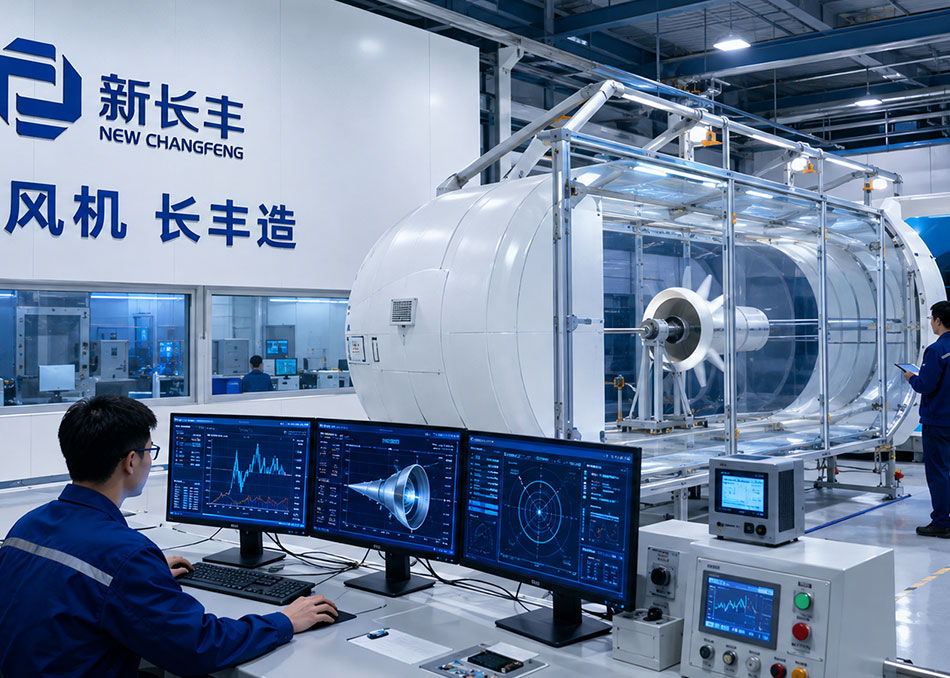
Commercial kitchen exhaust is a persistent challenge for restaurant owners and facility managers alike. When cooking fumes are not efficiently extracted, they leave sticky grease deposits on walls and equipment, compromise the working environment for chefs, and degrade air quality in dining areas. In constrained spaces such as shopping mall complexes or high-rise ground-floor restaurants, long duct runs, multiple elbows, and high static pressure from shared exhaust shafts often overwhelm standard axial fans or residential range hoods. This is where centrifugal fans—with their high static pressure capability, heat resistance, and oil-fouling resilience—become the core power unit of a professional kitchen exhaust system.
Centrifugal fans generate airflow by spinning an impeller that flings air radially outward into a scroll housing, producing significantly higher pressure than axial fans. This fundamental design allows them to maintain stable exhaust performance even when faced with extended ductwork, numerous bends, and backpressure from common shafts. In a commercial kitchen, the centrifugal fan must not only overcome duct resistance but also work in tandem with grease filters and electrostatic precipitators to form a complete capture–convey–clean–discharge chain. This article explores the application characteristics, selection criteria, installation considerations, and common pitfalls of centrifugal fans in kitchen exhaust systems, providing a professional reference for design and retrofit projects.
Core Role and Technical Advantages of Centrifugal Fans in Kitchen Exhaust
The resistance in a kitchen exhaust system is far more complex than it appears: local losses at the hood, friction losses along horizontal ducts, additional losses at elbows and transitions, and the positive pressure at the terminal rain cap or shared shaft all demand that the fan supply sufficient static pressure. Axial fans move large air volumes at low pressure, but they struggle when ducts are slightly long or contain several bends. Centrifugal fans, by contrast, are engineered to generate the high static pressure required to push air through tortuous paths and against system backpressure.
Beyond pressure, centrifugal fans offer several advantages tailored to kitchen environments:
- Heat resistance: The motor is typically mounted outside the airstream (belt-driven or with a cooling impeller), allowing the fan to handle elevated exhaust temperatures.
- Oil-fouling tolerance: The impeller design and accessible cleanout ports make it easier to remove grease buildup compared to axial fans.
- Stable performance: They maintain consistent airflow even when filters become partially loaded, reducing the risk of smoke spillage.
- Noise control: When properly selected and installed, centrifugal fans can operate at lower sound levels than axial fans of similar capacity, especially in ducted systems.
In summary, the centrifugal fan is not just a ventilation component—it is the heart of the entire kitchen exhaust system, ensuring that fumes are captured at the source, transported efficiently, and delivered to purification equipment before discharge.
Key Selection Criteria for Kitchen Exhaust Centrifugal Fans
Selecting the right centrifugal fan for a kitchen exhaust application requires a systematic approach. The first step is to calculate the total airflow required, based on the number of cooking appliances, the hood dimensions, and the recommended capture velocity. Industry guidelines, such as those from ASHRAE or local codes, provide baseline ventilation rates. The second step is to estimate the total system static pressure, which includes losses from the hood, ductwork, elbows, transitions, grease filters, and the exhaust stack or shaft.
Once the operating point (airflow vs. static pressure) is determined, the fan must be selected to operate near its peak efficiency at that point. Oversizing leads to excessive noise and energy consumption, while undersizing results in poor capture and smoke leakage. Key parameters to evaluate include:
- Fan type: Forward-curved vs. backward-curved impellers. Forward-curved fans are compact and cost-effective, but backward-curved fans offer higher efficiency and better resistance to grease buildup.
- Drive configuration: Direct-drive fans are simpler and more efficient, but belt-driven fans allow for speed adjustment and easier motor replacement in high-temperature applications.
- Material and coating: The fan housing and impeller should be constructed from corrosion-resistant materials and coated to facilitate cleaning.
- Certification: Look for fans that meet relevant safety and performance standards, such as AMCA or UL listings for kitchen exhaust use.
It is also essential to coordinate with the grease filtration and emission control equipment. The fan must be compatible with the pressure drop of the electrostatic precipitator or other purification devices, and the system should be designed to maintain negative pressure in the kitchen to prevent fumes from escaping into dining areas.
Installation, Commissioning, and Maintenance Best Practices
Proper installation is critical to the performance and longevity of a centrifugal fan in a kitchen exhaust system. The fan should be mounted on a sturdy base with vibration isolators to minimize noise transmission. Access must be provided for cleaning and maintenance, and the ductwork should be supported independently to avoid stressing the fan casing. In belt-driven models, the belt tension and pulley alignment must be checked during commissioning.
Commissioning involves verifying the airflow and static pressure at the design point, using pitot tubes or thermal anemometers. Adjustments may be made via variable frequency drives (VFDs) or pulley changes to achieve the desired performance. It is also important to test the operation of the entire system, including the grease filters and purification units, to ensure coordinated function.
Routine maintenance is non-negotiable: grease accumulation on the impeller and housing reduces performance and increases fire risk. Cleaning intervals should be based on the cooking volume and grease production, but a monthly inspection is a good starting point. Motors should be checked for overheating, and bearings should be lubricated according to the manufacturer's recommendations. A well-maintained centrifugal fan can provide years of reliable service.
Common Missteps in Kitchen Exhaust Fan Selection and Installation
Several recurring mistakes can undermine the effectiveness of a kitchen exhaust system. One is selecting a fan solely based on airflow (CFM) without considering static pressure. Another is ignoring the pressure drop of the purification equipment, which can be significant, especially with high-efficiency electrostatic precipitators. A third is placing the fan too close to the hood, which may cause turbulence and reduce capture efficiency.
Improper duct design also contributes to problems: excessive elbows, sharp transitions, and undersized ducts increase resistance and reduce airflow. Additionally, failing to provide adequate makeup air can create negative pressure in the building, making it difficult for the exhaust fan to work effectively and potentially causing backdrafting of combustion appliances.
Finally, some operators underestimate the importance of cleaning. A fan that is clogged with grease will not perform as designed, and the entire system may fail to meet emission standards. Regular cleaning and inspection are not optional—they are essential to maintaining compliance and safety.
FAQ
Q: What is the difference between a centrifugal fan and an axial fan for kitchen exhaust?
A: Centrifugal fans generate higher static pressure, making them suitable for systems with long duct runs, multiple elbows, or shared exhaust shafts. Axial fans move large air volumes at low pressure and are typically used for general ventilation where duct resistance is minimal.
Q: How do I know what static pressure my kitchen exhaust system requires?
A: You need to sum the pressure losses of all components: the hood, ductwork (including straight sections and fittings), grease filters, purification devices, and the terminal stack. A professional HVAC engineer can perform this calculation, or you can use duct calculator tools and manufacturer data.
Q: Can I use a variable frequency drive (VFD) with my centrifugal fan?
A: Yes, VFDs are commonly used to adjust fan speed and airflow, especially in systems with varying cooking loads. However, ensure the motor is inverter-duty rated and that the fan is not operated below its minimum speed to avoid overheating.
Q: How often should I clean my centrifugal fan in a commercial kitchen?
A: Cleaning frequency depends on the cooking volume and type. As a general rule, inspect the fan monthly and clean when grease buildup is visible. High-volume operations may require more frequent cleaning, and some jurisdictions have specific requirements for grease removal.
Q: What are the signs that my kitchen exhaust fan is undersized or failing?
A: Common signs include poor smoke capture, visible fumes in the kitchen, excessive noise, and reduced airflow at the hood. If the fan motor cycles frequently or trips on thermal overload, it may be struggling against excessive static pressure.
In summary, centrifugal fans are indispensable for commercial kitchen exhaust systems, providing the high static pressure needed to overcome duct resistance and ensure effective fume capture and purification. By carefully selecting the right fan, installing it properly, and maintaining it diligently, you can achieve a safe, efficient, and compliant kitchen ventilation system. For professional guidance and high-quality centrifugal fans tailored to your kitchen exhaust needs, consult XCFFJ's team of ventilation specialists.