
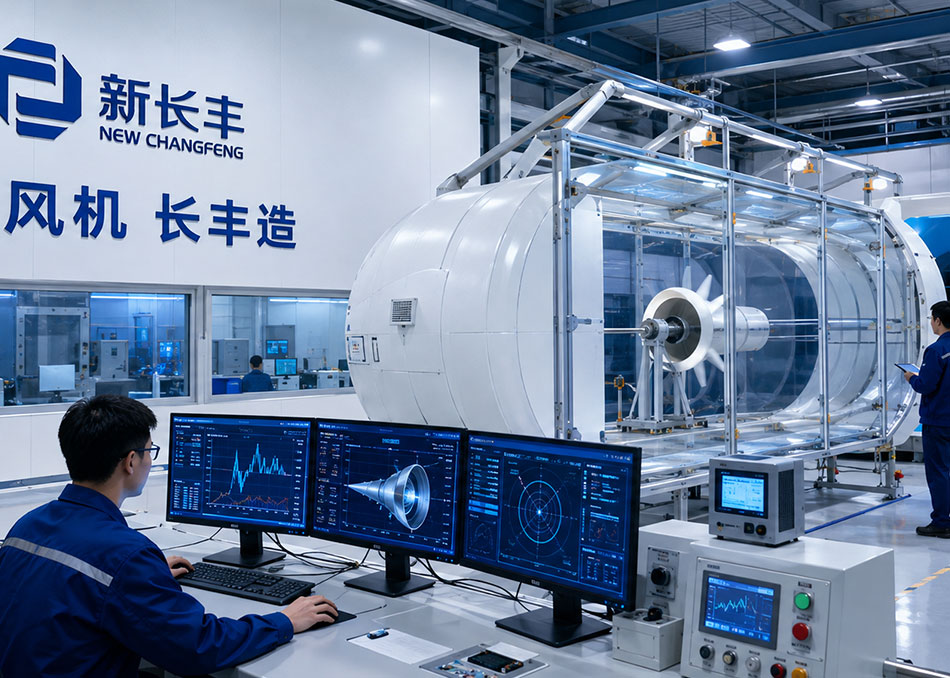
In industrial ventilation retrofit projects, procurement teams often face two distinct requirements at once: workshops that are hot and stuffy need overall air exchange and cooling, while commercial kitchens need a supply of fresh air to improve the working environment. Inquiries about water-cooled fresh air unit pricing frequently reveal confusion between water-cooled fresh air units and negative pressure fans—some even mistakenly believe that a negative pressure fan can handle kitchen exhaust. This article starts from ventilation principles to clarify equipment boundaries, focuses on the correct application of negative pressure fans in workshop air exchange, and offers practical guidance for selecting and budgeting water-cooled fresh air units.
1. Clarify the Boundaries: Negative Pressure Fans for Workshop Air Exchange, Water-Cooled Fresh Air Units for Supply Air Cooling
Negative pressure fans are axial-flow ventilation devices installed on exterior walls or windows to exhaust air outward, creating a slight negative pressure indoors. Outdoor air then naturally enters through opposite doors and windows, carrying away heat, dust, and odors. Their value lies in high-volume overall air exchange, making them suitable for industrial workshops, warehouse logistics facilities, and similar spaces that are hot, stuffy, and may contain light dust or odors. According to GB/T 1236 Fan Performance Testing, airflow and pressure should be measured on a standard test rig; buyers should request traceable test evidence from suppliers rather than relying solely on nameplate ratings.
Water-cooled fresh air units, on the other hand, are supply-side equipment. They treat outdoor fresh air through water-cooled evaporative cooling or coil cooling and then deliver it indoors, creating organized make-up air. They work in tandem with negative pressure fans—one supplies, the other exhausts—rather than replacing each other. It is important to emphasize that negative pressure fans are not kitchen exhaust devices; cooking fumes should be handled by dedicated fume purification equipment in accordance with GB 18483 Emission Standard of Cooking Fume.
2. How Negative Pressure Fans Work in Workshop Air Exchange
The core principle of negative pressure ventilation is to use a fan to exhaust air from the workshop, lowering indoor pressure slightly below atmospheric pressure. Fresh outdoor air then flows in through designed openings, creating a continuous air exchange. This method is particularly effective for large, open industrial spaces where ducted supply air would be costly or impractical.
Proper design requires matching fan airflow capacity to the workshop volume and heat load. The number and placement of fans, as well as the size of inlet openings, must be calculated to avoid dead zones or excessive negative pressure that could affect structural integrity or worker comfort. GB 51251 Technical Standard for Smoke and Heat Exhaust Systems in Buildings provides relevant guidance for smoke exhaust, though negative pressure fans for general ventilation are typically selected based on heat removal and air change rates.
Energy efficiency is another critical factor. GB 19761 Minimum Allowable Values of Energy Efficiency and Energy Efficiency Grades for Fans sets benchmarks for fan efficiency. Selecting fans that meet or exceed these standards reduces operating costs over the equipment's lifespan. Variable frequency drives can further optimize performance by adjusting fan speed to actual demand.
3. Water-Cooled Fresh Air Units: Selection and Budgeting Considerations
When evaluating water-cooled fresh air unit pricing, it is essential to consider the unit's cooling capacity, airflow rate, and the specific climate conditions. Evaporative cooling is most effective in hot, dry climates, while coil cooling may be necessary in humid regions. The unit should be sized to provide adequate fresh air per person or per square meter, as required by local ventilation codes.
Installation costs, water quality, and maintenance requirements also impact the total cost of ownership. Water-cooled units require a reliable water supply and proper drainage; poor water quality can lead to scaling and reduced efficiency. Regular maintenance, including cleaning of cooling pads or coils, is necessary to sustain performance.
For commercial kitchens, the fresh air unit should be integrated with the kitchen exhaust system to maintain proper pressure balance. A slight negative pressure in the kitchen relative to adjacent areas helps contain odors and fumes, but excessive negative pressure can cause downdrafts in exhaust hoods and reduce capture efficiency. Coordination between exhaust and supply air volumes is key.
4. Common Pitfalls and Practical Tips
- Do not use negative pressure fans for kitchen fume exhaust. They are not designed to handle grease-laden air and do not meet emission standards. Use dedicated fume purification equipment.
- Size fans based on calculated air change rates. Over- or undersizing leads to inadequate ventilation or energy waste.
- Ensure adequate make-up air openings. Without sufficient inlet area, negative pressure fans cannot achieve rated airflow.
- Consider noise levels. Negative pressure fans can be noisy; select low-noise models or incorporate sound attenuation where needed.
- Verify performance data. Request test reports according to GB/T 1236 and check energy efficiency against GB 19761.
FAQ
Q: Can a negative pressure fan be used to exhaust cooking fumes from a commercial kitchen?
A: No. Negative pressure fans are not designed for grease-laden air and do not meet fume emission standards such as GB 18483. Kitchen exhaust should be handled by specialized fume purification equipment, such as electrostatic precipitators or UV systems, followed by a dedicated exhaust fan.
Q: How do I determine the right number of negative pressure fans for my workshop?
A: The required airflow is typically calculated based on the workshop volume and desired air change rate (e.g., 10–20 air changes per hour for general workshops, higher for heat-intensive processes). Divide the total required airflow by the airflow capacity of a single fan to determine the number. Consult a ventilation engineer for precise sizing.
Q: What is the typical price range for a water-cooled fresh air unit?
A: Prices vary widely depending on cooling capacity, airflow rate, brand, and features. It is not possible to provide a specific figure without detailed specifications. Request quotes from multiple suppliers based on your project's requirements, and compare total cost of ownership including installation and maintenance.
Q: Can negative pressure fans help cool a workshop in summer?
A: Yes, negative pressure fans can effectively reduce indoor temperature by exhausting hot air and drawing in cooler outdoor air, especially when combined with evaporative cooling pads on the inlet side. However, their cooling effect depends on outdoor conditions and airflow design.
In summary, negative pressure fans are a cost-effective solution for workshop air exchange and cooling, while water-cooled fresh air units serve as supply-air cooling systems for kitchens and other spaces. Understanding their distinct roles ensures proper equipment selection and efficient operation. For tailored advice on your ventilation project, contact XCFFJ—our team can help you specify the right equipment and provide transparent pricing.