
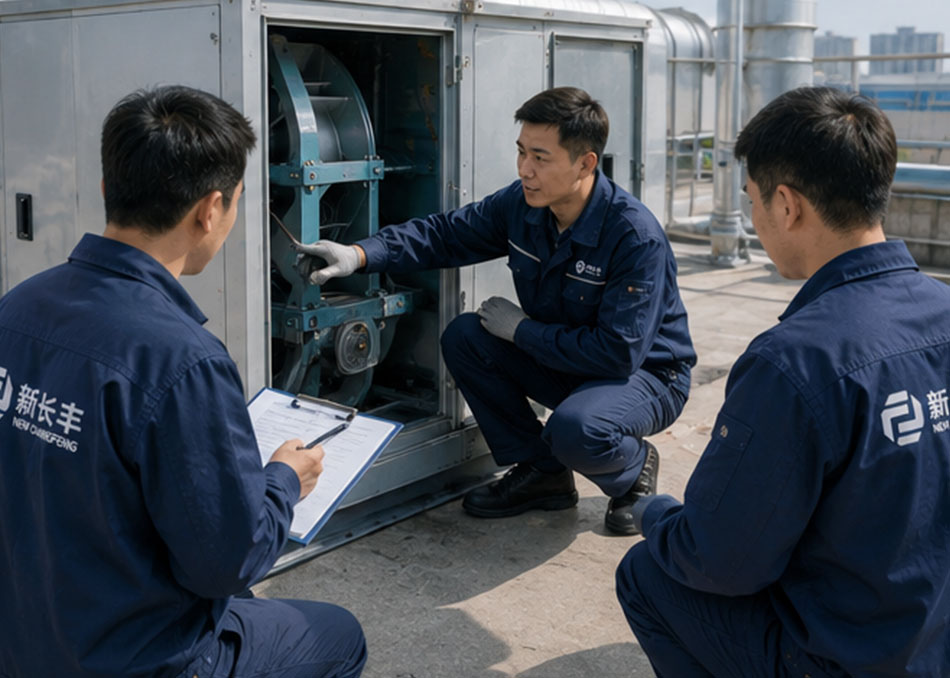
For restaurant owners and kitchen staff, the twin challenges of greasy smoke and intense heat are all too familiar. The acrid fumes and waves of heat not only compromise food quality but also pose serious health risks to employees, and inadequate ventilation can even create fire hazards. Traditional axial fans or basic exhaust fans often struggle in kitchens with dense cooktop layouts, complex ductwork, or multi-story buildings—delivering insufficient static pressure, excessive noise, and poor purification. Enter the water-cooled fresh air unit: a system that combines supply air, cooling, and purification, with a centrifugal fan at its core. This article explores the working principles of water-cooled fresh air units and highlights the critical role of centrifugal fans in commercial kitchen exhaust and fume purification, offering professional guidance for your kitchen ventilation upgrade.
Core Structure and Operating Principle of Water-Cooled Fresh Air Units
A water-cooled fresh air unit, as the name implies, integrates water-based evaporative cooling with fresh air delivery. Its essential components include a centrifugal fan, a water curtain or water film heat exchange module, filters, supply air ducting, and a control system. During operation, outdoor fresh air passes through a primary filter, then through a wetted water curtain where evaporative cooling absorbs sensible heat from the air, lowering its temperature. The cooled air is then pressurized by the centrifugal fan and delivered via ductwork to various kitchen zones, replenishing fresh air, balancing negative pressure, and assisting the exhaust system in expelling cooking fumes effectively.
Within this system, the centrifugal fan acts as the heart. Unlike axial fans, which move air parallel to the shaft, centrifugal fans draw air in along the axis and discharge it radially, generating significantly higher static pressure. This characteristic is crucial for commercial kitchens—where long duct runs, multiple elbows, and the need to overcome resistance from grease filters and exhaust hoods demand robust pressure capability. Centrifugal fans excel in these conditions, ensuring consistent airflow even against high system resistance.
Why Centrifugal Fans Are Essential for Kitchen Exhaust and Purification
Kitchen exhaust systems face unique challenges: high temperatures, grease-laden air, and fluctuating pressure demands. Centrifugal fans are engineered to handle these conditions effectively.
- High Static Pressure: They generate the pressure needed to push air through extensive duct networks, especially in multi-story buildings where vertical runs add resistance.
- Grease Handling: The robust construction and impeller design allow them to handle air with moderate grease content, though proper filtration upstream is still recommended.
- Noise Control: With appropriate housing and isolation mounts, centrifugal fans can operate quieter than comparable axial fans, an important factor in open kitchen designs.
- Efficiency: When matched with variable frequency drives (VFDs), they can adjust speed to match demand, saving energy during off-peak hours.
In the context of fume purification, centrifugal fans provide the necessary airflow to transport grease-laden air to external purification devices, such as electrostatic precipitators or activated carbon filters, ensuring compliance with emission standards like GB 18483.
Key Considerations for Selecting and Installing Centrifugal Fans in Kitchen Exhaust
Choosing the right centrifugal fan for your kitchen exhaust system requires careful evaluation of several factors:
- Airflow and Pressure Requirements: Calculate the total airflow needed based on kitchen size, number of cooktops, and hood dimensions. Also, determine the total static pressure loss across the ductwork, fittings, and filters.
- Material and Coating: For coastal or humid environments, consider stainless steel or epoxy-coated fans to resist corrosion.
- Motor Efficiency: Look for high-efficiency motors (e.g., IE3 or IE4) to reduce energy consumption.
- Noise Levels: Check the fan's noise rating (dB) and consider installing silencers or acoustic enclosures if needed.
- Compliance: Ensure the fan meets relevant local codes and standards, such as GB/T 1236 for performance testing and GB 19761 for energy efficiency.
Proper installation is equally important. The fan should be mounted on a sturdy base with vibration isolators to minimize structural noise. The ductwork should be smooth with minimal bends, and a grease filter should be placed upstream to protect the fan and downstream purification equipment.
Integrating Centrifugal Fans with Water-Cooled Fresh Air Units for Optimal Performance
The synergy between water-cooled fresh air units and centrifugal fans can dramatically improve kitchen comfort and safety. The water-cooled unit supplies cool, fresh air to offset the heat generated by cooking, while the centrifugal fan in the exhaust system ensures that fumes are efficiently captured and expelled. This balanced approach maintains a slight negative pressure in the kitchen, preventing odors from escaping to dining areas.
For retrofit projects, existing exhaust systems can be upgraded by replacing undersized axial fans with high-static centrifugal fans, often without major ductwork changes. Modern centrifugal fans with backward-curved impellers offer higher efficiency and lower noise, making them ideal for continuous operation in busy kitchens.
Frequently Asked Questions
Q: Can a centrifugal fan be used in a ductless kitchen exhaust system?
A: Yes, but only if paired with a high-efficiency purification unit. In ductless systems, the fan must overcome the resistance of the filters and recirculate clean air back into the kitchen. Centrifugal fans are suitable for this application, but ensure the filter system is adequately sized to handle the airflow.
Q: How does a water-cooled fresh air unit help with kitchen exhaust?
A: It provides a continuous supply of cool, filtered fresh air, which helps maintain a comfortable working environment, reduces heat stress, and balances the negative pressure created by exhaust fans. This prevents backdrafts and ensures the exhaust system operates efficiently.
Q: What maintenance is required for centrifugal fans in kitchen exhaust systems?
A: Regular inspection and cleaning are essential. Grease accumulation on the impeller can cause imbalance and reduce efficiency. Clean the fan blades and housing periodically, check belt tension (if belt-driven), and lubricate bearings according to the manufacturer's schedule. Also, replace filters upstream to minimize grease reaching the fan.
Conclusion
Centrifugal fans are indispensable for effective commercial kitchen exhaust and fume purification. Their high static pressure, durability, and efficiency make them the preferred choice over axial fans in demanding environments. When integrated with water-cooled fresh air units, they create a balanced ventilation system that enhances comfort, safety, and compliance. For your kitchen ventilation project, consult with experts and select fans that meet your specific airflow and pressure needs. XCFFJ offers a range of reliable centrifugal fans and complete ventilation solutions tailored to commercial kitchens. Contact us today to optimize your kitchen's air quality and operational efficiency.