
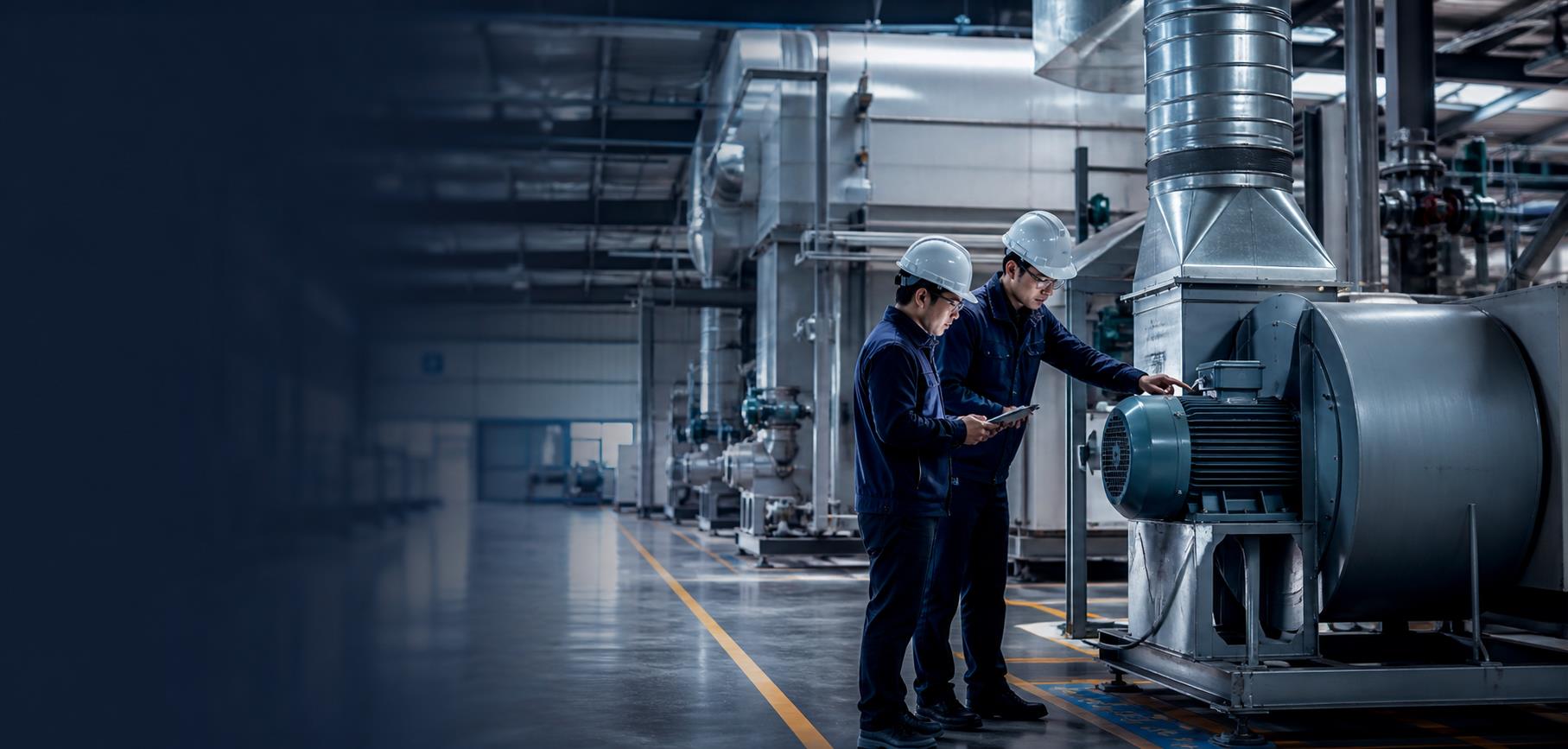
Water-Cooled Fresh Air Units: More Than Just for Kitchens
When people hear "water-cooled fresh air unit," their first thought is usually "kitchen cooling equipment." That's not wrong, but it barely scratches the surface. The core capabilities of a water-cooled fresh air unit — make-up air, cooling, and air exchange — are essentially an "air replacement system." Any space with high temperatures, high occupancy density, stale air, or negative pressure problems is a potential application.
Starting with Kitchens: The Most Demanding Proving Ground
The kitchen is the most "hardcore" application scenario for water-cooled fresh air units. Grease, high temperatures, high humidity, exhaust negative pressure — nearly every hostile condition converges here. Green Island Wind's product literature states that its kitchen water-cooled purification fresh air unit is designed specifically for "high-heat, high-grease, and large-space scenarios," with applications explicitly listing restaurant kitchens, industrial workshop kitchens, and commercial kitchen facilities.
Xin Changfeng's technical documentation further explains the logic: the kitchen exhaust hood continuously extracts air, creating negative pressure. If make-up air cannot keep up, stove burner performance is affected, exhaust efficiency declines, and grease may even spill into the front of house. The water-cooled fresh air unit plays the role of "organized make-up air" here, while simultaneously cooling the incoming fresh air to improve the chef's working environment.
Equipment that survives in a kitchen can basically deliver "dimensional superiority" in other scenarios.
Internet Cafes and Mahjong Parlors: Air Quality Saviors for Densely Occupied Spaces
The air quality problems in internet cafes and mahjong parlors differ from kitchens, but are equally troublesome. The kitchen conflict is grease plus high temperature; the internet cafe and mahjong parlor conflict is rising carbon dioxide levels from dense occupancy, lingering smoke odors, and stuffy discomfort.
Xin Changfeng's engineering documentation points out that if an internet cafe relies solely on exhaust fans to extract air, indoor negative pressure continuously increases, and fresh air infiltrates unpredictably through door and window gaps. The paths are short and coverage is poor — areas near the entrance feel cool, while seats deeper inside remain stuffy. The reasonable approach is for water-cooled fresh air units to draw outdoor air, cool it, and deliver it into personnel activity zones, with exhaust outlets removing stale air, forming a "supply-exhaust" matched airflow organization.
The make-up air logic for mahjong parlors is the same. A mahjong table seats four people, a medium-sized parlor accommodates dozens simultaneously, and operations run for over ten hours continuously. Indoor air quickly becomes stale. The water-cooled fresh air unit plays the role of a "respiratory system" here: supplying air while cooling, continuously diluting carbon dioxide and odor concentrations. It should be noted that evaporative cooling effectiveness correlates with ambient humidity — the drier the air, the more pronounced the temperature drop; in humid, muggy regions, the cooling sensation diminishes, and the unit should be positioned more as a ventilation and comfort improvement device.
Industrial Workshops: The Most Traditional "Home Turf"
Industrial scenarios are actually the "original home" of water-cooled fresh air units. Industrial evaporative coolers are widely used in workshops, warehouses, and large spaces in electronics, textiles, machinery, chemicals, and food processing industries — the core principle being evaporative cooling.
The common characteristics of these scenarios: large spaces, dispersed heat sources, non-fixed personnel, and low precision requirements for temperature and humidity. Compressor refrigeration is extremely costly in such open or semi-open spaces, while water-cooled fresh air units use water as the medium and fans as the power source, with relatively simple structure and operating energy consumption at only about 1/8 of traditional air conditioning.
Baidu Baike data shows that a single industrial evaporative cooler can cover 100-150 square meters, with cooling ranges of about 5-9°C in humid regions and 10-15°C in dry-hot regions. Textile mills additionally benefit from its humidification function — relative humidity can reach about 75%, helping reduce yarn breakage rates and improve product quality.
Data Centers: An Unexpected Energy-Saving Weapon
This is the most "crossover" application of water-cooled fresh air units. Data center computer rooms generate enormous heat, and PUE (Power Usage Effectiveness) values remain persistently high, with traditional precision air conditioning consuming staggering amounts of energy. But computer rooms have strict temperature and humidity requirements — can water-cooled fresh air systems be used?
The answer is yes, but intelligent control is required. Aolan, in core equipment room renovation projects in Liaoning, Shandong, and Fujian, introduced a solution of "evaporative air cooler supplying cold air + negative pressure exhaust fan removing hot air + intelligent control system." The system includes three operating modes: in low temperatures, it runs in dry-condition fresh air mode, directly introducing outdoor cold air; in suitable climates, it runs in wet-condition evaporative cooling mode, cooling fresh air before delivery; in hot and humid weather, it coordinates with the original precision air conditioning system.
Measured data is impressive. A 236 m² equipment room in Liaoning saw annual air conditioning system electricity consumption drop from 519,000 kWh to 204,000 kWh — a 60.6% energy savings rate. After renovation of an equipment room in Shandong, PUE dropped from 1.67 to 1.38, with a 56.9% energy savings rate. The common logic of these projects: while meeting computer room temperature and humidity requirements, maximize the utilization time of "natural cooling sources" and reduce precision air conditioning operating hours.
Other Scenarios: Shared Principles, Different Needs
The application boundaries of water-cooled fresh air units continue to expand. Product literature summarizes their applicable scope as "almost all locations requiring cooling, ventilation, and air exchange," including shopping malls, supermarkets, offices, hotels, hospitals, stations, stadiums, and schools.
Shanghai Kaimeiheng's water-cooled fresh air system emphasizes fresh air supply and air exchange cooling in industrial workshops and commercial spaces, with the core logic of "filtering outdoor fresh air and delivering it indoors, then circulating indoor stale air out, forming indoor-outdoor air exchange."
Different scenarios have different selection priorities for water-cooled fresh air units: kitchens prioritize static pressure and oil resistance; internet cafes and mahjong parlors prioritize noise and airflow organization; industrial workshops prioritize airflow coverage and cooling range; data centers prioritize intelligent control and filtration precision. But the underlying logic is consistent — using evaporative cooling principles to introduce cooled fresh air and solve air quality and thermal comfort problems in the space.
Conclusion
The kitchen is the most demanding proving ground for water-cooled fresh air units, but not the only stage. Internet cafes, mahjong parlors, industrial workshops, and even data centers — wherever "air exchange plus cooling" is needed, this evaporative cooling logic is at work. Understanding this has practical significance for both selection and use: don't ask "where can water-cooled fresh air units be used," but rather "how much air does my space need to supply, how much cooling is required, and what problem needs to be solved." Equipment is a tool; matching needs is what matters.