
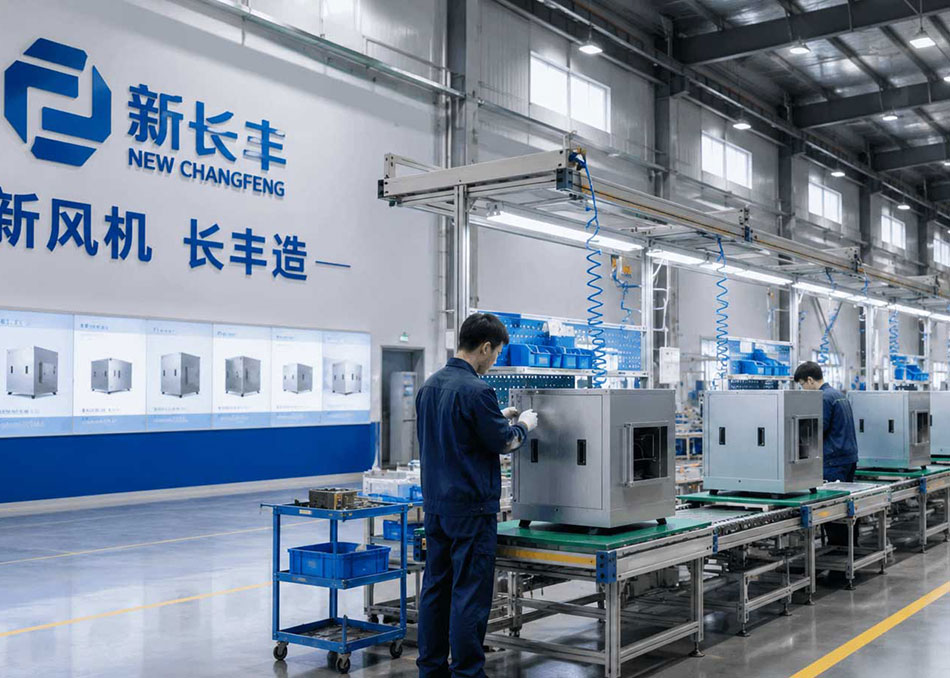
In commercial kitchens, exhaust hoods continuously extract smoke, heat, and odors, creating a negative pressure environment inside the cooking area. When make-up air is insufficient, kitchens suffer from stubborn doors that are hard to open, reduced exhaust efficiency, loss of air-conditioned air, and even backflow of unpleasant odors from drains. The scientific solution lies in introducing a fresh air system, and water-cooled fresh air units—offering both cooling and air supply—have become a preferred choice for resolving kitchen negative pressure. However, the reliable performance of a water-cooled fresh air unit depends largely on its core power component: the centrifugal fan. This article examines the real-world challenges of kitchen negative pressure and outlines key centrifugal fan selection criteria for water-cooled fresh air units, helping contractors and facility managers make informed decisions.
Understanding Kitchen Negative Pressure and the Principle of Make-Up Air
Kitchen exhaust systems, such as integrated fume purifiers and exhaust fans, continuously expel indoor air. If fresh air replacement is inadequate, the indoor pressure drops below outdoor levels, resulting in negative pressure. The consequences are immediate: reduced capture efficiency of exhaust hoods (causing smoke to escape), increased resistance when opening doors, compromised performance of air conditioning and ventilation systems, and odor backflow from drainage systems. According to GB 51251 (Technical Standard for Building Smoke Control and Exhaust Systems) and related ventilation design codes, kitchens should maintain a reasonable negative pressure differential. Typically, make-up air volume should be at least 80% of the exhaust volume, and the fresh air should be delivered preferentially near the exhaust hood or the operator's work area.
Water-cooled fresh air units excel in this context because they not only introduce outdoor fresh air but also cool it via evaporative cooling, thereby reducing supply air temperature and alleviating the hot and stuffy environment common in commercial kitchens. This is especially valuable during hot summer months or in regions with high ambient temperatures.
Why Centrifugal Fans Are Critical in Water-Cooled Fresh Air Units
The centrifugal fan is the heart of any water-cooled fresh air unit. Unlike axial fans, centrifugal fans generate higher static pressure, making them ideal for overcoming the resistance of ductwork, filters, and cooling media. In kitchen make-up air applications, the fan must deliver sufficient air volume while also handling the pressure drop caused by the evaporative cooling pad and air distribution system.
When selecting a centrifugal fan for a water-cooled fresh air unit, several performance parameters must be considered:
- Air Volume (Flow Rate): The fan must supply the required make-up air volume, typically 80–100% of the exhaust volume, to maintain a balanced or slightly negative pressure in the kitchen.
- Static Pressure: The fan must overcome the total system resistance, including duct friction, bends, dampers, and the cooling pad. Under-sizing the static pressure leads to insufficient airflow, while over-sizing wastes energy.
- Efficiency: High-efficiency fans reduce energy consumption and operating costs, especially in continuous operation scenarios common in commercial kitchens.
- Noise Level: Kitchens are already noisy environments, but excessive fan noise can affect staff comfort and communication. Selecting a fan with appropriate noise characteristics is important.
- Corrosion Resistance: Kitchen air may contain grease, moisture, and cleaning chemicals. Fan components should be made of or coated with corrosion-resistant materials to ensure longevity.
Key Selection Criteria for Centrifugal Fans in Water-Cooled Fresh Air Units
To ensure optimal performance and durability, the following criteria should guide the selection of centrifugal fans for water-cooled fresh air units used in kitchen negative pressure solutions:
1. Match Fan Performance to System Requirements
Begin by calculating the required air volume and static pressure based on kitchen size, exhaust rate, and duct layout. Consult fan performance curves and select a fan that operates at its best efficiency point (BEP) for the desired flow and pressure. Avoid oversizing, which leads to higher energy use and potential noise issues, or undersizing, which fails to resolve negative pressure.
2. Consider the Airflow Direction and Installation Space
Centrifugal fans come in various configurations—forward-curved, backward-curved, and airfoil—each with distinct performance characteristics. Forward-curved fans are compact and provide high airflow at low static pressure, while backward-curved fans offer higher efficiency and are more suitable for higher pressure applications. The available installation space within the water-cooled fresh air unit will dictate the fan size and orientation (e.g., single inlet vs. double inlet).
3. Evaluate Motor and Drive Options
Direct-drive fans eliminate belt maintenance and reduce energy losses, but they require a motor that matches the fan's speed and torque. Belt-driven fans offer flexibility in adjusting fan speed (via pulley changes) but require periodic maintenance. For kitchen environments, direct-drive with an EC (electronically commutated) motor is increasingly popular due to its energy efficiency, variable speed control, and lower maintenance requirements.
4. Ensure Compliance with Safety and Hygiene Standards
Since the fan will be part of a system supplying air to a food preparation area, it must comply with relevant food safety and ventilation standards. The fan should be easy to clean, with smooth surfaces that prevent grease accumulation. Additionally, electrical components must be properly sealed and protected against moisture, especially in water-cooled units where humidity is high.
5. Prioritize Reliability and Serviceability
Kitchen operations cannot afford prolonged downtime. Choose fans from reputable manufacturers with a proven track record in commercial ventilation. Consider factors such as bearing quality, housing rigidity, and ease of access for cleaning and maintenance. A fan that is difficult to service will incur higher long-term costs.
Practical Recommendations for Contractors and Facility Managers
When integrating a water-cooled fresh air unit into a kitchen ventilation system, consider the following best practices:
- Balance Exhaust and Supply: Ensure that the make-up air system is interlocked with the exhaust system, so that they operate simultaneously. This prevents the kitchen from going into excessive negative or positive pressure.
- Position Supply Air Effectively: Deliver cool fresh air near cooking stations and exhaust hoods without causing drafts that disturb flame or cooking processes. Use adjustable diffusers to direct airflow.
- Incorporate Filtration and Cooling Media: The water-cooled fresh air unit should include appropriate filters to remove dust and particles, and an efficient evaporative cooling pad to maximize cooling effect while minimizing pressure drop.
- Monitor and Adjust: Install pressure sensors and variable frequency drives (VFDs) to modulate fan speed based on real-time kitchen conditions, optimizing energy use and comfort.
Frequently Asked Questions
Q: How much make-up air is needed to resolve kitchen negative pressure?
A: As a general rule, the make-up air volume should be at least 80% of the exhaust volume, and ideally close to 100% for critical environments. This ensures that the negative pressure is minimized while still preventing smoke and odors from escaping into dining areas. The exact ratio should be determined based on local codes and the specific kitchen layout.
Q: Can a water-cooled fresh air unit replace air conditioning in a kitchen?
A: Water-cooled fresh air units provide effective cooling via evaporative processes, but they are not a substitute for mechanical air conditioning in all climates. They are most effective in hot, dry conditions. In humid climates, their cooling capacity is reduced. They are best used as a supplement to exhaust systems and as a means to improve comfort, not as a primary cooling solution in all cases.
Q: What is the typical lifespan of a centrifugal fan in a water-cooled fresh air unit?
A: The lifespan depends on factors such as operating hours, maintenance frequency, and environmental conditions (e.g., grease, moisture). With regular cleaning and proper lubrication, a high-quality centrifugal fan can last 10–15 years. However, in harsh kitchen environments, components like bearings and belts (if present) may need replacement sooner. Choose fans with sealed bearings and corrosion-resistant coatings to extend service life.
Conclusion
Addressing kitchen negative pressure is essential for maintaining a safe, comfortable, and efficient cooking environment. Water-cooled fresh air units provide an effective solution by combining fresh air supply with evaporative cooling, and the centrifugal fan is the component that makes it all possible. By carefully selecting the fan based on air volume, static pressure, efficiency, noise, and durability, contractors and facility managers can ensure that their kitchen ventilation system operates reliably and cost-effectively. For more guidance on choosing the right centrifugal fan for your water-cooled fresh air unit, consult with XCFFJ's technical team, who can provide tailored recommendations based on your specific kitchen requirements.