
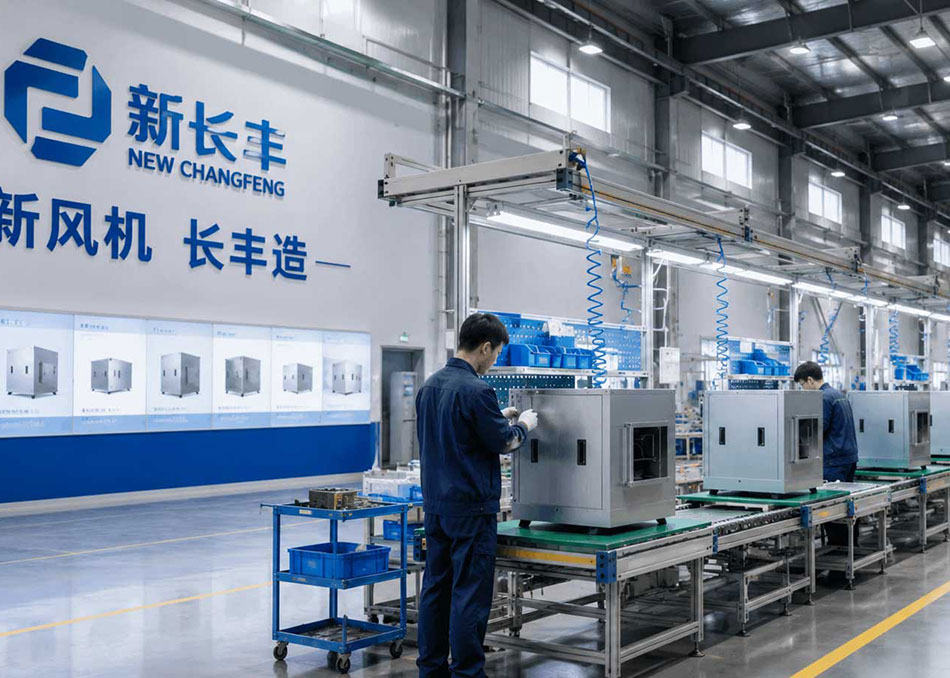
When a commercial kitchen's exhaust system kicks on, the space behind the line often swings into negative pressure within seconds. The symptoms are familiar to anyone who has worked a busy service: flames pulled toward the hood, grease-laden air drifting into the dining room, doors that resist being pushed open, sewer odors rising through floor drains, and exhaust fans laboring harder than they should. These are rarely faults in the exhaust equipment itself. They are signs that exhaust and makeup air are out of balance. A water-cooled fresh air unit addresses this by supplying filtered outdoor air while simultaneously cooling it—a dual role that makes it especially useful in hot, tightly sealed back-of-house spaces.
Why Negative Pressure Forms in the Back of House
Exhaust hoods, water-wash hoods, and integrated electrostatic fume purifiers continuously remove large volumes of air from the kitchen. Without an approximately equal volume of outdoor air entering to replace it, indoor pressure drops below that of surrounding spaces, and the kitchen goes negative. This is not an equipment failure but a state of airflow imbalance—one that amplifies along the building's internal air paths.
From a fluid dynamics standpoint, the greater the resistance along the makeup air path, the higher the pressure differential between kitchen and exterior. The exhaust fan must then overcome more system resistance to hold its design airflow, so effective exhaust capacity falls and the likelihood of fume escaping at the hood face rises. GB 18483, the emission standard for cooking fume from the catering industry, requires food service operations to ensure fume capture and purification. Capture efficiency depends directly on hood face velocity and how makeup air is organized—when negative pressure runs away, even a well-matched purifier cannot perform as intended.
The consequences show up in daily operations:
- Unstable burner combustion: insufficient makeup air starves the combustion zone of oxygen, producing yellow flames and reduced heat output.
- Fume spillage: grease and smoke escape the hood and migrate into front-of-house areas, creating complaints and cleaning burdens.
- Door and drain problems: hard-to-open doors and sewer gas backing up through floor drains are classic pressure-imbalance symptoms.
- Higher fan load: exhaust fans run against elevated resistance, consuming more energy and wearing faster.
The Water-Cooled Fresh Air Unit's Dual Role: Makeup Air Plus Cooling
A water-cooled fresh air unit is designed to introduce outdoor air into the kitchen while removing heat from that air stream through a water-cooled heat exchange process. In the negative-pressure scenario, it serves two functions at once: it restores the air balance that the exhaust system depends on, and it lowers the temperature of the incoming air so the kitchen does not become unbearable during summer service.
This matters because makeup air is not a neutral addition. In many kitchens, the volume of outdoor air needed to balance exhaust is large, and in hot climates or upper-floor locations that air can arrive at high dry-bulb temperatures. Supplying it untreated simply trades a pressure problem for a heat problem. A water-cooled design conditions the air before delivery, so the makeup air supports both comfort and hood performance rather than undermining them.
Properly organized, the unit helps re-establish a controlled pressure relationship in which the kitchen sits slightly negative relative to the dining area—keeping odors contained—while remaining close enough to neutral that hood capture, burner stability, and door operation all function normally. The goal is not to eliminate negative pressure entirely but to keep it within a range the exhaust system was designed for.
Selection Points for Kitchen Makeup Air Units
Sizing and selection should follow the exhaust system, not the other way around. Start by establishing the design exhaust volume of the hoods and purifiers, then determine the makeup air volume and the acceptable pressure relationship between kitchen and adjacent spaces. Fan performance should be verified against GB/T 1236, the standard for fan performance testing, and energy performance considered in light of GB 19761 for fan energy efficiency.
Several practical factors deserve attention during selection:
- Air volume matching: makeup air is typically balanced to a substantial share of exhaust volume, with the remainder drawn through transfer paths; the exact ratio depends on hood design and building layout.
- Cooling capacity: size the water-cooled coil for local climate design conditions and the sensible heat load of the incoming air, not for a mild average day.
- Filtration: incoming air should be filtered to protect the coil and keep the kitchen supply clean.
- Noise: back-of-house staff work beside the unit for hours; select fan and casing designs that keep sound levels appropriate for the space.
- Water quality and maintenance access: water-cooled systems depend on clean heat exchange surfaces, so plan for accessible coils, drains, and service clearances.
Where smoke control is part of the building design, coordination with GB 51251, the standard for smoke and heat exhaust ventilation systems, is also necessary so that kitchen makeup air does not conflict with emergency smoke management strategies.
Installation and Ongoing Operation
Installation layout determines whether the unit actually solves the pressure problem. Supply air should be distributed so it reaches the cooking line without blowing directly across hood faces or disrupting capture. Diffuser placement, duct routing, and transfer grilles between kitchen and dining areas all influence the resulting pressure map. Commissioning should include measurement of the kitchen-to-exterior pressure differential and adjustment of exhaust and supply volumes until the system operates as a coordinated whole.
Maintenance keeps that balance stable over time. Clogged filters reduce supply volume, which quietly pushes the kitchen back toward stronger negative pressure; fouled water-cooled coils reduce cooling capacity; and unbalanced belts or bearings raise noise. A simple routine—filter checks, coil cleaning, water-side inspection, and periodic airflow verification—prevents the gradual drift that turns a balanced kitchen back into a problematic one.
FAQ
Q: Is negative pressure in a commercial kitchen always a problem?
A: Not always. A slight negative pressure relative to the dining area is desirable because it contains odors. Problems arise when the differential becomes large enough to destabilize burners, pull fume from the hood, make doors hard to open, or draw sewer gas through drains. The objective is control, not elimination.
Q: Can I simply open a door or window instead of installing a makeup air unit?
A: Opening a door can relieve pressure temporarily, but it provides uncontrolled, unfiltered, unconditioned air and is unreliable across seasons and security requirements. A dedicated water-cooled fresh air unit delivers a metered, filtered, and cooled supply that can be balanced against the exhaust system.
Q: Why choose a water-cooled fresh air unit rather than a standard supply fan?
A: A standard supply fan restores air balance but delivers hot outdoor air in summer. A water-cooled unit conditions the air as it supplies it, addressing pressure and heat together—particularly valuable in compact kitchens where separate cooling equipment is difficult to accommodate.
Q: How does makeup air relate to compliance with fume emission rules?
A: GB 18483 requires effective capture and purification of cooking fume. Capture depends on hood face velocity and airflow organization, both of which degrade when negative pressure is excessive. Balanced makeup air supports the conditions under which purifiers can meet their design performance.
Summary
Negative pressure in the back of house is an airflow balance issue, and it is best solved at the source—by supplying conditioned outdoor air in a controlled, measured way. A water-cooled fresh air unit restores that balance while keeping incoming air cool, helping protect hood capture, burner stability, door operation, and the working environment behind the line. If your kitchen shows the telltale signs of pressure imbalance, reviewing your makeup air strategy is the logical first step.