
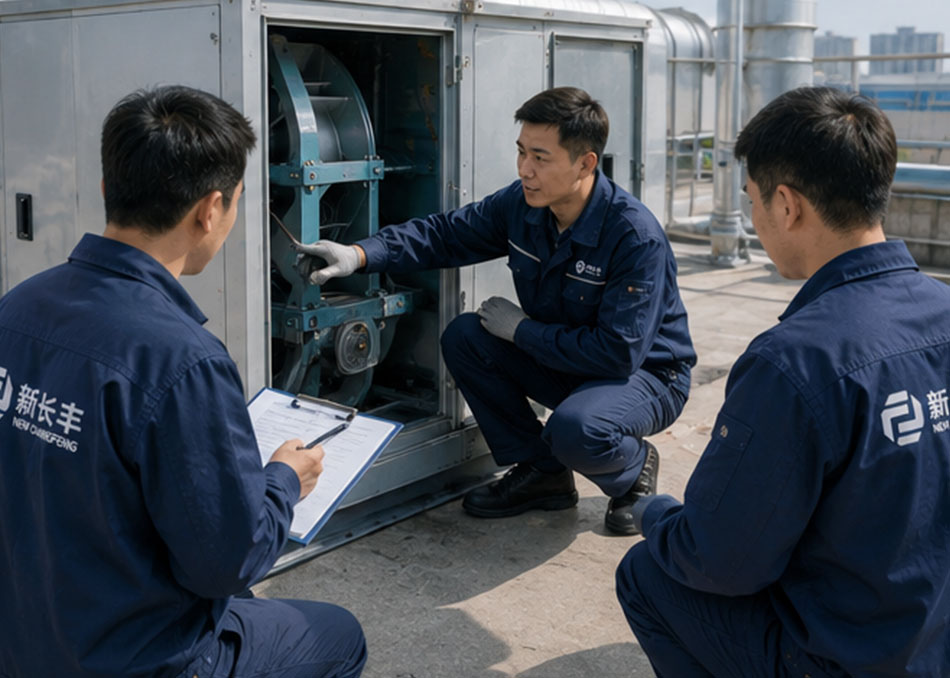
Industrial plants and commercial kitchens are two environments where ventilation often becomes a daily headache. Factory floors absorb heat from machinery, people, and roof radiation, pushing indoor temperatures well above outdoor levels in summer. That heat drags down productivity, raises worker turnover, and makes recruitment harder. Commercial kitchens face a different set of pressures: grease-laden fumes, cooking odors, and complaints from nearby residents. Poor exhaust doesn't just hurt the dining environment—it can put a restaurant on the wrong side of environmental regulations.
A common mistake during retrofits is treating factory cooling and kitchen exhaust as the same problem, applying one equipment strategy to both. In reality, factory cooling is about large-space air exchange and evaporative cooling, while kitchen exhaust is about local capture and purification before discharge. They differ in airflow organization, equipment selection, and the standards they must meet. This article walks through both topics—evaporative air coolers for factory cooling and kitchen exhaust system design—to help plant managers, restaurant operators, and HVAC engineers make clearer decisions.
How Evaporative Air Coolers Work in Factory Cooling
Evaporative air coolers—also called evaporative coolers, water-cooled air conditioners, or swamp coolers—rely on a simple physical principle: as hot outdoor air passes through a wet cooling pad, water evaporates and absorbs sensible heat, lowering the air temperature before it is delivered indoors. Unlike compressor-based air conditioning, this process does not use a refrigerant compression cycle. That means lower energy consumption and the ability to introduce large volumes of fresh air, which suits hot, open or semi-open industrial spaces.
In factory settings, evaporative air coolers are typically paired with negative pressure fans to create a directed airflow path. Fresh, cooled air enters from one side, absorbs heat from equipment and workers, and is exhausted out the other side. This "push-pull" arrangement prevents hot air from stagnating and avoids the short-circuiting that happens when supply and exhaust are poorly placed. Because the system constantly replaces indoor air, it also helps dilute airborne dust and fumes—an important secondary benefit in many workshops.
Evaporative cooling is not a universal replacement for refrigerated air conditioning. It performs best in hot, dry to moderately humid climates, and in buildings where doors or windows cannot be kept sealed. When outdoor humidity is very high, the temperature drop becomes smaller. For those conditions, a hybrid approach—evaporative cooling for general ventilation plus spot cooling or dehumidification where needed—often makes more sense. Equipment should be selected based on actual site conditions, not catalog claims.
- Best-fit spaces: workshops, warehouses, logistics centers, school canteens, and other large-volume areas with heat gains and moderate humidity.
- Key components: cooling pads, water circulation system, centrifugal or axial fan, and air distribution ducting or diffusers.
- Design references: fan performance should be verified per GB/T 1236, and fan energy efficiency considered under GB 19761. For smoke exhaust applications, GB 51251 applies.
Designing a Kitchen Exhaust System That Actually Works
Commercial kitchen exhaust follows a different logic. The goal is to capture grease, smoke, and odors at the source—before they spread into the dining area or escape outside. The hood is the first line of defense: it must be sized and positioned to intercept the thermal plume rising from cooking equipment. If the hood is too small, too far from the cooking surface, or starved of makeup air, fumes will spill into the kitchen and beyond, no matter how powerful the fan is.
After capture, the exhaust air usually passes through a purification stage. Electrostatic fume purifiers are common because they charge and collect grease particles efficiently. Some systems also use UV or combined filtration to address odors. The purified air is then discharged through ductwork and a fan. In many jurisdictions, the discharge must meet emission limits such as those in GB 18483 for kitchen fume. Regular cleaning and maintenance are essential—a purifier that is never cleaned quickly loses efficiency and becomes a fire risk.
Makeup air is the most overlooked part of kitchen exhaust design. If a kitchen exhausts a large volume of air without replacing it, the space becomes negatively pressurized. That causes doors to be hard to open, exhaust hoods to lose capture efficiency, and even back-drafting of combustion appliances. A balanced design supplies filtered makeup air—often tempered for comfort—to replace what is exhausted. In some cases, a dedicated fresh air unit or a silent fresh air cabinet can be integrated to maintain pressure balance and improve working conditions.
- Capture first: correct hood type, overhang, and mounting height matter more than fan power.
- Purify before discharge: electrostatic or combined filtration reduces grease and odor complaints.
- Balance the air: provide makeup air to avoid negative pressure and loss of hood performance.
- Maintain regularly: cleaning schedules protect efficiency, safety, and compliance.
Choosing the Right Equipment for Each Application
Factory cooling and kitchen exhaust call for different equipment families. For factory cooling, evaporative air coolers, negative pressure fans, and axial or centrifugal fans are typical. For kitchen exhaust, you need grease-rated hoods, electrostatic purifiers, and exhaust fans designed for hot, grease-laden air. Using a general-purpose fan in a kitchen exhaust line can lead to grease buildup, imbalance, and premature failure. Similarly, using a kitchen-style purifier in a factory makes little sense—there is no cooking grease to capture.
Noise is another factor that often gets ignored until after installation. In factories, excessive fan noise can exceed occupational limits and add to worker fatigue. In kitchens, noise from exhaust fans can make communication difficult and annoy neighbors. Selecting fans with appropriate sound power levels, mounting them with vibration isolation, and designing ductwork with smooth transitions all help. For projects near residential areas, the discharge location and direction also matter—blowing grease-laden air toward a neighbor's window is a recipe for complaints.
When specifying equipment, ask for performance data that can be traced to standard test methods. Airflow, static pressure, and power should not be taken at face value without reference to GB/T 1236 or equivalent. Energy efficiency matters over the life of the system, especially for equipment that runs many hours a day. A slightly higher upfront cost for an efficient fan or cooler can pay back quickly in electricity savings and reduced maintenance.
Common Pitfalls and How to Avoid Them
Many factory cooling projects fail because the airflow path is not thought through. Cooled air is supplied at one end but finds the nearest open door and escapes before it reaches workstations. Or exhaust fans are placed without considering prevailing winds, causing hot air to be pulled back in. A simple airflow diagram—showing supply, heat sources, and exhaust—can prevent these errors. Commissioning with smoke or anemometer checks confirms that the design works in practice, not just on paper.
In kitchens, the most frequent mistake is undersizing the hood or neglecting makeup air. Another is discharging exhaust too close to fresh air intakes, which recirculates odors back into the building. Grease traps and duct access doors are also often omitted, making cleaning difficult and increasing fire risk. Building codes and fire standards typically require access for cleaning at regular intervals; designing for maintenance from the start saves trouble later.
Finally, avoid the temptation to copy a design from a different building type. A system that works in a dry climate factory may underperform in a humid one. A kitchen exhaust layout for a small café will not scale to a hotel banquet kitchen. Site-specific assessment—heat load, humidity, cooking style, building pressure, and local regulations—should drive the final design.
FAQ
Q: Can an evaporative air cooler replace traditional air conditioning in a factory?
A: It depends on climate and process requirements. Evaporative coolers work well in hot, dry to moderately humid conditions and where large air exchange is acceptable. In very humid climates or where strict temperature and humidity control is needed, they may not be sufficient on their own. A hybrid approach is often best.
Q: How often should a kitchen exhaust system be cleaned?
A: Cleaning frequency depends on cooking volume and grease production. High-volume frying operations may need monthly or more frequent cleaning, while lighter cooking may allow longer intervals. Local fire codes and GB 18483 requirements should be consulted. Regular inspection is the safest guide.
Q: Why does my kitchen hood not capture fumes even though the fan is running?
A: Common causes include insufficient makeup air (negative pressure), hood mounted too high or too small, ductwork blockage, or fan performance degraded by grease buildup. Checking pressure balance and hood overlap is the first step.
Q: What standards apply to fan performance and kitchen fume emission?
A: In China, GB/T 1236 covers fan performance testing, GB 19761 addresses fan energy efficiency, GB 51251 governs smoke and heat exhaust systems, and GB 18483 sets kitchen fume emission limits. For international projects, equivalent local standards apply.
Summary
Factory cooling and kitchen exhaust are distinct challenges that require different design approaches. Evaporative air coolers combined with negative pressure ventilation offer an energy-efficient way to cool large industrial spaces, provided the climate and airflow path are suitable. Kitchen exhaust systems must prioritize capture, purification, and makeup air to protect indoor air quality and meet emission rules. By understanding the principles and avoiding common pitfalls, facility managers and engineers can create safer, more comfortable, and more compliant environments.
For equipment selection and system design support, XCFFJ manufactures a range of industrial and commercial ventilation products, including evaporative air coolers, cabinet centrifugal fans, negative pressure fans, and kitchen exhaust purifiers. Visit www.xcffj.com to learn more or discuss your project requirements.