
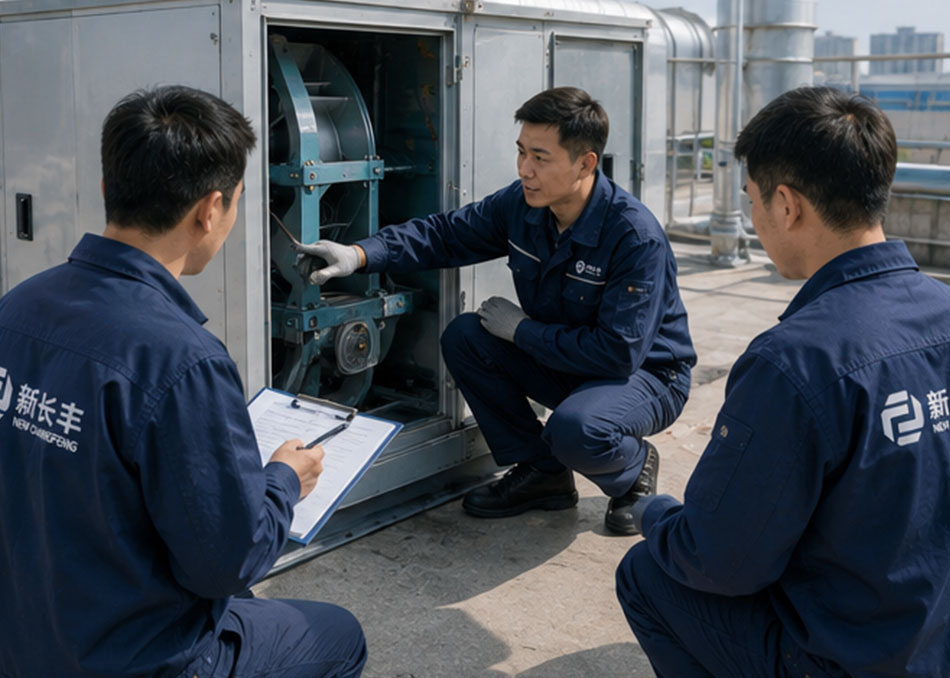
In subtropical regions like Guangzhou, where summers are long and humidity is high, factory workshops often struggle with heat buildup, stagnant air, lingering odors, and dust accumulation. Natural ventilation through open doors and windows is rarely enough to carry away the heat load and contaminated air during the hot, humid season. As a result, negative pressure fans have become a common choice for workshop ventilation and cooling in such climates. However, many buyers focus only on price or airflow when selecting a model, only to find that after installation the ventilation effect is poor, noise is excessive, electricity costs rise, or adjacent processes are affected. This article outlines a selection approach for negative pressure fans based on the climate and actual workshop conditions in subtropical regions, for the reference of factory managers, HVAC engineering companies, and equipment procurement staff.
1. Calculate Ventilation Requirements Before Choosing a Fan Model
The basic principle of negative pressure ventilation is: install negative pressure fans on one side of the workshop to exhaust air outward, creating a slight negative pressure indoors, so that outdoor air enters through doors, windows, or air inlets on the opposite side, forming a directed airflow. The first step in selection is not picking a machine, but determining the required ventilation capacity. In engineering practice, the "air changes per hour" (ACH) method is commonly used to estimate this, i.e., the number of times the workshop air is completely replaced per hour. Requirements vary greatly among workshops: general assembly shops and warehouse spaces have relatively moderate air change requirements; workshops with welding fumes, injection molding heat, baking residual heat, or odor generation need higher ventilation intensity; and production lines with high personnel density should also consider fresh air supplementation.
In subtropical regions, the outdoor air enthalpy in summer is high. If the ventilation rate is insufficient, indoor heat cannot be discharged, and the perceived temperature will be noticeably higher than the thermometer reading. Therefore, when estimating, factors such as equipment heat dissipation, personnel heat load, and solar radiation through the roof or walls should be taken into account. It is advisable to refer to relevant standards such as GB 50019 (Code for Design of Heating, Ventilation and Air Conditioning) for design parameters, and to consult professional HVAC engineers for accurate calculations. Overestimating ventilation needs can lead to oversized fans, wasted energy, and excessive noise, while underestimating will fail to solve the heat and air quality problems.
2. Match Fan Type and Performance to the Workshop Layout
Negative pressure fans are essentially axial-flow fans designed for wall or window installation, characterized by high airflow and low pressure. When selecting, consider the workshop layout: for long, narrow workshops, it is better to install fans at one end and air inlets at the other to create a unidirectional airflow; for large open spaces, multiple fans may be distributed along the wall to avoid dead zones. The fan's airflow and static pressure should be matched to the resistance of the air path. If the workshop has many obstacles or long air ducts, a fan with higher static pressure may be needed, or a centrifugal fan may be more suitable.
Fan performance should be verified according to GB/T 1236 (Industrial fans – Performance testing) to ensure the manufacturer's data is reliable. Additionally, energy efficiency should be considered: GB 19761 (Minimum allowable values of energy efficiency and energy efficiency grades for fans) specifies energy efficiency grades, and choosing a fan with a higher efficiency grade can reduce operating costs. Noise is another important factor; negative pressure fans with direct-drive motors and optimized blade design generally produce lower noise. For workshops near residential areas or with noise-sensitive processes, pay attention to the sound pressure level at the installation location and consider adding silencers or vibration isolators.
3. Consider Climate and Environmental Factors
In hot and humid climates, the fan motor and housing should be protected against moisture and corrosion. Choose products with appropriate IP protection rating and anti-corrosion treatment, especially in workshops with high humidity or corrosive atmospheres. The fan blades should be made of materials resistant to deformation and corrosion, such as aluminum alloy or FRP. Additionally, the fan should be installed in a way that prevents rainwater from entering, and the outdoor side should have weatherproof covers or louvers.
For workshops that also require cooling, negative pressure fans can be combined with evaporative air coolers or water-cooled fresh air units to further reduce indoor temperature. However, note that negative pressure ventilation relies on exhaust to remove heat, while evaporative cooling introduces cooled fresh air; the two should be coordinated to avoid short-circuiting of airflow. In some cases, a hybrid system with both exhaust fans and fresh air units can achieve better comfort and air quality.
4. Installation and Maintenance Best Practices
Proper installation is critical to the performance of negative pressure fans. The fan should be mounted securely on a rigid frame, with the axis horizontal and the blades rotating freely. The air inlet side should be clear of obstructions, and the outlet should be directed away from adjacent buildings or air intakes to prevent recirculation of exhaust air. Electrical connections should be made by qualified personnel, with proper grounding and overload protection. After installation, test the fan for vibration and noise, and adjust if necessary.
Regular maintenance extends the fan's service life and maintains efficiency. Clean the blades and housing periodically to remove dust and debris, check the motor bearings for lubrication, and inspect the mounting bolts for tightness. In dusty workshops, more frequent cleaning may be required. It is also advisable to keep a maintenance log and schedule inspections at least twice a year, or more often in harsh environments.
5. Common Pitfalls to Avoid
- Focusing only on airflow: A fan with high airflow but insufficient static pressure may not overcome system resistance, resulting in poor actual ventilation.
- Ignoring noise: Cheap fans may have high noise levels, which can lead to worker complaints and even regulatory issues.
- Undersizing the number of fans: One fan may not be enough for a large workshop; calculate the required number based on air changes and fan capacity.
- Poor installation location: Installing fans too high or in dead corners can short-circuit airflow and reduce effectiveness.
- Neglecting maintenance: Dust buildup on blades can unbalance the fan, causing vibration and reduced lifespan.
Frequently Asked Questions
Q: How do I determine the right air changes per hour for my workshop?
A: Air change requirements depend on the workshop's function and heat load. As a general guide, assembly shops may need 6–10 air changes per hour, while workshops with heat or fumes may require 15–30 or more. Refer to GB 50019 or consult an HVAC engineer for a precise calculation based on your specific conditions.
Q: Can negative pressure fans be used in workshops with explosive atmospheres?
A: Standard negative pressure fans are not suitable for explosive atmospheres. In such cases, explosion-proof fans with appropriate certification must be used. Always assess the environment and select equipment accordingly.
Q: What is the difference between negative pressure fans and axial flow fans?
A: Negative pressure fans are a type of axial flow fan designed for wall mounting to create negative pressure. They typically have a lower profile and are optimized for exhaust applications. General axial flow fans may be used in ducts or for supply air, but the selection depends on the specific application.
Q: How often should I clean the fan?
A: In normal workshop conditions, clean the fan blades and housing every 3–6 months. In dusty environments, clean monthly. Regular cleaning prevents imbalance and maintains airflow.
Selecting the right negative pressure fan for workshop ventilation in subtropical climates requires a systematic approach: calculate ventilation needs, match fan performance to the layout, consider environmental factors, and ensure proper installation and maintenance. By following these guidelines, factory managers can achieve effective ventilation, improve worker comfort, and reduce energy costs. For tailored advice or product selection, consult XCFFJ's technical team, who can help you choose the optimal ventilation solution for your specific workshop.