
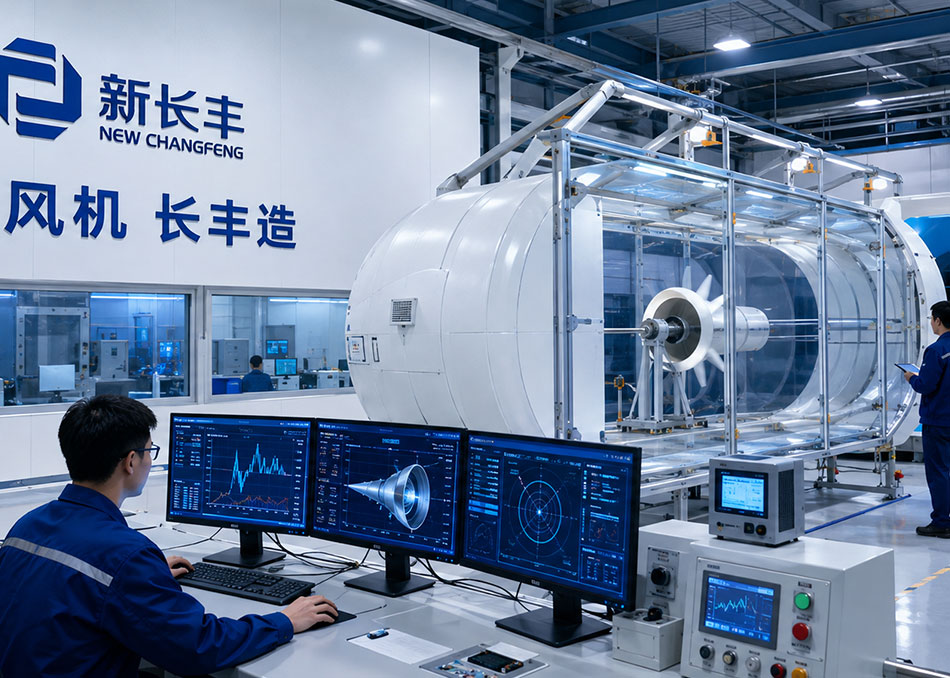
Workshop stuffiness, lingering odors, and difficult-to-remove dust and welding fumes are among the most persistent headaches for factory managers, especially during summer and peak production periods. Natural ventilation, constrained by building orientation and opening areas, often fails to achieve effective air exchange. Relying solely on spot cooling or air conditioning can introduce new problems such as high energy consumption and chaotic airflow organization. Negative pressure fans, with their "exhaust-primary, supply-secondary" ventilation approach, have become a widely applied foundational equipment in factory cooling and ventilation projects. This article outlines practical solutions for negative pressure fans in workshop ventilation, covering working principles, application scenarios, selection criteria, and installation and maintenance.
Working Principle and Workshop Ventilation Logic
Negative pressure fans are typically installed on exterior walls or in window openings. When operating, they force indoor air outside, creating a relative negative pressure inside the workshop. With properly designed air inlets (such as opposite doors and windows, louvers, or evaporative cooling pads), fresh outdoor air is drawn in along a predetermined path, forming a directed "exhaust—supply—circulation" airflow. This ventilation method does not rely on complex supply ductwork, and system resistance is relatively controllable, making it suitable for large spaces and open-plan factory buildings.
Technically, negative pressure fans often use axial impeller structures, emphasizing high airflow and low pressure characteristics, in line with the basic requirements of GB/T 1236 Industrial fans — Performance testing using standardized airways. Their core value lies not in "cooling" but in rapidly exchanging the entire workshop air at a relatively low system cost, carrying away heat, moisture, odors, and pollutants.
Application Scenarios in Workshop Ventilation
Negative pressure fans are particularly effective in scenarios where heat and pollutants are generated over a large area and natural ventilation is insufficient. Common applications include:
- Machining and assembly workshops: Removing residual heat from equipment and preventing oil mist and dust accumulation.
- Welding and fabrication shops: Diluting and exhausting welding fumes to improve air quality and comply with occupational health requirements.
- Warehouses and logistics centers: Reducing humidity and stuffiness, protecting stored goods from mold and deterioration.
- Plastic and rubber processing: Removing volatile organic compounds and heat generated during production.
In these environments, negative pressure fans work best when combined with planned inlet openings and, where necessary, evaporative cooling pads to further reduce incoming air temperature.
Selection Criteria for Negative Pressure Fans
Proper selection ensures efficient ventilation and energy savings. Key factors to consider include:
- Air volume requirements: Calculate the required air changes per hour based on workshop volume and heat/pollutant generation. Refer to ventilation design manuals for recommended air change rates.
- Fan performance: Choose fans with performance curves tested according to GB/T 1236, and verify that the operating point matches system resistance.
- Energy efficiency: Select fans compliant with GB 19761 Minimum allowable values of energy efficiency and energy efficiency grades for fans to reduce operating costs.
- Noise levels: Consider noise limits for the workplace and surrounding environment; choose low-noise models or implement acoustic measures.
- Durability and maintenance: Evaluate construction materials, motor protection class, and ease of cleaning and maintenance.
For workshops with specific requirements such as smoke exhaust, refer to GB 51251 Technical standard for smoke and heat exhaust ventilation systems for additional design considerations.
Installation and Maintenance Best Practices
Correct installation maximizes fan performance and lifespan. Recommendations include:
- Mount fans on the leeward side of the building when possible to utilize prevailing winds.
- Ensure adequate inlet area (typically 1.2 to 1.5 times the fan outlet area) to avoid excessive negative pressure and reduced airflow.
- Use weather hoods or louvers to prevent rain ingress and backdrafts.
- Regularly inspect and clean fan blades, guards, and motors to maintain balance and efficiency.
- Lubricate bearings according to the manufacturer's schedule and check electrical connections for safety.
For kitchen exhaust applications, additional grease filters and purification devices may be required to comply with GB 18483 Emission standard of cooking fume.
FAQ
Q: Can negative pressure fans be used for cooling in workshops?
A: Negative pressure fans primarily ventilate by exchanging indoor air with outdoor air. While they do not actively cool the air, they can effectively reduce perceived temperature by removing heat and increasing air movement. For further cooling, combine them with evaporative cooling pads.
Q: How do I determine the right number of negative pressure fans for my workshop?
A: The required number depends on workshop volume, desired air changes per hour, and fan airflow capacity. Calculate total required airflow (workshop volume × air changes) and divide by the airflow of a single fan at the expected static pressure. Consult a ventilation engineer for precise sizing.
Q: Are negative pressure fans suitable for workshops with explosive dust or gases?
A: Standard negative pressure fans are not designed for explosive atmospheres. In such environments, explosion-proof motors and fans certified for hazardous locations must be used. Always consult applicable safety standards.
Q: What maintenance do negative pressure fans require?
A: Regular maintenance includes cleaning blades and guards, checking belt tension (for belt-driven models), lubricating bearings, and inspecting electrical components. Frequency depends on operating hours and environmental conditions.
Negative pressure fans offer a cost-effective and reliable solution for workshop ventilation, improving air quality and thermal comfort. By understanding their principles, selecting appropriate models, and following proper installation and maintenance practices, factories can achieve efficient ventilation and a healthier work environment. For tailored advice on negative pressure fans and other ventilation equipment, contact XCFFJ today.