
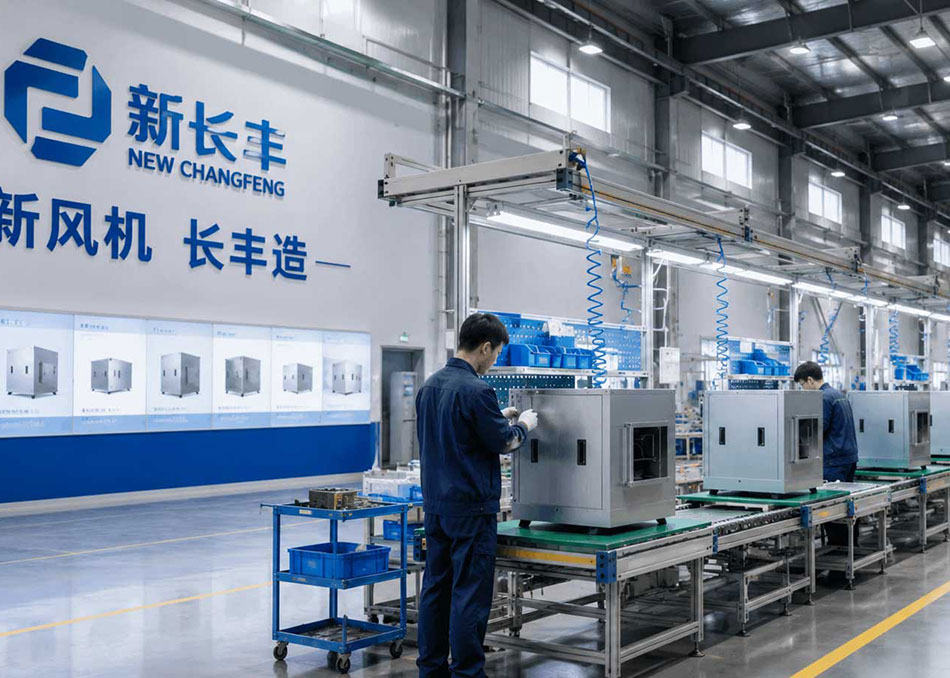
Walk into most industrial workshops on a hot afternoon and the problem isn't the equipment—it's the air. Heat, humidity, dust, odors, and fumes hang in the space, and workers feel far hotter than the actual temperature. Productivity drops, error rates climb, and retention suffers. Many facility managers have tried spot fans, open windows, or even air conditioning, usually with disappointing results. Negative pressure fans have become the mainstream solution for workshop ventilation and cooling because they solve a different problem: not moving air around, but exchanging it. This guide explains how negative pressure ventilation works in industrial settings, how to select and install the right system, and what ongoing operation and maintenance require—drawing on the product practice of the XCFFJ (Xinchangfeng) brand.
Why Negative Pressure Fans Suit Industrial Workshop Ventilation and Cooling
The principle is straightforward. Fans are mounted on an exterior wall or window on one side of the workshop. When running, they force indoor air out, creating a slight negative pressure inside. Fresh outdoor air then flows in naturally through doors, windows, and intake openings on the opposite side, establishing a continuous airflow path through the space. Compared with ceiling fans or pedestal fans that simply stir the air, negative pressure ventilation actually removes heat, moisture, dust, and odors—true air exchange rather than air circulation.
Technically, most negative pressure fans use an axial impeller with a large diameter and low rotational speed, which helps keep noise and energy consumption controlled at a given air exchange rate. Two standards form the basic basis for judging whether a fan is fit for purpose: GB/T 1236, Fan Performance Testing, which covers airflow and static pressure measurement, and GB 19761, Minimum Allowable Values of Energy Efficiency for Fans. Checking a supplier's test data against these standards is a reasonable first step in due diligence.
The fit with industrial workshops is practical as much as technical. Large open floor areas, high ceilings, and multiple heat sources make spot cooling inefficient, while the negative pressure approach treats the whole volume as a single ventilation zone. It also works with the building rather than against it—no ductwork is needed across the shop floor, and installation typically involves only exterior wall or window openings.
Matching Fan Selection to the Workshop's Real Conditions
Selection starts with the space itself, not the catalog. The key inputs are the workshop volume, the number of air changes per hour the process requires, the layout of openings on the intake side, and the internal heat load from machinery, lighting, and people. A workshop with heavy heat-generating equipment or airborne dust needs a higher exchange rate than a light assembly area. Because airflow and static pressure figures must come from verified performance data, ask suppliers for test reports referencing GB/T 1236 rather than relying on nominal claims.
Energy efficiency deserves equal attention. GB 19761 sets minimum efficiency thresholds, and a fan that meets them will typically cost less to run over its service life than a cheaper unit that does not. For facilities with variable conditions—shift patterns, seasonal load changes—consider whether fan speed control or staged fan banks make sense, so the system isn't always running at full output when the workshop is lightly occupied.
Intake design is the most commonly overlooked factor. Negative pressure ventilation only works if replacement air can enter freely. Blocked louvers, undersized intake openings, or a sealed building envelope will starve the fans and collapse the airflow path. Plan the intake side as carefully as the exhaust side, and confirm that doors and windows on the intake face can remain open during operating hours or that dedicated intake louvers are installed.
Installation Layout and Airflow Path Design
Effective negative pressure systems are designed around a deliberate airflow path. Fans are typically grouped on one exterior wall, with intake openings distributed on the opposite side so fresh air sweeps across the working area before being exhausted. Avoid placing fans where they short-circuit—pulling air directly from a nearby open door rather than from across the shop floor. In long or L-shaped buildings, zoning the fans so each area has its own intake-to-exhaust route usually performs better than a single large bank at one end.
Mounting height and fan spacing matter too. Fans mounted too low can create strong local drafts at workstations while leaving upper air layers stagnant; fans spaced too widely can leave dead zones between them. A layout review using the building's plan and section drawings, before any wall openings are cut, is time well spent. For roofs and walls where structural or weather considerations apply, coordinate with the building's structural and envelope requirements—exterior penetrations must be properly flashed and sealed.
Noise is a frequent concern in workshops near residential areas or in buildings with strict occupational limits. Large-diameter, low-speed axial fans generally produce lower noise at comparable airflow than small high-speed units, and mounting fans on resilient bases or isolating them from lightweight wall panels helps reduce structure-borne sound. Where noise is critical, discuss acoustic options with the supplier at the design stage rather than retrofitting later.
Operation, Maintenance, and Measuring Results
Once installed, the system should be commissioned rather than simply switched on. Verify that the intended airflow path exists—check for short-circuiting, confirm intake openings are clear, and observe whether air moves through the occupied zone rather than only along the ceiling. Simple smoke or anemometer checks at a few representative points can reveal problems that are invisible from the floor.
Maintenance is modest but not optional. Fan blades, guards, and louvers accumulate dust, which reduces airflow and can unbalance the impeller. A scheduled cleaning routine—frequency depends on the dustiness of the process—keeps performance close to design values. Belts, bearings, and motors on belt-driven units need periodic inspection, and electrical connections should be checked for tightness and insulation. Keep a simple log of cleaning and inspection dates so the maintenance program is auditable.
Track results with basic metrics: worker feedback on thermal comfort, measured air velocity in work areas, and energy consumption per operating hour. Comparing these before and after installation, and over successive seasons, shows whether the system is delivering and helps justify further optimization.
Where XCFFJ Fits In
XCFFJ (Shenzhen Xinchangfeng Dust Removal & Cooling Equipment Co., Ltd.) manufactures industrial and commercial ventilation and cooling equipment, including negative pressure fans alongside cabinet centrifugal fans, multi-wing centrifugal fans, evaporative air coolers, and roof turbo ventilators. For workshop ventilation and cooling projects, the company's approach is to match fan selection and layout to the building's actual volume, heat load, and intake conditions, and to provide performance data that can be checked against GB/T 1236 and GB 19761. Product information is available at www.xcffj.com.
FAQ
Q: How is a negative pressure fan different from a large industrial ceiling fan?
A: A ceiling fan circulates air within the space, which can improve perceived comfort but does not remove heat, moisture, dust, or odors. A negative pressure fan exhausts indoor air and draws fresh air in from outside, so it performs actual air exchange. In workshops with strong heat or fume sources, exchange is usually the more effective strategy.
Q: Can negative pressure ventilation work in a workshop with air conditioning?
A: It can, but the two systems need coordinated control. Running exhaust fans while air conditioning operates will pull cooled air out of the building. In practice, many facilities use negative pressure ventilation for general exhaust and cooling during hot periods and rely on air conditioning for specific enclosed areas, with interlocks or operating procedures to prevent the systems from fighting each other.
Q: What standards should I check when evaluating a negative pressure fan?
A: Ask for performance test data consistent with GB/T 1236 for airflow and static pressure, and evidence of compliance with GB 19761 for energy efficiency. For buildings where smoke and heat exhaust is a design consideration, GB 51251 applies to those separate life-safety systems and should be handled by the appropriate fire engineering professionals.
Q: How often does a negative pressure fan need maintenance?
A: It depends on the dust and grease load in the workshop. Light-duty environments may need cleaning and inspection a few times a year; dusty or greasy processes may require monthly attention. The practical rule is to inspect whenever airflow appears to drop or noise changes, and to keep a written maintenance log.
Negative pressure ventilation is not a complicated technology, but it is a system: fan selection, intake design, layout, and maintenance all determine whether a workshop actually feels cooler and breathes better. If you are planning a ventilation and cooling upgrade for an industrial facility, review your building's volume, heat sources, and intake conditions first, then specify equipment against verifiable performance standards. For product details and project guidance, visit www.xcffj.com.