
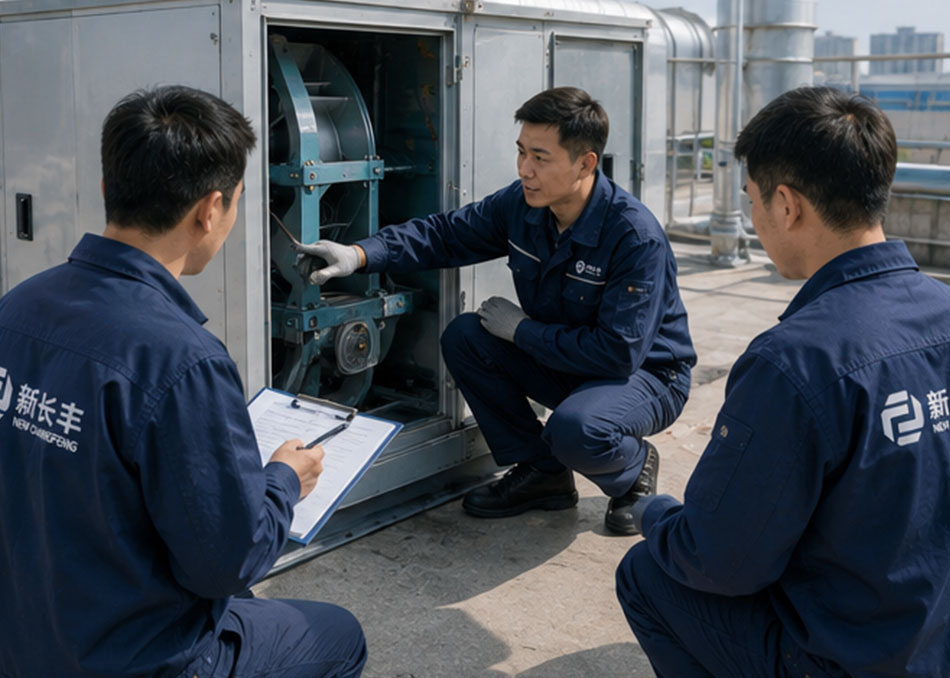
Mahjong parlors and card rooms may not be large, but their ventilation challenges are disproportionately complex. Dense private rooms, long occupant stays, a high proportion of smokers, and doors and windows kept tightly closed for sound insulation all contribute to a rapid buildup of stale air, smoke odor, and stuffiness. Many operators try adding exhaust fans, only to find that exhaust works but makeup air doesn't follow—creating negative pressure indoors. The result: air leaks in through door gaps, and odors actually spread more aggressively. Meanwhile, factory workshops and commercial kitchens face the same imbalance between exhaust and makeup air. This article uses mahjong parlor ventilation as a starting point, combined with the general logic of kitchen negative pressure solutions and ventilation makeup air, to discuss how to correctly apply and select water-cooled fresh air units, with practical insights for factory cooling equipment selection.
1. The Air Pain Point in Mahjong Parlors: It's Not About Exhausting, It's About Not Being Able to Supply
The ventilation difficulty in mahjong parlors is essentially "excess exhaust, insufficient makeup air." Private rooms are densely occupied, and polluted air from breathing and smoking needs timely replacement. However, most venues only install exhaust equipment without a matching makeup air path. Once the exhaust fan runs, indoor pressure drops below outdoor pressure, and outdoor air can only seep in无序ly through door gaps, window cracks, and duct openings—bringing in not fresh air but odors from corridors and restrooms, creating a vicious cycle of "more exhaust, more stuffiness."
According to basic ventilation engineering principles, to maintain stable air exchange in a room, exhaust volume and makeup air volume should be roughly balanced, with the indoor space kept at a controlled slight negative or slight positive pressure. Mahjong parlors are better suited to an "organized makeup air + orderly exhaust" approach: makeup air equipment actively supplies filtered, temperature-controlled fresh air, while exhaust equipment removes polluted air in an organized manner, keeping indoor pressure difference within a controllable range. This not only prevents odor backflow but also ensures that every corner receives fresh air.
2. How Water-Cooled Fresh Air Units Work and Their Advantages
A water-cooled fresh air unit is essentially a fresh air handling unit that uses water as the cooling medium. It draws in outdoor air, filters it, and cools it through a water-cooled coil before supplying it indoors. Compared with traditional air-cooled direct-expansion fresh air units, water-cooled units offer higher cooling efficiency and more stable performance under high-temperature conditions, as they rely on cooling tower or chilled water systems for heat rejection rather than being limited by outdoor air temperature.
In mahjong parlor applications, the water-cooled fresh air unit provides multiple benefits:
- Effective makeup air: Actively supplies fresh air to balance exhaust and prevent negative pressure.
- Cooling and dehumidification: Cools incoming air in summer, reducing indoor temperature and stuffiness; some models can also dehumidify, improving comfort.
- Filtration and purification: Built-in filters remove dust and some odors, improving indoor air quality.
- Low noise: Water-cooled units typically have lower outdoor unit noise, making them suitable for venues sensitive to noise, such as mahjong parlors.
It is important to note that the cooling capacity, airflow, and external static pressure of a water-cooled fresh air unit must be selected based on the actual room size, occupancy, and exhaust volume. Undersizing will fail to meet makeup air demands, while oversizing may cause energy waste and noise issues.
3. General Logic for Solving Kitchen Negative Pressure and Ventilation Makeup Air
Commercial kitchens face similar challenges: range hoods and exhaust fans remove large volumes of air, but without adequate makeup air, negative pressure causes problems such as difficulty opening doors, backflow of grease fumes, and incomplete combustion in gas appliances. The solution logic is the same as in mahjong parlors: balance exhaust and makeup air, and maintain a slight negative pressure in the kitchen relative to the dining area to prevent odor leakage, while ensuring sufficient makeup air.
In practice, makeup air volumes are typically designed to be 80%–90% of exhaust volume, with the remainder entering naturally through door gaps, keeping the kitchen at a slight negative pressure. Water-cooled fresh air units can serve as makeup air equipment, supplying cooled or heated fresh air to improve kitchen working conditions. For kitchens with high grease content, pre-filtration or grease filters should be considered to protect the unit's coil.
4. Practical Recommendations for Factory Cooling Equipment
Factories and workshops often face high temperatures, poor ventilation, and airborne dust. When selecting cooling equipment, consider the following:
- Evaporative air coolers: Suitable for open or semi-open spaces, using water evaporation for cooling, with low energy consumption but limited temperature drop in humid regions.
- Negative pressure fans: Used in conjunction with evaporative cooling pads or water curtains to create negative pressure ventilation, rapidly removing hot air from the workshop.
- Water-cooled fresh air units: Suitable for closed or semi-closed workshops requiring temperature control and air quality, providing cooled fresh air while maintaining positive pressure to prevent dust infiltration.
- Roof turbo ventilators: Rely on natural wind and thermal pressure for ventilation, requiring no electricity, suitable for auxiliary ventilation.
Selection should be based on workshop area, heat source intensity, personnel density, and process requirements. It is advisable to consult a professional ventilation engineer for load calculations and airflow organization design.
5. FAQ
Q: Can a mahjong parlor just use exhaust fans without makeup air?
A: No. Without makeup air, exhaust fans create negative pressure, causing outdoor air to seep in through gaps无序ly, bringing in odors and reducing exhaust efficiency. A balanced design with both exhaust and makeup air is necessary.
Q: What is the difference between a water-cooled fresh air unit and a regular fresh air unit?
A: A water-cooled fresh air unit uses water as the cooling medium, offering higher cooling efficiency and stability under high temperatures. Regular fresh air units may only filter and supply air without cooling, or use direct-expansion cooling which is less efficient in hot climates.
Q: How to determine the makeup air volume for a mahjong parlor?
A: Makeup air volume should be roughly equal to exhaust volume, based on the number of air changes per hour (typically 6–10 for mahjong parlors) and occupancy. A professional ventilation engineer can calculate the specific requirement.
Q: Does a water-cooled fresh air unit require a cooling tower?
A: Yes, water-cooled units require a cooling water system, typically including a cooling tower or chilled water system, to reject heat. This means initial investment may be higher, but operating efficiency is better in the long run.
In summary, whether for mahjong parlors, commercial kitchens, or factory workshops, the key to ventilation lies in balancing exhaust and makeup air and choosing the right equipment. Water-cooled fresh air units offer an effective solution for spaces requiring cooled fresh air and pressure control. For specific selection and design, consult a professional ventilation equipment supplier. XCFFJ provides a range of ventilation and cooling products, including water-cooled fresh air units, negative pressure fans, and evaporative air coolers, to meet diverse needs. Visit our website for more information.