
In any commercial kitchen, the battle against grease-laden smoke and intense heat is a daily reality. Beyond compromising food safety and staff well-being, poor exhaust performance can trigger fire code violations and failed inspections. Many operators find that even with hoods installed, the kitchen remains hazy, walls turn sticky with grease, and the fan noise is deafening. The root cause often isn't a lack of equipment but a poorly designed exhaust system—and the choice of fan technology suited to the demanding kitchen environment. This article explains why cabinet centrifugal fans are the backbone of professional kitchen exhaust systems and how to design a system that truly delivers.
Why Cabinet Centrifugal Fans Are Essential for Kitchen Exhaust
Kitchen exhaust systems handle a uniquely challenging airflow: a mix of grease vapor, steam, and high-temperature air, often through long duct runs with multiple elbows and transitions. Axial fans, with their low-pressure output, simply cannot overcome the cumulative resistance of such ductwork. Multi-blade centrifugal fans, while offering high airflow, typically generate insufficient static pressure, leading to weak suction at the far end of the system.
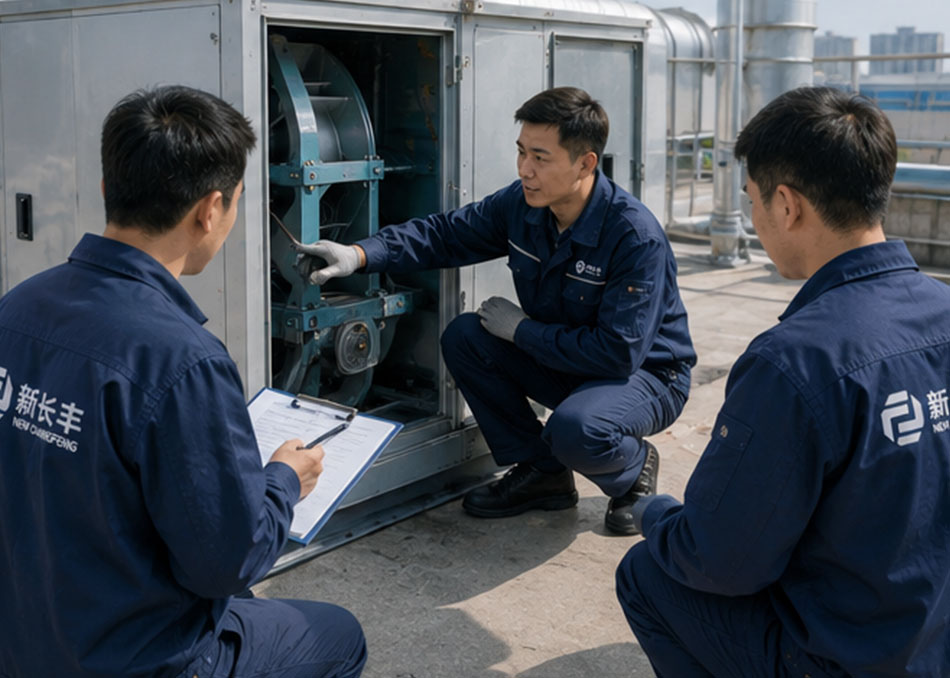
Cabinet centrifugal fans, by contrast, employ a centrifugal impeller within a scroll housing, generating the high static pressure needed to push contaminated air through ducts, filters, and purification units to the discharge point. Their enclosed cabinet design incorporates sound-absorbing insulation, significantly reducing operational noise compared to bare centrifugal fans—a critical advantage when fans are mounted near dining areas or on rooftops where noise ordinances apply. Moreover, the motor is often isolated or externally mounted, protecting it from grease and heat, which simplifies maintenance and extends service life.
Key Elements of a Well-Designed Kitchen Exhaust System
A professional kitchen exhaust system is not a single appliance but a coordinated assembly of five components: hoods, ductwork, purification equipment, the fan, and fresh air supply. Each must be specified and integrated correctly.
Hood Selection and Positioning
The hood is the first line of capture. Its size, shape, and placement must match the cooking equipment's heat and smoke output. Overhanging the cooking surface by at least 150–200 mm and positioning the lower edge at the recommended height ensures effective capture. For high-heat appliances like woks or grills, consider canopy hoods with higher capture velocities.
Ductwork Design and Sizing
Ducts should be as short and straight as possible, with smooth interior surfaces to minimize friction loss. Use gradual bends (45° or 30°) instead of sharp 90° elbows, and avoid sudden expansions or contractions. Proper duct sizing—neither too small (excessive velocity and noise) nor too large (grease accumulation)—is essential. Industry practice suggests a duct velocity between 10–12 m/s to keep grease suspended.
Purification Equipment Integration
Before the fan, the air typically passes through grease filters or an electrostatic precipitator to remove oil mist. The pressure drop across these devices must be accounted for when calculating total system resistance. High-efficiency purifiers not only protect the fan but also comply with local emission regulations, such as GB 18483 for cooking fume limits.
Fan Sizing and Placement
The fan must be selected based on the required airflow (CFM) and total static pressure (sum of hood, duct, fittings, and purifier losses). Placing the fan after the purification unit (negative pressure side) is common, but ensure the fan is rated for the temperature and any residual grease. Cabinet centrifugal fans are ideal for rooftop installations where space and noise are concerns.
Fresh Air Makeup
An often-overlooked component is the supply air system. Without adequate makeup air, the kitchen becomes negatively pressurized, causing exhaust hoods to lose efficiency and doors to slam. Design a balanced system that introduces tempered fresh air to replace the exhausted volume, maintaining a slight negative pressure relative to dining areas.
Designing for Performance and Compliance
To achieve consistent performance, follow a systematic approach:
- Calculate the total exhaust volume based on the heat load and hood dimensions (e.g., 1.5–2 m/s capture velocity at the hood face).
- Map the duct route and sum all pressure losses, including fittings and the purifier's initial and final (dirty) pressure drop.
- Select a cabinet centrifugal fan whose performance curve provides the required airflow at the calculated static pressure, with a safety margin of 10–15%.
- Ensure the fan's motor is sized for the start-up torque and operating temperature.
- Add variable frequency drives (VFDs) to adjust speed for peak and off-peak cooking periods, saving energy and reducing noise.
Compliance with standards such as GB/T 1236 for fan performance testing and GB 19761 for energy efficiency ensures that the selected fan meets industry benchmarks. Fire safety codes (e.g., GB 51251) dictate duct material, fire dampers, and fan shutdown interlocks—factors that must be integrated into the design from the outset.
Maintenance and Long-Term Reliability
Even the best-designed system degrades without proper maintenance. Grease accumulation on impellers and filters reduces airflow and increases fire risk. Schedule regular cleaning of filters, inspect ductwork for buildup, and check belt tension and motor bearings. Cabinet centrifugal fans with accessible panels and removable impellers simplify these tasks. Also, monitor vibration and noise—sudden changes often indicate imbalance or bearing wear.
Frequently Asked Questions
Q: Can an axial fan be used for kitchen exhaust in short duct runs?
A: For very short, straight runs with minimal resistance, an axial fan might suffice, but it is not recommended. Kitchen exhaust always contains grease and heat, and axial fans are prone to grease buildup on blades and motor overheating. Cabinet centrifugal fans provide the necessary pressure and are designed for the harsh kitchen environment, ensuring reliability and compliance.
Q: How do I calculate the static pressure for my kitchen exhaust system?
A: Sum the pressure losses of every component: hood (typically 50–100 Pa), duct (friction loss per meter), fittings (elbows, transitions), and the purification unit (check manufacturer's data). Add a safety margin of 10–15%. Use the total to select a fan from its performance curve. If you lack experience, consult a ventilation engineer.
Q: What is the ideal placement for a cabinet centrifugal fan in a kitchen exhaust system?
A: Ideally, place the fan after the grease filter or electrostatic purifier, on the roof or outside the building. This minimizes grease exposure to the fan and reduces indoor noise. Ensure the duct from the hood to the fan is as short and straight as possible, and that the fan is accessible for maintenance.
Q: How often should the exhaust fan be cleaned?
A: Grease filters should be cleaned weekly or monthly depending on cooking volume. The fan impeller and housing should be inspected quarterly and cleaned when grease buildup is visible. Regular cleaning prevents performance loss and reduces fire risk, and it extends the fan's lifespan.
Designing a commercial kitchen exhaust system is a nuanced engineering task. By understanding the unique demands of kitchen effluent and selecting the right equipment—particularly cabinet centrifugal fans—you can achieve efficient smoke extraction, a comfortable working environment, and full compliance with safety and environmental standards. For expert guidance and high-quality ventilation solutions, reach out to XCFFJ, where we specialize in industrial and commercial ventilation equipment tailored to your needs.