
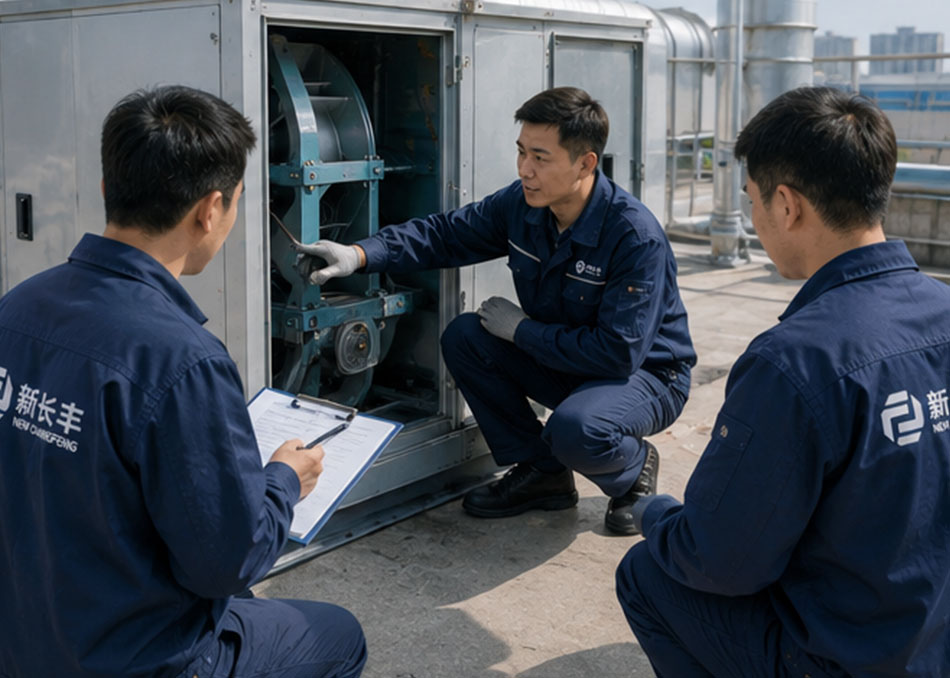
Commercial kitchen exhaust systems often reveal their real problems only after opening day: smoke that won't clear during peak hours, a stifling hot back-of-house, grease-laden air drifting back into the dining room, noise complaints from neighbors, and grease accumulation in ductwork that becomes a fire risk. In most cases, the root cause is not a single piece of equipment but a failure to organize exhaust and makeup air into a coherent airflow strategy. Cabinet centrifugal fans—centrifugal impellers housed in a sound-attenuated enclosure—have become a common choice for commercial kitchen exhaust and makeup air because they offer solid pressure reserves, a compact footprint, and straightforward noise control. This guide walks through selection logic, key parameters, and common pitfalls from the perspective of real kitchen operating conditions.
Why Cabinet Centrifugal Fans Suit Commercial Kitchen Exhaust
The defining difference between kitchen exhaust and ordinary room ventilation is resistance. Grease-laden air must pass through a water-wash hood or collection hood, duct runs, elbows, transitions, a grease purification unit, a backdraft damper, and a fire damper before it reaches outdoors. Stacked together, these components create substantial system resistance—and that resistance keeps rising as grease accumulates on the purifier and duct walls. Axial fans move high air volume but generate relatively low static pressure, so they struggle to "pull" through long duct runs and multi-stage purification equipment. Cabinet centrifugal fans use a centrifugal impeller, whose pressure characteristics are better suited to overcoming the resistance of medium-to-long duct runs and multi-stage purification.
Installation and noise are the other reasons. Commercial kitchen projects are often located in mixed-use complexes, street-front retail units, or the ground floor of residential buildings—spaces with limited mechanical room area and sensitive noise environments. A cabinet centrifugal fan integrates the impeller and motor inside an enclosure whose panels can be lined with acoustic material, and the inlet and outlet positions are typically flexible. That makes it easier to route ductwork within tight ceilings and to keep radiated noise below the limits that trigger complaints. For projects subject to local noise ordinances, this enclosure-based approach is often the difference between passing and failing a noise inspection.
Matching Fan Performance to Kitchen Duty
Selection should start with the actual duty point, not with a catalog "best efficiency" number. The required airflow is driven by hood capture velocity and hood dimensions, while the required static pressure is the sum of all downstream losses: hood, duct friction, fittings, purification unit, dampers, and discharge. Because grease loading increases resistance over time, a reasonable design margin should be applied—but excessive oversizing wastes energy and can increase noise. The goal is a fan whose performance curve intersects the system curve at a point that still delivers adequate capture as the system fouls.
Standards provide the framework for verifying performance. In China, GB/T 1236 defines fan performance testing methods, and GB 19761 sets fan energy efficiency grades—both are useful references when comparing quoted performance data. For exhaust systems in buildings, GB 51251 addresses smoke and heat exhaust design, and GB 18483 governs kitchen fume emission limits. A fan that meets its quoted airflow and pressure at the tested condition, and that is matched to a purification unit capable of meeting GB 18483, is far more likely to perform as intended than one selected on airflow alone.
Practical selection checks include:
- Duty point verification: Confirm the fan's airflow and static pressure at the actual system resistance, not at a free-air condition.
- Grease and moisture tolerance: Kitchen exhaust carries grease and water vapor; motor placement and enclosure drainage should be appropriate for that environment.
- Temperature considerations: If the system also serves as a fire smoke exhaust path, the fan must meet the applicable smoke exhaust requirements.
- Noise targets: Check sound pressure levels at the nearest sensitive receiver, not just at the fan outlet.
- Maintenance access: Ensure the impeller and purification unit can be cleaned without dismantling ductwork.
Balancing Exhaust with Makeup Air
A kitchen that exhausts without a planned makeup air path will run under negative pressure. The symptoms are familiar: doors that are hard to open, backdrafting at the hood, and smoke that refuses to leave the cooking zone. Makeup air should be introduced in a controlled way—typically a portion near the hood and the remainder distributed through the kitchen—so that the exhaust hood can capture fumes without creating uncomfortable drafts at the cooking line.
Cabinet centrifugal fans are frequently used on the makeup air side as well, particularly when the supply air must overcome its own duct resistance or pass through filtration. In humid climates, a water-cooled fresh air unit or evaporative cooling section can be combined with the supply fan to improve kitchen comfort without compromising the exhaust balance. The key is to treat exhaust and supply as one system: airflow rates, pressure relationships, and control sequences should be designed together, not specified independently.
Common Selection Mistakes and How to Avoid Them
Many underperforming kitchen exhaust systems share the same mistakes. Choosing a fan by airflow alone, without checking static pressure at the duty point, is the most common—it leads to a fan that looks adequate on paper but stalls against real duct and purifier resistance. Ignoring grease loading is another: a system that works when new may fail within months as resistance climbs. Skipping makeup air design creates negative pressure that undermines even a correctly sized exhaust fan.
Noise is frequently an afterthought. A fan selected for performance but installed without attention to vibration isolation, flexible connections, or enclosure attenuation can generate complaints that force costly retrofits. Finally, maintenance access is often overlooked: if the impeller and purification unit cannot be reached easily, cleaning will be deferred, resistance will rise, and the system will degrade. Designing for service access from the start is one of the most cost-effective decisions in a kitchen exhaust project.
FAQ
Q: Can a cabinet centrifugal fan handle both exhaust and makeup air?
A: Yes. Cabinet centrifugal fans are used on both sides of a kitchen ventilation system. On the exhaust side they overcome hood, duct, and purification resistance; on the makeup air side they overcome supply duct and filtration resistance. The selection parameters differ, so each should be sized for its own duty point.
Q: How do I know what static pressure my kitchen exhaust system needs?
A: Static pressure is the sum of losses across the hood, duct run, fittings, purification unit, dampers, and discharge. These should be calculated during design, with a margin for grease accumulation. Quoted fan performance should be compared at that calculated duty point, following testing methods such as GB/T 1236.
Q: Why does my kitchen still feel smoky even though the exhaust fan runs?
A: The usual cause is an imbalance between exhaust and makeup air, or insufficient capture velocity at the hood. If the kitchen is under negative pressure, smoke cannot be captured effectively regardless of fan size. Check the makeup air path and the hood capture performance before replacing the fan.
Q: How often should a kitchen exhaust fan be cleaned?
A: Cleaning frequency depends on cooking volume and grease production. High-volume operations may need impeller and duct cleaning on a monthly or quarterly basis. Because grease buildup increases system resistance and fire risk, maintenance intervals should be set based on observed accumulation, not a fixed calendar alone.
Getting commercial kitchen exhaust right comes down to treating exhaust and makeup air as a single airflow system, selecting the fan at its real duty point, and planning for grease loading, noise, and maintenance from the start. Cabinet centrifugal fans are a strong fit for this duty because their pressure characteristics and enclosed construction address the core challenges of kitchen exhaust. To discuss your project's airflow requirements, explore cabinet centrifugal fans and related ventilation equipment at www.xcffj.com.