
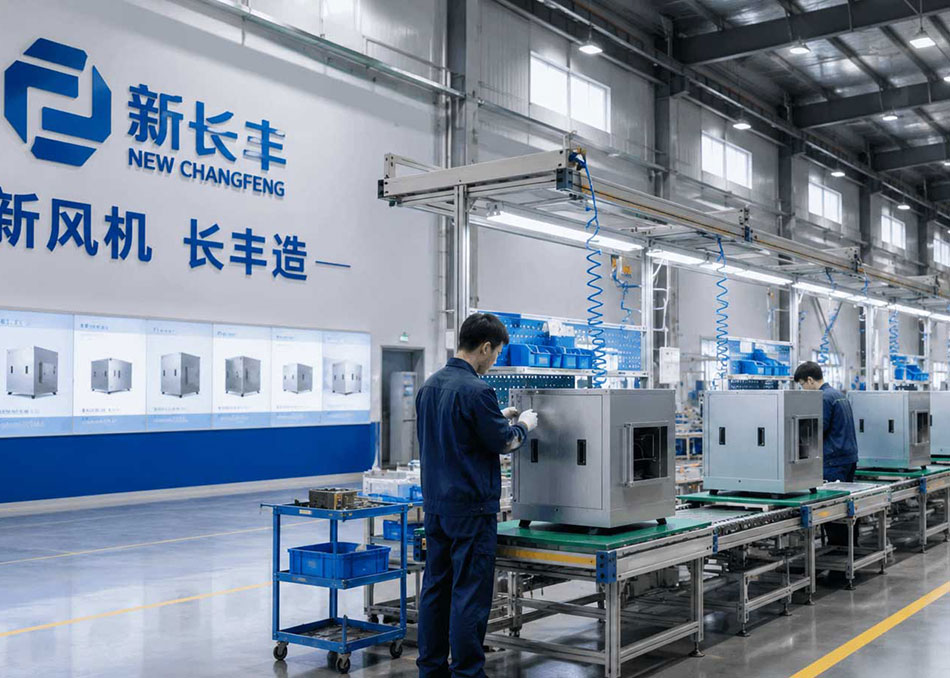
Hotel kitchens are a uniquely punishing thermal environment. Open flames from ranges radiate heat continuously, steamers and ovens release moisture-laden vapor, and dishwashing lines add yet more humidity. Add the grease-laden fumes from frying and sautéing, and the result is a workspace that often runs several degrees hotter than outdoor conditions. Cooks working long shifts at the pass face heat stress, dehydration, and declining focus—all of which hurt ticket times and raise safety risks. Traditional fixes like opening windows, installing ceiling fans, or relying on high-capacity exhaust alone tend to fall short: they either pull cooled air out with the fumes or remove smoke without relieving the radiant heat at the station itself. That's why more hotels are turning to commercial kitchen air conditioners, and in particular to water-cooled fresh air units designed for spot cooling at the workstation. This article explains how these units work and what to consider when selecting one for hotel kitchen cooling.
Why Standard Air Conditioning Doesn't Belong in a Hotel Kitchen
The first instinct for many facility managers is to install a conventional cabinet air conditioner or a central AC system in the back of house. In practice, this rarely works well. The kitchen's air is fundamentally different from a living room or office: it carries high concentrations of grease, water vapor, and particulate matter, and it requires a continuous, substantial supply of fresh air to maintain the negative pressure balance needed by the exhaust system.
A standard air conditioner cools by recirculating indoor air across an evaporator coil. In a kitchen, those fins quickly become coated with grease, and cooling capacity drops off rapidly. Cleaning and maintenance become frequent and costly. Just as importantly, a standard AC does not introduce outdoor air, so it cannot solve the make-up air problem that kitchens face.
The real goal in hotel kitchen cooling is workstation spot cooling—making the person standing at the range, the prep station, or the steamer feel cooler, rather than trying to bring the entire kitchen volume down to a set temperature. That distinction drives the equipment requirements: high sensible cooling capacity, resistance to grease and moisture, and the ability to deliver fresh, filtered air directly to the worker.
How a Water-Cooled Fresh Air Unit Works
A water-cooled fresh air unit combines three functions in one package: it introduces outdoor air, cools it using a water-cooled condenser circuit, and delivers it as a directed stream to the workstation. Unlike a split-system AC that rejects heat to outdoor air through a remote condenser, a water-cooled unit transfers heat to a water loop—typically connected to a cooling tower, chiller, or dedicated water circuit—which makes it well suited to kitchens where outdoor condenser placement is difficult or where high ambient temperatures would degrade air-cooled performance.
The process begins with outdoor air being drawn through a filtration stage that captures dust and some grease aerosols. The filtered air then passes over a cooling coil, where heat and moisture are removed. Because the condenser is water-cooled, the refrigeration cycle can operate efficiently even when the kitchen's outdoor air intake is hot. The cooled, dehumidified air is then supplied through ducting or a directed outlet to the cook's position, creating a localized zone of cooler, drier air.
This approach differs fundamentally from recirculating AC. The unit is constantly bringing in fresh outdoor air, which helps the kitchen maintain the negative pressure needed for proper exhaust. At the same time, it doesn't waste energy cooling air that will immediately be sucked out by the hood—it targets the air to the person who needs it.
- Fresh air introduction: Helps balance exhaust requirements and improves indoor air quality.
- Water-cooled condenser: Maintains cooling performance in high-ambient kitchen environments.
- Spot delivery: Focuses cooling on the workstation rather than the whole room.
- Grease-resistant design: Filters and coils are configured for kitchen conditions, reducing maintenance frequency.
Key Selection Considerations for Hotel Kitchen Cooling
Choosing the right unit requires more than matching a tonnage figure. The first step is to assess the heat load at the specific workstation. Radiant heat from ranges, convection from ovens, and moisture from steamers all contribute. A unit that is undersized will struggle to make a noticeable difference; one that is oversized may create uncomfortable drafts or short-cycle.
Air distribution matters as much as capacity. The supply outlet should be positioned to create a gentle envelope of cool air around the worker without blowing directly onto open flames or into the exhaust hood, which would waste cooling energy. Adjustable louvers or flexible ducts are useful for tuning the airflow pattern after installation.
Water quality and loop design also affect long-term reliability. The water-cooled condenser requires a stable supply of cooling water; scale buildup can reduce heat transfer, so water treatment or periodic cleaning should be part of the maintenance plan. In hotels where a central chilled water loop is available, tying into that loop can simplify installation.
Noise is another practical concern. Kitchen staff work in close quarters, and a unit that is too loud interferes with communication during service. Look for models engineered with low-noise fans and vibration isolation, and consider locating the compressor section away from the immediate work zone if possible.
Finally, verify that the unit's performance ratings are backed by recognized testing standards. In China, fan performance is commonly tested per GB/T 1236, and energy efficiency may be referenced to GB 19761. For any kitchen exhaust or makeup air system, coordination with the smoke exhaust design under GB 51251 is also important to ensure the overall ventilation strategy is balanced.
Integrating Spot Cooling with Kitchen Exhaust and Fume Purification
A water-cooled fresh air unit does not operate in isolation. It is part of a broader kitchen ventilation system that includes exhaust hoods, ductwork, and fume purification equipment. The exhaust system removes grease, smoke, and heat, but it also creates negative pressure that must be relieved with makeup air. If makeup air is not provided in a controlled way, the kitchen will draw in air through doors and windows, bringing in unconditioned outdoor air and undermining comfort.
By supplying filtered, cooled fresh air directly to the workstation, the water-cooled unit helps satisfy makeup air demand while improving conditions at the station. This can reduce the load on the exhaust system by allowing it to operate more efficiently. In kitchens that also use electrostatic fume purifiers, the makeup air helps maintain proper airflow through the hood, which supports capture efficiency.
For hotel engineering teams, the takeaway is that spot cooling should be designed alongside the exhaust and purification strategy, not added as an afterthought. A balanced system delivers better comfort, lower energy use, and easier maintenance.
Frequently Asked Questions
Q: Can I use a regular split-system air conditioner for hotel kitchen cooling?
A: It is not recommended. Standard split systems recirculate indoor air and their coils clog quickly with grease, causing rapid loss of cooling capacity. They also do not provide fresh air, so they cannot help with kitchen makeup air requirements. A water-cooled fresh air unit is designed specifically for the grease, moisture, and fresh-air demands of a commercial kitchen.
Q: How does a water-cooled fresh air unit handle the kitchen's high humidity?
A: The cooling coil removes moisture as air passes over it, so the supply air is both cooler and drier than outdoor air. This dehumidification effect is important in kitchens where steamers and dishwashers add significant latent load. The water-cooled condenser also helps maintain consistent performance when outdoor temperatures are high.
Q: What maintenance does a water-cooled fresh air unit require?
A: Typical maintenance includes cleaning or replacing air filters, inspecting and cleaning the cooling coil, checking the water circuit for scale or corrosion, and verifying fan and compressor operation. Because kitchen air is dirty, filter service intervals may be shorter than in other applications. Following the manufacturer's schedule and using appropriate water treatment will extend equipment life.
Q: Will spot cooling make the whole kitchen cold?
A: No. Spot cooling is designed to create a comfortable zone at the workstation, not to cool the entire kitchen volume. This targeted approach is more energy-efficient because it focuses cooling where people actually stand, rather than conditioning air that will be exhausted.
Conclusion
Hotel kitchen cooling is not simply a matter of adding an air conditioner. The combination of radiant heat, moisture, grease, and exhaust requirements calls for a purpose-built solution. Water-cooled fresh air units address these challenges by introducing filtered outdoor air, cooling and dehumidifying it, and delivering it directly to the workstation—improving comfort for cooks without fighting the exhaust system. When selected and integrated correctly with the kitchen's exhaust and fume purification design, they can make a measurable difference in working conditions and productivity. To explore equipment options for your hotel kitchen, visit www.xcffj.com or contact our team for application guidance.