
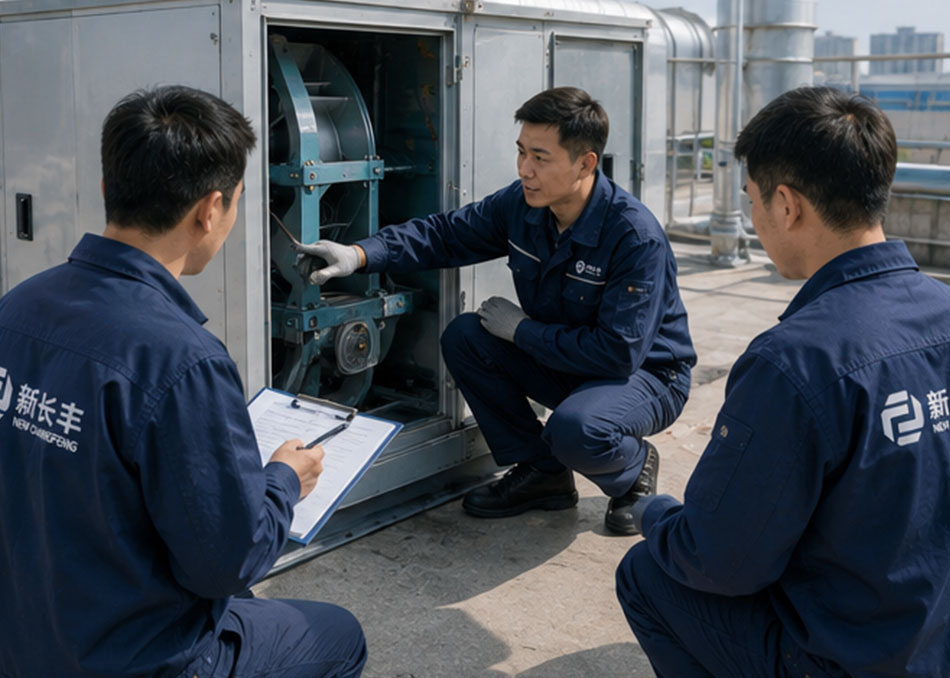
In factories, commercial kitchens, warehouses, and logistics hubs, effective ventilation is fundamental to air quality and operational safety. Axial fans, with their compact structure, easy installation, and straight-through airflow, are among the most common devices in supply and exhaust systems. Yet many users report that after a year or two, airflow drops noticeably, noise increases, energy bills rise, and impellers may even seize or motors overheat. The root cause is often not the equipment itself but a long-term lack of maintenance. This article focuses on axial fans used in ventilation for smoke exhaust purification and air supply, and clarifies the key maintenance points.
The Role of Axial Fans in Ventilation
Axial fans move air parallel to the fan shaft, making them suitable for high-volume ventilation in systems with low duct resistance. In industrial plants, they are often used for sidewall supply or exhaust to create organized air circulation. In commercial kitchens and canteens, they primarily handle makeup air and auxiliary exhaust, working with fume purifiers and exhaust hoods to maintain slight negative pressure and prevent smoke leakage.
It is important to recognize that axial fans are not universal solutions. Main exhaust in smoke purification systems usually must overcome the resistance of longer ducts and purification equipment, a task better suited to cabinet centrifugal fans with higher pressure capability. Axial fans are more appropriate for low-resistance makeup air, supply air, and general ventilation. Misapplication forces equipment to operate under inefficient conditions, which even the best maintenance cannot fully offset.
- Industrial workshops: sidewall supply/exhaust, spot cooling, general ventilation
- Commercial kitchens: makeup air, auxiliary exhaust, prep area ventilation
Why Maintenance Matters: Common Issues and Root Causes
Axial fans are relatively simple, but they are not maintenance-free. Over time, dust and grease accumulate on blades, increasing imbalance and reducing airflow while raising noise and energy consumption. Bearings wear out, belts loosen (in belt-driven models), and motors can overheat due to blocked cooling paths or voltage fluctuations. In kitchens, grease buildup is especially severe and can become a fire hazard.
Regular maintenance is not just about performance—it is about safety and compliance. GB/T 1236 (fan performance testing) and GB 19761 (fan energy efficiency) provide benchmarks for performance and efficiency, while GB 51251 (smoke and heat exhaust) and GB 18483 (kitchen fume emission) set requirements for system design and emissions. Neglected maintenance can lead to violations and increased operational risks.
Maintenance Best Practices for Axial Fans
To keep axial fans operating efficiently in ventilation applications, establish a routine maintenance schedule. The frequency depends on the environment: dusty industrial settings may require monthly checks, while kitchen applications need more frequent cleaning due to grease.
- Cleaning: Regularly clean blades, housing, and guards. Use appropriate degreasers in kitchens. Ensure all power is off before cleaning.
- Inspection: Check for loose fasteners, abnormal noise, vibration, and signs of corrosion. Inspect belts and bearings for wear.
- Lubrication: Follow manufacturer guidelines for bearing lubrication. Over-lubrication can be as harmful as under-lubrication.
- Electrical checks: Verify motor current, insulation resistance, and terminal connections. Ensure proper grounding.
- Performance monitoring: Periodically measure airflow and static pressure to detect degradation. Compare with baseline data.
- Seasonal preparation: Before peak seasons (summer for cooling, winter for heating), conduct thorough inspections.
In smoke exhaust and makeup air systems, ensure that axial fans are interlocked with purifiers and hoods. Check that makeup air volumes balance exhaust to maintain negative pressure without causing door-opening difficulties or insufficient exhaust.
Application-Specific Maintenance: Industrial vs. Commercial Kitchen
Industrial workshops: Dust and particulates are the main enemies. Install filters or screens if necessary, and clean regularly. In facilities with corrosive atmospheres, choose corrosion-resistant models and inspect more frequently. For spot cooling, ensure fans are positioned to avoid blowing dust onto workers or products.
Commercial kitchens: Grease is the primary challenge. Axial fans used for makeup air should draw from clean areas to avoid grease intake. Auxiliary exhaust fans near hoods require frequent degreasing. Ensure that the makeup air is filtered and tempered if needed to avoid drafts. Coordinate with kitchen exhaust purifiers to maintain proper negative pressure and prevent fume leakage into dining areas.
FAQ
Q: How often should I clean my axial fan?
A: In clean environments, every 3–6 months may suffice. In dusty industrial settings, monthly cleaning is recommended. In commercial kitchens, grease buildup can be rapid, so cleaning every 1–2 months is advisable. Always follow the manufacturer's recommendations and local regulations.
Q: Can I use an axial fan for kitchen exhaust?
A: Axial fans are generally not suitable for main kitchen exhaust because they cannot overcome the high resistance of long ducts and grease filters. They are better used for makeup air or auxiliary exhaust in low-resistance paths. For main exhaust, use a cabinet centrifugal fan or a specialized kitchen exhaust fan designed for grease and high static pressure.
Q: What are the signs that my axial fan needs maintenance?
A: Reduced airflow, increased noise or vibration, higher energy consumption, unusual smells (overheating), and visible dust or grease accumulation are all indicators. Address these promptly to avoid costly downtime.
Q: How does maintenance affect energy efficiency?
A: Clean blades and proper belt tension can significantly reduce energy use. According to GB 19761, fan energy efficiency is directly tied to operating conditions. Regular maintenance helps maintain optimal efficiency and lowers operating costs.
Conclusion
Axial fans are reliable workhorses in ventilation systems, but their performance and longevity depend on proper maintenance. By understanding their role, following a structured maintenance routine, and addressing application-specific challenges, you can ensure efficient smoke exhaust and air supply in your facility. For expert advice on selecting and maintaining axial fans for your specific needs, contact XCFFJ—we are here to help you achieve a safer, more comfortable environment.