
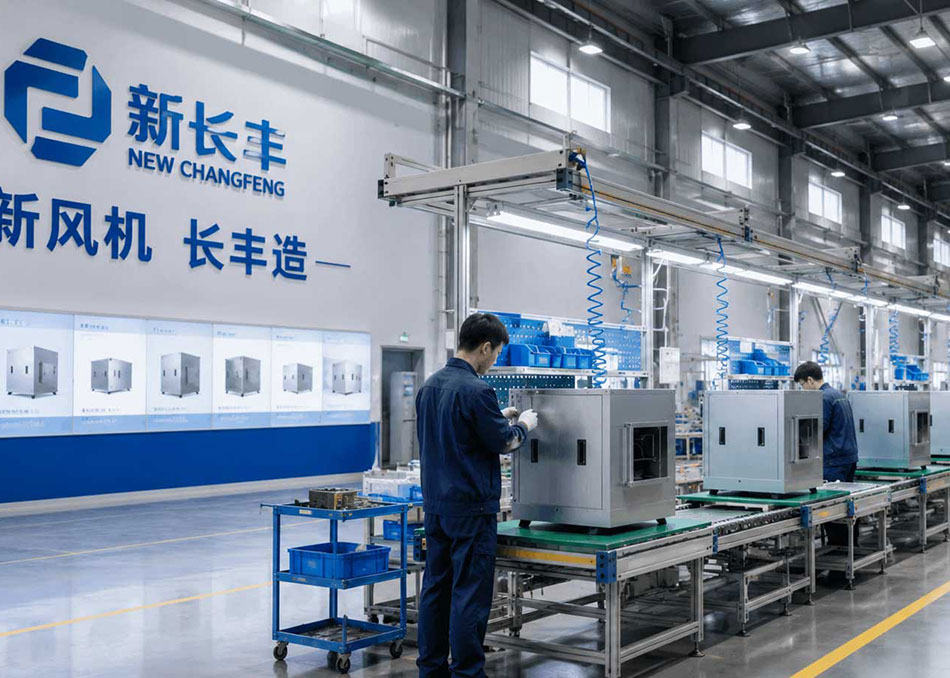
Walk into many commercial kitchens and the complaint is the same: the exhaust hood is running, the fume purifier is installed, the exhaust fan is oversized, yet the line cooks are still sweating and grease-laden air drifts into the dining room. The instinct is to add more exhaust capacity. In most cases, the real problem is on the supply side. The kitchen has pulled itself into a strong negative pressure, and there is no controlled path for make-up air to return. A water-cooled fresh air unit addresses both halves of that problem—pressure balance and temperature—but only if it is placed where the air it delivers actually helps.
Why Negative Pressure Has to Be Solved First
Every minute a kitchen exhaust system runs, it removes a large volume of air from the space. If doors and windows are sealed and no dedicated make-up air path exists, indoor pressure drops below outdoor pressure. The consequences cascade through the whole system: the exhaust fan moves less air than its rated curve suggests, grease and smoke swirl around the hood lip instead of entering the capture zone, doors become hard to open, and sewer odors get drawn back into the room.
GB 18483, the emission standard for cooking fume in the catering industry, sets requirements for fume collection and purification efficiency. Collection efficiency, however, depends on airflow organization upstream of the hood. A hood cannot capture what the room's pressure balance will not deliver to it. This is why make-up air is not an optional accessory to the exhaust system—it is part of the system.
Strong negative pressure also undermines the hood's capture velocity. When supply air is missing, replacement air enters through whatever gaps exist: door cracks, wall penetrations, floor drains. That air arrives in unpredictable directions and drafts, disturbing the thermal plume rising from the cooking surface. The result is the familiar pattern of fume leakage at the hood edges even when the fan is running at full speed.
What a Water-Cooled Fresh Air Unit Actually Does
A water-cooled fresh air unit draws in outdoor air, passes it through an evaporative cooling section, and delivers tempered fresh air into the kitchen. The evaporative process lowers the dry-bulb temperature of the supply air without the refrigerant circuit and condensing unit required by a conventional air conditioner. For a hot kitchen, this means the make-up air does not simply replace exhausted air—it replaces it with cooler air, easing the heat load at the cooking line.
Because the unit handles both functions at once, it is well suited to the make-up air role in food service. A dedicated supply fan alone would balance pressure but deliver hot outdoor air in summer, which cooks and staff notice immediately. A water-cooled unit keeps the pressure balance and takes the edge off the supply temperature, so the make-up air is not fighting the kitchen's comfort.
It is important to be clear about what the unit is not. It is not a substitute for the exhaust hood and fume purification system, and it is not a whole-kitchen air conditioner. Its job is controlled make-up air: enough volume to offset exhaust, delivered at a temperature and velocity that support rather than disrupt hood capture.
Placement Principles for Kitchen Make-Up Air
Placement determines whether the supply air helps the hood or fights it. A few principles apply across most commercial kitchen layouts:
- Deliver air to the make-up zone, not the capture zone. Supply outlets should be positioned so air reaches the kitchen's occupied and perimeter areas before it is drawn toward the hood. Blowing directly at the cooking line disturbs the plume and pushes fume outward.
- Keep supply velocity low at the occupied level. High-velocity jets create drafts at the cooking line and can strip capture air away from the hood. Diffusers that distribute air broadly at low velocity are preferable to concentrated throw.
- Match supply volume to exhaust volume. Make-up air should be balanced against the exhaust system's actual operating airflow, not its nameplate maximum. A slight negative pressure relative to adjacent spaces is usually desirable to keep odors contained, but a strong negative pressure is not.
- Route the air path across the kitchen. Ideally, supply air enters on the side of the kitchen opposite the hood, sweeps through the work area, and is then drawn into the exhaust. This gives the hood a supply of replacement air without a direct draft.
- Account for the unit's own location. The outdoor intake should be sited away from grease exhaust discharge, trash areas, and loading docks. The unit itself needs service access, condensate drainage, and a mounting position that does not obstruct egress or work zones.
In tight kitchens, a common solution is to mount the unit on the roof or in a mechanical space and duct the tempered air to low-velocity diffusers near the dining-room side of the kitchen. Where duct runs are short, a wall-mounted or ceiling-mounted arrangement near the perimeter can work. The right choice depends on the hood layout, the available mechanical space, and the length of duct runs, which affect both pressure loss and the temperature gain in the supply air.
Common Placement Mistakes and Their Symptoms
Most make-up air failures show up as recognizable symptoms. Supply outlets aimed at the hood face produce visible fume spill at the hood edges and a persistent haze in the kitchen. Undersized supply relative to exhaust keeps the room in deep negative pressure, with doors that pull shut and exhaust airflow that measures well below design. Oversized supply without a clear path can pressurize the kitchen and push odors into the dining area, the opposite of the intended containment.
A unit placed far from the kitchen, with long duct runs, may deliver air that has picked up heat along the way, reducing the cooling benefit. A unit placed too close to the cooking line, without adequate diffusion, creates the draft problem described above. In each case, the equipment may be functioning correctly—the layout is what needs attention.
Commissioning matters as much as placement. After installation, measure the actual supply and exhaust airflows, check the pressure relationship between the kitchen and adjacent spaces, and observe hood capture under real cooking conditions. Adjust diffuser settings and fan speeds based on those measurements rather than on assumptions from the design drawings.
Integrating the Unit with the Rest of the Ventilation System
A water-cooled fresh air unit works best as part of a coordinated system that includes the exhaust hood, the fume purifier, and the exhaust fan. Controls should interlock supply and exhaust so that make-up air runs whenever exhaust runs, preventing the kitchen from being pulled into negative pressure during partial-load operation. Where the exhaust system has variable-speed control, the supply side should track it.
Fan performance should be verified according to GB/T 1236, the standard for fan performance testing, and equipment selection should consider GB 19761 fan energy efficiency requirements. For kitchens with fire-rated exhaust systems, GB 51251 governs smoke and heat exhaust design, and make-up air provisions must be consistent with those requirements. These standards are not paperwork—they define the airflow relationships that determine whether the kitchen works.
Maintenance access deserves attention at the placement stage. Evaporative cooling media, water systems, and filters need periodic service. A unit installed where technicians cannot safely reach it will be neglected, and neglected cooling media lose effectiveness and can become a hygiene issue.
Frequently Asked Questions
Q: Can a water-cooled fresh air unit replace a kitchen air conditioner?
A: No. The unit's role is tempered make-up air—it offsets exhaust volume and reduces supply air temperature through evaporative cooling. It is not designed to control the entire kitchen's sensible and latent load the way a dedicated air-conditioning system is. In many kitchens, the two work together: the fresh air unit handles make-up air and the cooling system handles the remaining heat load.
Q: How do I know whether my kitchen has a negative pressure problem?
A: Common signs include doors that are hard to open or pull shut on their own, exhaust airflow that measures below design, fume escaping the hood edges, drafts entering from unexpected openings, and sewer or drain odors. A pressure measurement between the kitchen and adjacent spaces, taken while the exhaust system runs, gives a clear answer.
Q: Where should the supply diffusers be located relative to the hood?
A: Generally, on the side of the kitchen opposite the hood, delivering air at low velocity so it sweeps through the work area before being drawn into the exhaust. Directly aiming supply air at the hood or the cooking line is the most common placement error and typically causes fume spill.
Q: Does the unit need a water supply and drain?
A: Evaporative cooling sections require water supply and drainage, and the unit needs condensate management. These connections should be confirmed during site planning, since they affect where the unit can be installed.
Getting the Airflow Right
Kitchen ventilation problems are usually system problems, not equipment problems. A water-cooled fresh air unit gives food service operators a practical way to balance exhaust with tempered make-up air, but the benefit depends on placement, supply volume, and coordination with the exhaust system. When the unit is sited to support hood capture rather than disturb it, the kitchen becomes cooler, the hood captures what it should, and the exhaust system performs closer to its design intent.
If you are planning a kitchen ventilation upgrade or troubleshooting persistent negative pressure, the XCFFJ team can help review your layout, airflow balance, and equipment selection for water-cooled fresh air units and related ventilation equipment.