
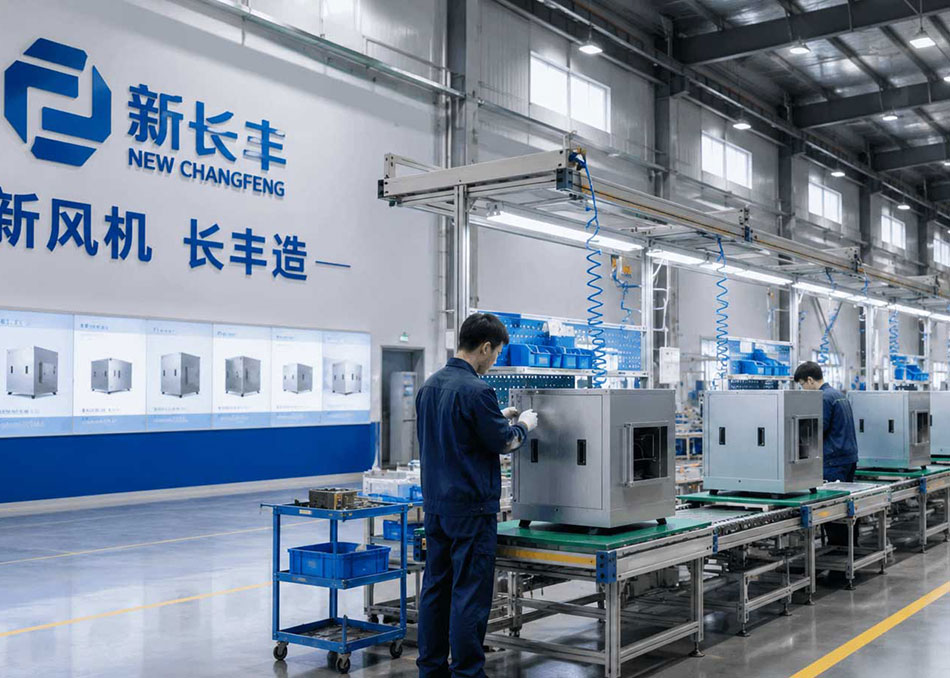
In commercial foodservice, the back-of-house is a uniquely punishing thermal environment. Open flames radiate heat onto the line, combi ovens and fryers release continuous steam and hot air, and exhaust hoods often operate with unbalanced make-up air. The result is a workstation climate where staff feel simultaneously roasted from the front and stifled from behind. Many operators focus solely on whether the exhaust is drawing properly, overlooking the need for directed workstation cooling. That oversight contributes to high chef turnover, slower ticket times, and a spike in summer complaints. From a ventilation engineering standpoint, cooling a commercial kitchen follows the same logic as any industrial heat remediation: capture and remove heat first, then condition the air delivered to the worker. The commercial kitchen air conditioner is a product category built specifically for this second step—workstation cooling. It does not attempt to chill the entire kitchen to comfort-level temperatures; instead, it delivers cooled air precisely to fixed positions such as the range line, prep station, and plating area, trading a relatively small cooling capacity for a noticeable improvement in perceived comfort.
Why Standard Air Conditioning and Fans Fall Short in the Kitchen
Comfort air conditioners are designed for relatively clean indoor air. Kitchen air, by contrast, carries grease particles, water vapor, acidic gases, and dust. Grease deposits on evaporator fins quickly degrade heat transfer efficiency, can clog condensate drainage, and create odor issues. In high-humidity conditions, a standard unit running for extended periods may struggle to manage latent load, leading to coil icing, water carryover, or microbial growth. Fans offer a simpler path—moving air increases convective and evaporative heat loss from the skin—but when the air is hot and humid, a fan can feel like a convection oven, and it may also disrupt the exhaust hood’s capture envelope, pulling contaminated air back into the breathing zone.
Commercial kitchen air conditioners address these constraints through design choices suited to the environment. They typically feature enhanced filtration or easy-clean heat exchange surfaces, corrosion-resistant components, and a directional supply air pattern that targets the workstation rather than the whole room. The goal is not to cool the kitchen volume but to create a localized microclimate around the worker—what ventilation engineers sometimes call “spot cooling” or “task cooling.”
It is essential to understand that kitchen exhaust and workstation cooling are two separate systems. The hood and electrostatic fume purifier are responsible for capturing and cleaning cooking fumes; the commercial kitchen air conditioner is responsible for cooling the worker. They must be coordinated during design. If the air conditioner blows cold air across the hood’s capture zone, it can interfere with fume containment and create the awkward situation where the unit feels cold but grease still migrates into the dining area.
Key Design Considerations for Workstation Cooling
Effective workstation cooling begins with heat load assessment. The engineer should identify the radiant, convective, and latent loads at each position—range, wok station, grill, fryer, prep, and plating—and determine whether the priority is sensible cooling (lowering air temperature) or latent cooling (removing moisture). In many kitchens, the perceived discomfort at the range line is driven as much by radiant heat as by air temperature, so a combination of shielding, localized supply air, and exhaust capture is more effective than cooling alone.
Supply air location and throw pattern matter. The cooled air should be delivered to the breathing zone and upper body without blowing directly onto food or into the exhaust plume. Adjustable louvers or fabric diffusers can help direct airflow. Where the kitchen has a make-up air unit, the commercial kitchen air conditioner should be integrated into the overall air balance so that the kitchen remains slightly negative relative to adjacent dining spaces, preventing odor migration.
- Capture first: Ensure the exhaust hood and fume purification system are correctly sized and balanced before adding cooling capacity.
- Target the worker, not the room: Position supply outlets to cool the workstation microclimate rather than attempting whole-room temperature reduction.
- Manage moisture: In high-humidity kitchens, select equipment with adequate latent capacity and reliable condensate management.
- Protect the equipment: Specify units with filtration and coil protection suitable for grease-laden air, and establish a cleaning schedule.
- Coordinate with exhaust: Avoid supply air patterns that disrupt hood capture or push fumes into occupied spaces.
- Consider noise: Kitchen staff work in close proximity to equipment; select fans and compressors with sound levels appropriate for the space.
Integration with Broader Kitchen Ventilation and Fume Control
A commercial kitchen air conditioner does not replace the exhaust hood, make-up air unit, or electrostatic fume purifier. It complements them. The exhaust system removes heat, moisture, and cooking effluent at the source. The make-up air system replaces extracted air and helps maintain pressure relationships. The commercial kitchen air conditioner then addresses the residual heat that reaches the worker, particularly at positions that are difficult to cool through general ventilation alone.
In projects where the kitchen is part of a larger facility—such as a hotel, school canteen, or central kitchen—the ventilation strategy should align with the building’s overall smoke and heat exhaust provisions. In China, for example, GB 51251 provides requirements for smoke and heat exhaust systems, while GB 18483 sets emission limits for kitchen fume. Although local codes vary by region, the principle is consistent: capture and treat fumes at the source, then condition the air where people work.
Operators should also consider maintenance access. Grease-laden air will eventually coat any heat exchanger, so units should be selected with serviceability in mind—accessible filters, cleanable coils, and drain pans that can be inspected and cleaned without dismantling the entire assembly.
Practical Steps for Retrofitting an Existing Kitchen
Retrofitting workstation cooling into an existing kitchen requires a phased approach. Start with a ventilation audit: measure exhaust airflow, make-up air balance, and temperature/humidity at each workstation. Identify whether the primary complaint is radiant heat, still air, high humidity, or a combination. This data will determine whether the solution is a commercial kitchen air conditioner, improved make-up air distribution, or both.
Next, select equipment that matches the environment. Look for units designed for commercial kitchen conditions, with corrosion-resistant construction, appropriate filtration, and a supply air pattern that can be aimed at the workstation. Avoid oversized comfort units that will short-cycle and fail to remove moisture. Where possible, choose models with variable capacity or multiple fan speeds to match changing kitchen loads throughout the day.
Finally, commission the system with the exhaust and make-up air systems running simultaneously. Verify that hood capture is not compromised, that the kitchen remains under negative pressure relative to dining areas, and that workstation air velocities are comfortable rather than drafty. Provide training to kitchen staff on filter cleaning and basic maintenance, and establish a service schedule for coil cleaning and refrigerant checks.
FAQ
Q: Can a commercial kitchen air conditioner replace a kitchen exhaust hood?
A: No. The exhaust hood and fume purification system are responsible for capturing and removing cooking fumes, grease, and moisture at the source. The commercial kitchen air conditioner provides localized cooling for staff. They serve different functions and must be designed to work together.
Q: Why not just use a standard split-system air conditioner in the kitchen?
A: Standard comfort air conditioners are not designed for grease-laden, high-humidity air. Grease deposits on coils reduce cooling capacity and can lead to drainage problems and odors. Commercial kitchen air conditioners typically include features such as enhanced filtration, corrosion-resistant components, and serviceable heat exchangers to withstand the kitchen environment.
Q: Will a commercial kitchen air conditioner disrupt the exhaust hood’s performance?
A: It can if the supply air is directed across the hood’s capture zone. Proper design ensures that cooled air is delivered to the workstation without interfering with fume capture. This is why commissioning with both systems running is essential.
Q: How do I know if my kitchen needs workstation cooling?
A: Common indicators include staff complaints of heat and stuffiness, high turnover in summer months, condensation on cold surfaces, and temperature readings at workstations that consistently exceed comfort thresholds even when the exhaust is running. A ventilation audit can confirm whether the issue is radiant heat, humidity, or insufficient air movement.
Conclusion
Cooling a commercial kitchen is not about chilling the entire room—it is about making the workstations tolerable so that staff can perform safely and efficiently. A commercial kitchen air conditioner, correctly applied, delivers targeted cooling where it matters most: the range line, prep area, and plating station. When integrated with a properly balanced exhaust and make-up air system, it becomes part of a comprehensive ventilation strategy that addresses heat, moisture, and fumes. XCFFJ manufactures a range of ventilation and cooling equipment for commercial and industrial applications, including commercial kitchen air conditioners, electrostatic fume purifiers, and make-up air units. To discuss your kitchen’s specific requirements, visit www.xcffj.com.