
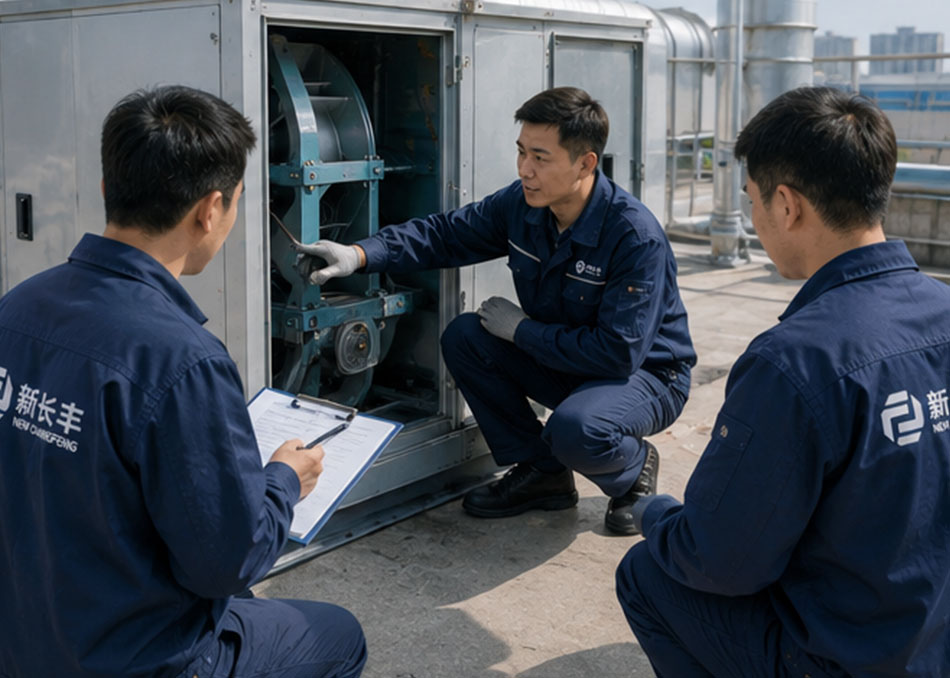
In a commercial kitchen, the exhaust system is often treated as a simple matter of "pulling the smoke out." In practice, it involves airflow matching, duct resistance, grease filtration, noise control, and fire safety. When kitchen fumes spill into the dining area, exhaust feels weak, purifiers alarm repeatedly, or the fan draws complaints from neighbors, the root cause is frequently not the purifier itself but the wrong exhaust fan selection. The DT cabinet centrifugal fan—a box-type centrifugal unit with relatively high pressure output and more controllable noise—has become a common choice in commercial kitchen exhaust and purification systems. This guide explains the technical principles and practical selection points for DT cabinet centrifugal fans in restaurant back-of-house exhaust.
Why DT Cabinet Centrifugal Fans Suit Commercial Kitchen Exhaust
The key difference between kitchen exhaust and general ventilation is system resistance. Kitchen exhaust ducts are usually long, have multiple bends, and must connect in series with grease filters, electrostatic fume purifiers, and silencers. Axial fans move large volumes of air but generate limited pressure; when facing long ducts and purifier resistance, they can stall, leaving insufficient capture at the hood and allowing fumes to escape.
DT cabinet centrifugal fans are centrifugal machines. Air enters the impeller axially and is discharged radially, gaining higher pressure to overcome complex duct networks. The cabinet (box-type) housing typically includes sound-absorbing material on the inner walls, which absorbs and blocks part of the operating noise compared with an exposed centrifugal fan. For restaurants in residential buildings or mixed-use complexes, this noise advantage is critical.
It is worth noting that the DT cabinet centrifugal fan is only one part of the system. Correct selection depends on matching the fan curve to the actual system resistance, not simply choosing the largest available unit.
Key Selection Factors for Kitchen Exhaust Applications
Selecting a DT cabinet centrifugal fan for kitchen exhaust requires attention to airflow, pressure, temperature, and grease resistance. The fan must handle hot, greasy air without premature failure, and it must be sized so the motor operates near its best efficiency point rather than at the extreme ends of its curve.
- Airflow and pressure: Calculate the required exhaust volume from the number and type of cooking appliances, then estimate total system resistance including hood filters, duct runs, elbows, and the fume purifier. Choose a fan whose curve delivers the required airflow at that resistance.
- Temperature rating: Kitchen exhaust can be hot. Confirm the fan and motor are rated for the expected operating temperature, and consider a belt-drive arrangement that isolates the motor from the hot airstream when appropriate.
- Grease and cleaning: Kitchen exhaust carries grease. Select a fan with accessible construction for cleaning and ensure the impeller design resists grease buildup that can cause imbalance and vibration.
- Noise: Check sound pressure levels at the intended operating point. The cabinet structure helps, but duct layout and fan speed also matter. Avoid oversizing that forces the fan to run at an inefficient, noisy point.
- Compliance: In China, fan performance is tested per GB/T 1236, energy efficiency is classified under GB 19761, kitchen fume emission follows GB 18483, and smoke exhaust systems must meet GB 51251. Specify fans with verifiable performance data and appropriate certifications.
Integrating the Fan with Purification and Fire Safety
A kitchen exhaust system is a chain: hood, duct, purifier, fan, and discharge point. The fan must be selected as part of that chain. If the fan is oversized relative to the purifier, it can pull air through too quickly, reducing purification efficiency and causing grease carryover. If undersized, the hood loses capture velocity and fumes escape into the kitchen.
Fire safety is equally important. Grease-laden ducts are a fire risk. The fan should be installed so that it does not become a fire path, and the system should include access for cleaning. In systems designed for smoke exhaust, GB 51251 requirements for smoke control may apply, and the fan must be suitable for that duty. For routine kitchen exhaust, the fan should be positioned to draw air through the purifier rather than pushing air through it, which helps contain grease and simplifies maintenance.
Noise control often involves both the fan cabinet and additional duct silencers. A common mistake is to add a silencer without addressing fan selection; if the fan operates at a poor point on its curve, noise and energy use both rise. Correct selection, proper duct sizing, and vibration isolation are the most effective first steps.
Common Pitfalls and Practical Tips
Many kitchen exhaust problems trace back to selection shortcuts. Choosing a fan by "rule of thumb" airflow alone ignores the pressure needed to overcome the actual system. Installing an axial fan in a long, high-resistance duct is a frequent cause of weak exhaust. Failing to account for the purifier's resistance when it is dirty leads to underperformance over time.
- Measure or estimate total system resistance before selecting the fan.
- Account for filter and purifier loading; a dirty purifier can add significant resistance.
- Provide access doors for duct and fan cleaning.
- Use vibration isolators and flexible connectors to reduce noise transmission.
- Verify motor voltage, phase, and enclosure type match the site conditions.
- Consider belt-drive versus direct-drive based on temperature, maintenance, and speed requirements.
For projects in schools, hotels, and central kitchens, the same principles apply, but duty cycles are often longer. In these cases, energy efficiency and serviceability become even more important. A fan that is easy to clean and operates near its best efficiency point will cost less to run and last longer.
FAQ
Q: Can I use a DT cabinet centrifugal fan with an electrostatic fume purifier?
A: Yes. In fact, centrifugal fans are often preferred in systems with electrostatic purifiers because they can overcome the additional resistance. However, the fan must be selected so that airflow through the purifier stays within its design range. Too much airflow reduces purification efficiency; too little causes fumes to escape. Always match the fan curve to the system resistance with the purifier in place.
Q: How do I control noise from a kitchen exhaust fan?
A: Start with correct selection. A fan operating near its best efficiency point is quieter than one forced to run at an extreme. The DT cabinet design helps by enclosing the impeller and adding sound-absorbing material. Additional measures include vibration isolators, flexible duct connectors, and duct silencers. Avoid oversizing, which often leads to higher noise and energy use.
Q: What maintenance does a DT cabinet centrifugal fan need in a kitchen?
A: Kitchen exhaust is greasy, so regular cleaning is essential. Inspect and clean the impeller and cabinet interior to prevent grease buildup that can cause imbalance and vibration. Check belts (if belt-drive), bearings, and motor condition. Ensure duct access doors are used and the purifier is maintained. A clean fan runs cooler, quieter, and longer.
Q: Is a DT cabinet centrifugal fan suitable for smoke exhaust systems?
A: That depends on the application and local code. In China, smoke exhaust systems must comply with GB 51251, which may require fans rated for high-temperature smoke exhaust. Standard kitchen exhaust fans are not necessarily rated for that duty. For combined kitchen exhaust and smoke exhaust, consult the code and select a fan with the appropriate rating.
Selecting the right DT cabinet centrifugal fan for a commercial kitchen is a matter of matching airflow and pressure to the real system, accounting for grease, heat, and noise, and integrating the fan with purification and fire safety requirements. XCFFJ manufactures DT cabinet centrifugal fans and a full range of ventilation and purification equipment for commercial kitchens, schools, hotels, and industrial facilities. For selection support and product details, visit www.xcffj.com.