
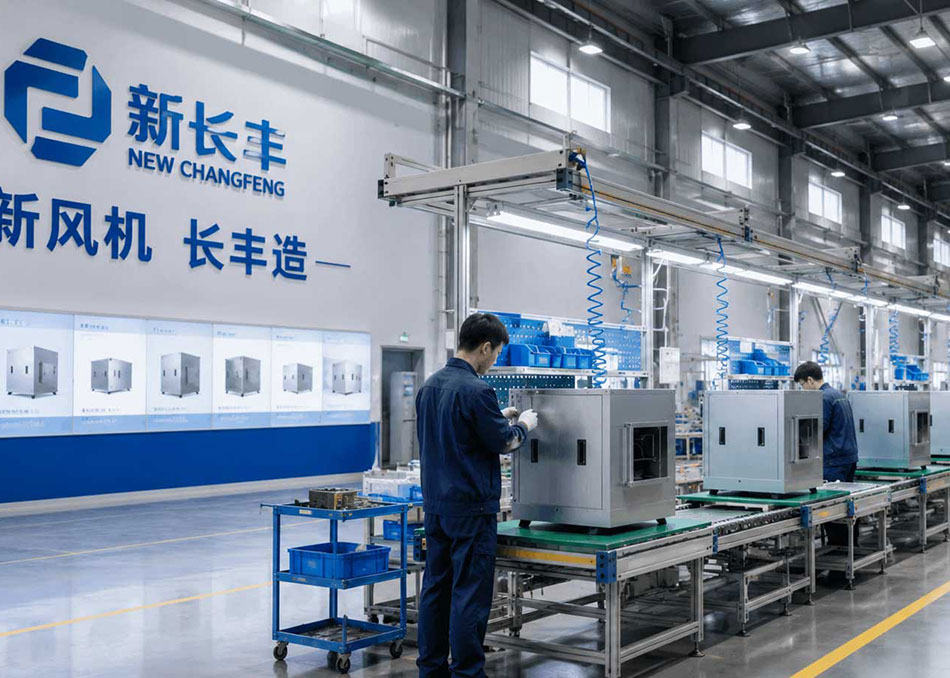
In hot, humid workshops, simply opening the windows rarely solves the problem. Hot air stagnates, dust and odors accumulate, workers feel stifled, and equipment overheats. Negative pressure fans address this by actively creating an organized airflow: they force air out, generating a slight negative pressure inside the workshop, which draws fresh outdoor air in through inlet openings and establishes a continuous cross-ventilation path. Yet many installations underperform—not because of the equipment itself, but because of where it is placed. The wrong location leads to short-circuiting airflow, stagnant dead zones, and noise complaints. This article focuses on factory cooling and ventilation, outlining the logic and practical considerations for choosing the right installation position for negative pressure fans.
Understand the Principle of Negative Pressure Ventilation Before Choosing a Location
A negative pressure fan is fundamentally an exhaust device, not a blower. Mounted on a wall or window opening, it expels indoor air outward. This creates a slight negative pressure inside relative to the outdoors, causing fresh outdoor air to enter naturally through doors, windows, or inlet louvers on the opposite or adjacent side. The effectiveness of this airflow depends on two conditions: first, a continuous path must exist between the exhaust point and the inlet point; second, that path must cover the worker activity areas and heat sources.
From a fluid dynamics perspective, air always takes the path of least resistance. If large open doors or windows are located right next to the exhaust fan, air will short-circuit locally, leaving the deeper parts of the workshop without airflow. Therefore, the first principle of installation is: place the exhaust point and the inlet point at opposite ends or diagonally across the workshop, forcing the air to travel through the work area. This explains why the same fan model mounted on an end wall versus the middle of a side wall can produce markedly different comfort levels.
Key Installation Location Strategies
Choosing the right spot is both an art and a science. The goal is to create a directed airflow that sweeps through the entire workspace, picking up heat, dust, and fumes along the way. Here are the main strategies:
- Opposite-end or diagonal placement: Position exhaust fans on one end wall and ensure inlet openings (doors, windows, louvers) are on the opposite end or diagonally across. This maximizes the travel distance and ensures air passes through the core work area.
- Avoid short-circuiting: Do not install exhaust fans adjacent to large open doors or windows that can serve as direct inlets. If unavoidable, add baffles or redirect the inlet to a distant point.
- Target heat sources and worker zones: Place exhaust fans near hot processes, machinery, or areas where workers are concentrated. The airflow will naturally follow the path from inlet to exhaust, so orienting that path through hot spots improves cooling.
- Consider structural constraints: Wall strength, available openings, and roof height all influence placement. In multi-story buildings, ensure the exhaust does not discharge into occupied spaces or near air intakes of other systems.
- Noise and neighbor considerations: Mount fans away from property lines, offices, or residential areas. Use vibration isolators and consider acoustic enclosures if necessary.
Common Mistakes and How to Avoid Them
Even with good intentions, installers often fall into traps that undermine performance. One frequent mistake is mounting all exhaust fans on the same wall without providing adequate inlet area on the opposite side. This starves the fans of replacement air, reducing airflow and increasing motor load. Another is placing fans too high or too low relative to the occupied zone—hot air stratifies near the roof, but workers need cooling at head height, so a mix of high-level exhaust and low-level inlets can be effective.
Another pitfall is ignoring the building envelope. If the workshop is not reasonably airtight, negative pressure may not develop, and the system will simply pull air from unintended openings. Sealing unnecessary gaps and controlling inlet locations are essential. Finally, noise complaints often arise when fans are placed near sensitive areas without proper attenuation. Pre-planning the location with noise in mind can save costly retrofits.
Integrating with Other Ventilation and Cooling Equipment
Negative pressure fans rarely work alone. In many factories, they are combined with evaporative air coolers, axial fans, or roof turbo ventilators to create a comprehensive climate control strategy. For instance, evaporative coolers can supply cooled fresh air at the inlet side, while negative pressure fans exhaust hot air at the opposite end, enhancing the cooling effect. Similarly, in kitchens or areas with fumes, negative pressure fans can work alongside electrostatic fume purifiers to ensure proper exhaust and air quality.
When integrating, consider the airflow balance: the total exhaust capacity should be slightly less than the supply capacity to maintain a slight negative pressure, but not so much that it causes drafts or starves combustion appliances. Coordination with other systems also affects placement—for example, keep exhaust fans away from fresh air intakes of air handling units to prevent cross-contamination.
Frequently Asked Questions
Q: Can I install a negative pressure fan on the roof instead of a wall?
A: Yes, roof installation is possible and sometimes preferable, especially in multi-story buildings or where wall space is limited. However, ensure the roof structure can support the fan and that exhaust is directed away from air intakes. Roof-mounted fans may also require weatherproofing and access for maintenance.
Q: How many negative pressure fans do I need for my workshop?
A: The number depends on workshop volume, heat load, and desired air exchange rate. A common approach is to calculate the required airflow based on air changes per hour (ACH) and then select fans accordingly. Consult a ventilation engineer to determine the right capacity; over- or under-sizing both lead to inefficiency.
Q: Will negative pressure fans work in a workshop with many open doors?
A: They can, but effectiveness is reduced because open doors create short-circuit paths. To improve performance, minimize unnecessary openings, use air curtains or strip curtains on frequently used doors, and ensure the primary inlet is located far from the exhaust fans.
Proper installation location is the cornerstone of effective negative pressure ventilation. By understanding airflow principles, avoiding common mistakes, and integrating with other equipment, you can achieve a cooler, safer, and more productive workshop environment. For tailored advice on selecting and placing negative pressure fans for your facility, contact XCFFJ—our team can help you design a ventilation solution that meets your specific needs.