
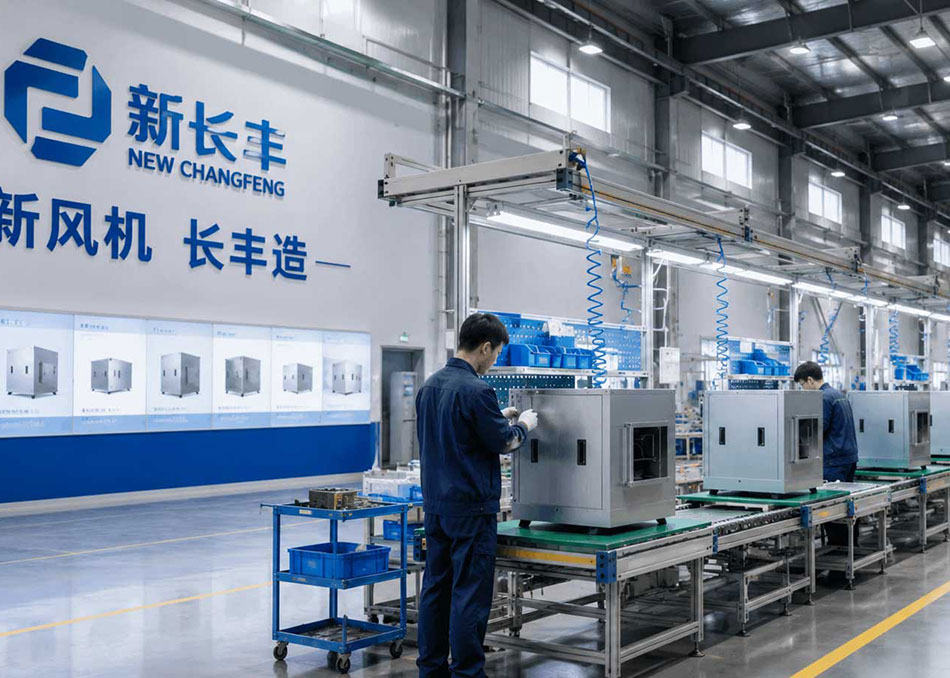
In hot seasons, factory workshops and large kitchen areas face a common challenge: concentrated heat sources, poor air circulation, and a persistent stuffy feeling. Many managers instinctively add more fans, but fans only stir local air—they don't solve the overall ventilation problem. The truly effective approach is to establish an organized intake and exhaust system. Negative pressure fans are the most common—and often most underestimated—component of such systems. By forcing exhaust air out, they create negative pressure indoors, allowing outdoor air to continuously enter through designated inlets, thereby systematically removing heat, moisture, and stale air. This article focuses on the practical application of negative pressure fans in workshop ventilation, while also addressing the common logic behind selecting cooling equipment for large kitchens, helping users avoid common pitfalls.
How Negative Pressure Fans Work and Their Fit for Workshop Ventilation
The core function of a negative pressure fan is exhaust, not supply. Installed on walls or window openings, the fan rapidly expels indoor air when running, creating a slight negative pressure compared to outdoors. Outdoor air then naturally enters through doors, windows, louvers, or dedicated inlets. This process creates a continuous unidirectional airflow pattern, avoiding the inefficient cycle of merely stirring air without exchanging it. For workshops with dispersed heat sources and high ceilings, this overall ventilation approach is more practical than spot cooling.
Technically, negative pressure ventilation combines mechanical exhaust with natural supply. The exhaust air volume must match the workshop's volume, heat source intensity, and personnel density. Insufficient inlet area can significantly weaken performance. Engineering practice typically estimates based on air changes per hour, referencing standards such as GB/T 1236 for fan performance testing to ensure reliable operation.
Key Selection Factors for Workshop and Large Kitchen Applications
Whether cooling a factory floor or a large commercial kitchen, the selection logic for negative pressure fans shares common principles. First, determine the required exhaust volume based on space size and heat load. Second, ensure adequate inlet area—typically 1.2 to 1.5 times the exhaust area—to avoid negative pressure that is too high and reduces efficiency. Third, consider the installation location: fans should be placed opposite or diagonal to inlets to create a cross-flow that covers the entire space.
For large kitchens, additional factors include grease and moisture. Negative pressure fans used in kitchen exhaust should be compatible with grease filters or positioned downstream of purification equipment to prevent grease buildup on fan blades. In workshops, noise control and energy efficiency are also important; selecting fans that meet GB 19761 energy efficiency standards helps reduce operating costs.
Practical Benefits: Heat Removal, Humidity Control, and Air Quality
Implementing a well-designed negative pressure ventilation system delivers multiple benefits. It effectively removes heat generated by machinery or cooking processes, lowering indoor temperatures and improving worker comfort. It also expels moisture and odors, preventing condensation and mold growth. In kitchens, combined with fume purification equipment, it helps meet emission standards such as GB 18483.
Moreover, negative pressure ventilation can be integrated with evaporative cooling or fresh air units to further improve air quality. For instance, drawing cooled air through evaporative coolers into the workshop while exhausting hot air can enhance cooling effects. This integrated approach is particularly valuable in hot, dry climates.
Common Pitfalls and Best Practices
Many installations underperform due to avoidable mistakes. One common error is insufficient inlet area, which starves the fan and reduces airflow. Another is placing fans too close to heat sources, causing short-circuiting of hot air. Also, neglecting regular maintenance—such as cleaning blades and checking belts—can lead to decreased performance and increased energy consumption.
Best practices include conducting a heat load assessment, designing a balanced airflow path, and using variable frequency drives where appropriate to adjust fan speed based on demand. Collaborating with experienced ventilation engineers ensures that the system meets specific site conditions and complies with relevant standards.
FAQ
Q: Can negative pressure fans be used in large kitchens with heavy grease?
A: Yes, but they should be installed downstream of grease filters or purification equipment to minimize grease accumulation on fan components. Regular cleaning is essential to maintain performance and safety.
Q: How do I determine the right number of negative pressure fans for my workshop?
A: Calculate the required air changes per hour based on workshop volume and heat load, then select fans with appropriate exhaust capacity. It's advisable to consult a ventilation professional to ensure proper sizing and placement.
Q: Are negative pressure fans energy-efficient?
A: When correctly sized and installed, they can be energy-efficient. Choose models that meet GB 19761 energy efficiency standards and consider variable frequency drives to match output to actual demand.
In summary, negative pressure fans offer a practical and effective solution for workshop ventilation and cooling, as well as for large kitchen exhaust. By understanding the principles, selecting the right equipment, and avoiding common mistakes, businesses can create a more comfortable and productive environment. For tailored advice on selecting negative pressure fans or integrated ventilation systems, contact XCFFJ—our team is ready to help you design a solution that meets your specific needs.