
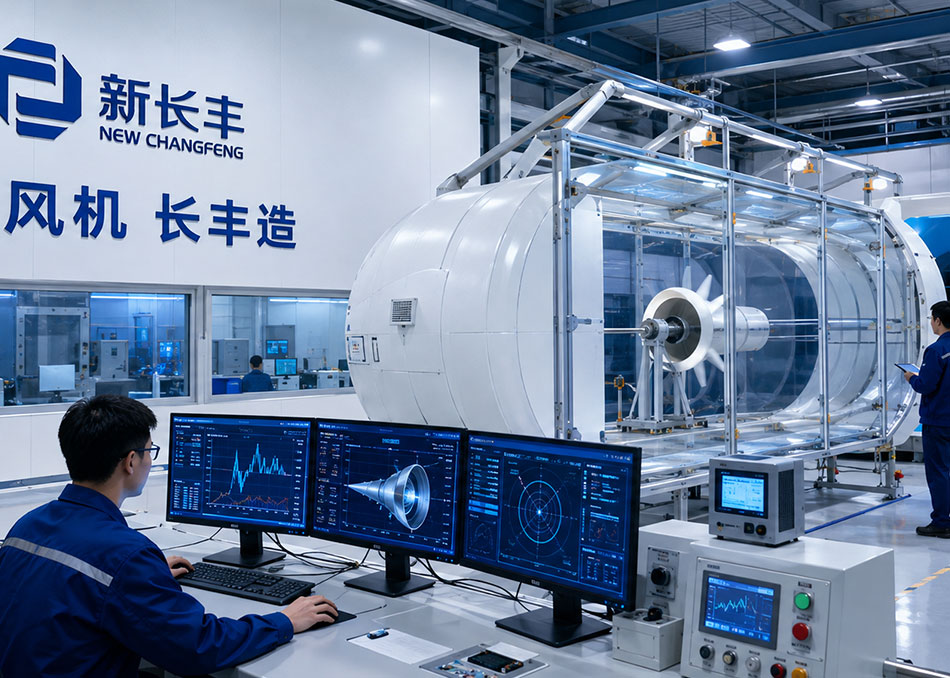
Workshop stuffiness, poor air circulation, and lingering odors and dust are among the most common—and most overlooked—problems in manufacturing facility management. When natural ventilation can't meet air exchange requirements, negative pressure fans have become a go-to solution for factory cooling and ventilation projects, thanks to their simple structure, flexible installation, and economical operation. However, with many similar products on the market, improper selection or a poor match with the manufacturer often undermines ventilation performance. This article explains the technical principles, selection criteria, and manufacturer evaluation dimensions to help workshop managers and procurement staff make informed decisions.
Why Negative Pressure Fans Suit Workshop Ventilation
The working principle of a negative pressure fan is straightforward: installed on an exterior wall or window, it forces indoor air out, creating a slight negative pressure inside. Fresh outdoor air then continuously enters through opposite doors, windows, or dedicated inlets, forming a directed airflow pattern. This "exhaust–supply" ventilation method is particularly suitable for large, multi-span industrial buildings, achieving overall air exchange without relying on complex duct systems.
Compared with simply using axial fans to blow air, negative pressure ventilation offers the advantage of controllable airflow paths. By strategically placing inlets, fresh air can be directed to cover work areas, gradually pushing heat, moisture, welding fumes, and odors toward the exhaust side. For high-temperature workshops, combining negative pressure fans with evaporative cooling pads or environmental air coolers can create an evaporative cooling effect, improving perceived temperature at workstations.
- Compact structure allows direct installation on walls, window frames, or roofs—ideal for retrofitting existing buildings.
- Low energy consumption and investment per unit of airflow.
- Simple maintenance with minimal downtime.
Key Selection Considerations for Workshop Air Exchange
Choosing the right negative pressure fan requires balancing airflow requirements, workshop layout, and operating conditions. Start by calculating the required air exchange rate based on workshop volume and heat load. For general manufacturing spaces, common air changes per hour range from 6 to 12, but higher rates may be needed for heat-intensive or dusty processes. Refer to standards such as GB/T 1236 for fan performance testing and GB 19761 for fan energy efficiency to ensure the selected model meets both performance and efficiency criteria.
Installation location and airflow organization are equally important. The fan should be positioned opposite the primary fresh air inlets to maximize cross-ventilation. In multi-span workshops, multiple fans may be needed to create a uniform negative pressure field. Noise levels should also be considered, especially in residential or mixed-use areas; selecting fans with lower sound power levels and installing vibration isolation can help.
- Calculate air volume based on workshop dimensions and required air changes.
- Verify fan performance curves and energy efficiency against GB/T 1236 and GB 19761.
- Plan inlet positions to ensure fresh air reaches work zones.
- Consider noise and vibration control for sensitive environments.
Evaluating Negative Pressure Fan Manufacturers
Not all manufacturers are equal. A reliable supplier should offer not only quality products but also technical support, customization, and after-sales service. Look for manufacturers with in-house testing capabilities and compliance with relevant standards. Experience in similar projects—such as factory ventilation, warehouse cooling, or kitchen exhaust—indicates practical know-how. Request performance data and case studies to verify claims.
Product quality hinges on components: fan blades, motors, and housings should be robust and corrosion-resistant. For harsh environments, consider models with protective coatings or stainless steel construction. Also, check for certifications and test reports. A manufacturer that provides transparent documentation and is willing to discuss technical details is more likely to deliver reliable performance.
- Check for in-house testing and compliance with GB/T 1236 and GB 19761.
- Review experience in similar industrial ventilation projects.
- Assess component quality—blades, motors, and housing materials.
- Request performance data and customer references.
Integrating Negative Pressure Fans with Other Ventilation Solutions
While negative pressure fans are effective on their own, they can be combined with other equipment for enhanced results. For hot workshops, pairing with evaporative air coolers or water-cooled fresh air units can provide both ventilation and cooling. In kitchens or areas with grease and smoke, negative pressure fans should be used in conjunction with kitchen exhaust purifiers to ensure compliance with GB 18483 emission standards. For large warehouses, roof turbo ventilators or axial fans can supplement air exchange.
System design should consider the interplay between supply and exhaust. Overly powerful exhaust without adequate makeup air can cause negative pressure that strains doors or starves other exhaust systems. Balance is key. A professional ventilation design—or manufacturer's technical team—can help optimize the layout.
- Combine with evaporative cooling for hot environments.
- Use with fume purification in kitchen or process exhaust.
- Ensure balanced makeup air to avoid excessive negative pressure.
Frequently Asked Questions
Q: How do I determine the right number of negative pressure fans for my workshop?
A: Calculate the total air volume required based on workshop volume and desired air changes per hour. Then divide by the airflow capacity of a single fan at the expected static pressure. It's advisable to consult a ventilation engineer or the manufacturer's technical team to account for layout and obstructions.
Q: Can negative pressure fans be used in workshops with explosive dust or gases?
A: Standard negative pressure fans are not suitable for hazardous environments. For explosive atmospheres, explosion-proof motors and fans certified for such conditions are required. Always consult with the manufacturer and adhere to local safety regulations.
Q: What maintenance do negative pressure fans require?
A: Regular cleaning of blades and housing to prevent dust buildup, checking belt tension (for belt-driven models), lubricating bearings as recommended, and inspecting electrical connections. A maintenance schedule every 3–6 months is typical, depending on operating hours and environment.
Selecting the right negative pressure fan and manufacturer is crucial for effective workshop ventilation. By understanding the technology, calculating your needs, and evaluating suppliers carefully, you can create a comfortable and productive work environment. For tailored advice and high-quality ventilation equipment, contact XCFFJ—our team can help you design a solution that meets your specific requirements.