
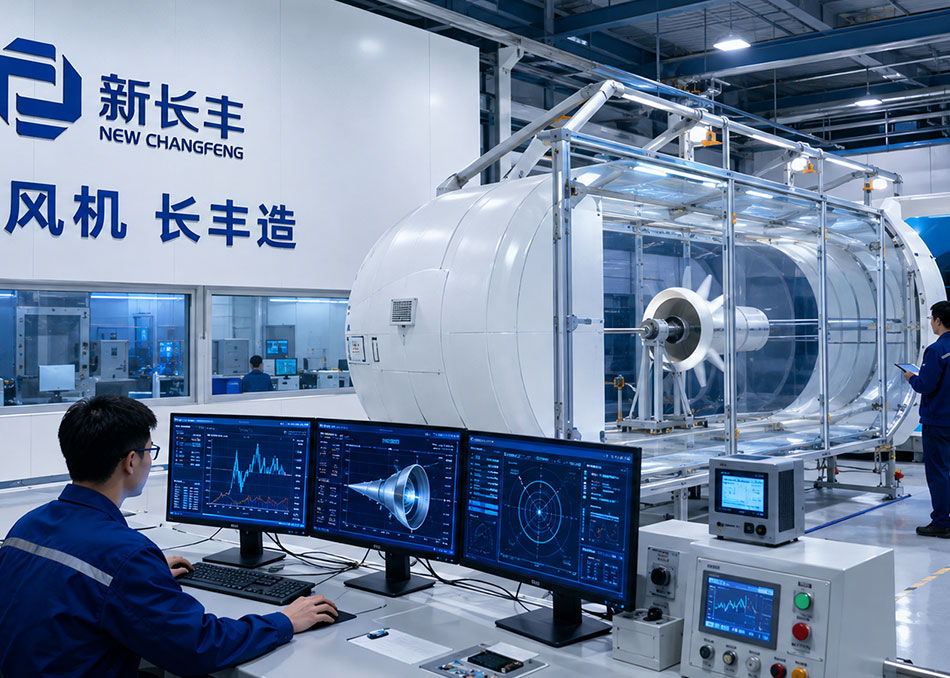
During the hot summer months, temperatures inside many factory workshops can easily climb several degrees above outdoor levels. Heat generated by machinery, the thermal load from dense staffing, and poor air circulation create a stuffy, oppressive environment that directly undermines productivity and worker health. Traditional fans merely stir the air locally — they cannot achieve true whole-space ventilation. Negative pressure fans, by contrast, force air out of the building, creating a negative pressure zone that draws fresh outdoor air in through doors, windows, and dedicated inlets. This article explores the practical installation points for using negative pressure fans in workshop ventilation and cooling scenarios.
How Negative Pressure Fans Work and Their Key Advantages
Negative pressure fans are a classic application of axial-flow ventilation equipment. Their core principle is simple: a large-volume, low-pressure impeller rotates to rapidly expel hot air, dust, odors, and fumes from the workshop to the outside. This exhaust action lowers the indoor air pressure below outdoor pressure, and the resulting pressure differential forces fresh outdoor air to flow in naturally through doorways, windows, or wall openings. This continuous “exhaust-supply” cycle is what distinguishes negative pressure ventilation from ordinary fans or supply-only blowers.
For factory cooling, negative pressure fans are especially well-suited to large-span, high-heat, densely occupied open workshops — for example, injection molding shops, welding bays, packaging lines, and warehouse logistics sorting areas. Compared to air conditioning systems, negative pressure fans offer significantly lower initial investment and operating costs. And unlike roof-mounted exhaust fans, they allow better control of airflow direction, ensuring that fresh air reaches personnel first before being drawn across the workspace and out through the exhaust side.
Key Installation Considerations for Workshop Ventilation
Proper installation is critical to achieving the desired ventilation effect. Here are the essential factors to consider:
- Placement of exhaust fans: Install negative pressure fans on the leeward wall (typically the side opposite the prevailing wind) and as high as possible, since hot air rises. This maximizes the removal of heat and contaminants.
- Fresh air inlets: Ensure adequate, unobstructed openings (doors, windows, louvers) on the opposite wall to allow fresh air to enter. The total inlet area should be at least equal to the fan discharge area to avoid “starvation” and reduced fan performance.
- Spacing and layout: For large workshops, space fans evenly along the wall, typically 5–8 meters apart (adjust based on fan size and building structure), to create uniform airflow without dead zones.
- Structural support: Use sturdy mounting brackets or concrete foundations to secure the fans, and seal gaps around the fan frame to prevent air leakage and vibration noise.
- Ducting and dampers: In most cases, negative pressure fans are installed directly on the wall without ducting. If ducting is required, keep it short and straight to minimize pressure loss. Consider installing backdraft dampers to prevent cold air infiltration when fans are off.
- Electrical safety: Ensure proper grounding, use weatherproof wiring, and install a dedicated circuit with overload protection. For dusty or humid environments, choose motors with appropriate IP ratings.
Optimizing Airflow for Effective Cooling
To achieve effective workshop cooling, the ventilation system must be designed as a complete airflow path. The goal is to create a “push-pull” effect: fresh air enters on one side, sweeps across the work area, and is exhausted on the opposite side. This requires careful coordination between fan capacity, inlet placement, and internal obstructions.
In practice, it is often beneficial to combine negative pressure fans with additional air movement devices, such as ceiling fans or portable blowers, to enhance air velocity at the worker level. Evaporative cooling pads or misting systems can also be integrated at the fresh air inlet to lower the incoming air temperature, providing a more comfortable working environment even in extreme heat. Regular maintenance — cleaning fan blades, checking belt tension, and lubricating bearings — is essential to sustain performance over time.
Common Mistakes to Avoid
Even well-chosen negative pressure fans can underperform if installation is flawed. Here are frequent pitfalls:
- Placing fans on the windward wall, which fights the natural wind and reduces exhaust efficiency.
- Insufficient fresh air openings, causing the fans to work against a vacuum and dramatically reducing airflow.
- Installing fans too low, missing the hot air layer that accumulates near the ceiling.
- Blocking fan discharge with exterior obstacles (e.g., signs, storage) or interior equipment that obstructs airflow.
- Neglecting to seal gaps around the fan frame, leading to air leakage and reduced negative pressure.
Conclusion
Negative pressure fans are a proven, cost-effective solution for workshop ventilation and cooling in industrial and commercial settings. By understanding their operating principle and following best practices for installation — correct placement, adequate fresh air inlets, and regular maintenance — you can create a comfortable, productive work environment even during the hottest months. For tailored advice and high-quality negative pressure fans, consult with XCFFJ, a trusted manufacturer of industrial ventilation and cooling equipment.
FAQ
Q: How many negative pressure fans do I need for my workshop?
A: The number depends on the workshop volume, heat load, and desired air changes per hour. As a rule of thumb, calculate the total required airflow (e.g., 20–30 air changes per hour for high-heat areas) and divide by the fan’s rated airflow. Always account for inlet area and duct losses. A professional ventilation survey can provide precise recommendations.
Q: Can negative pressure fans be used in dusty or humid environments?
A: Yes, but choose fans with appropriate protection (e.g., IP55 or higher) and corrosion-resistant coatings. Regular cleaning of blades and housing is necessary to prevent buildup that can affect balance and performance.
Q: What is the ideal mounting height for a negative pressure fan?
A: Mount the fan as high as possible on the wall, typically near the ceiling, because hot air accumulates at the top. This also helps create a better airflow pattern across the entire space. Ensure the fan is accessible for maintenance.