
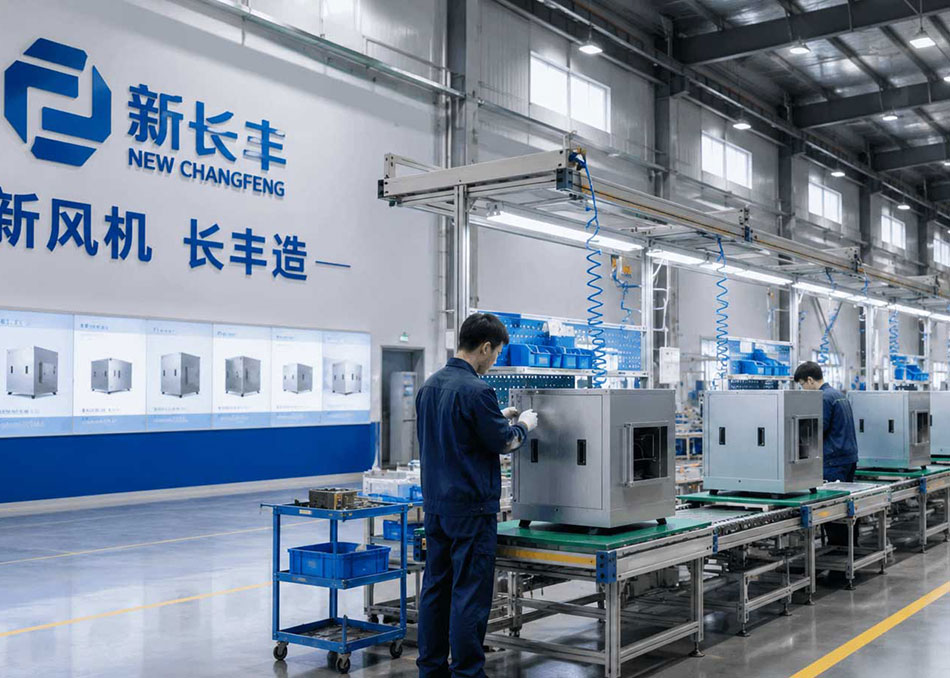
When a commercial kitchen exhaust system starts up, a familiar set of problems often follows: the exhaust hood seems to pull reasonably well, but the kitchen door becomes difficult to open, odors from the corridor drift back into the dining area, air-conditioned cool air is sucked out of the space, and the chef working closest to the range is still sweating. In most cases, the root cause is not the exhaust fan itself, but a lack of make-up air that pushes the kitchen into negative pressure. This article focuses on centrifugal fan selection and explains how a water-cooled fresh air unit can restore the balance between exhaust and make-up air while also improving kitchen cooling.
How Negative Pressure Forms in a Commercial Kitchen
During operation, the exhaust hood, ductwork, and exhaust fan form a suction path that removes cooking fumes, heat, and moisture from the kitchen. Under China's Emission Standard of Cooking Fume (GB 18483), food service establishments are required to install appropriate fume purification equipment and meet emission limits, which often leads to exhaust volumes being designed with a generous margin. However, every cubic meter of air that is exhausted must be replaced. If make-up air through doors and windows is insufficient, the kitchen space becomes negatively pressurized.
The consequences of negative pressure are easy to observe. First, the capture efficiency of the exhaust hood drops, and cooking fumes tend to spill from the edges of the hood into the kitchen and even the dining area. Second, fresh air cannot enter effectively, so the temperature near the cooking range remains high and the working environment feels stifling. Third, unfiltered and uncooled outdoor air is drawn in through door gaps, floor drains, and duct seams, bringing odors and pest risks. For restaurants that rely on central air conditioning, negative pressure also causes cooled air to be continuously pulled out of the space.
Why Make-Up Air Is Not Optional
Make-up air is the intentional supply of outdoor air into the kitchen to replace the air removed by the exhaust system. Without it, the exhaust system operates against a rising pressure difference and its effective exhaust capacity declines. In practice, a kitchen may appear to have a powerful exhaust fan, yet the actual air change rate in the breathing zone is far lower than expected because the fan is working against a vacuum.
A properly designed make-up air strategy should deliver filtered, tempered air directly to the cooking area. This reduces the negative pressure, improves hood capture, and lowers the temperature around the range. It also protects the building's HVAC balance by preventing conditioned air from being drawn out through the exhaust path. In many projects, the missing piece is not a larger exhaust fan but a dedicated fresh air unit that can supply air at the right location and condition.
Centrifugal Fan Selection Points for Kitchen Make-Up Air
Centrifugal fans are widely used in commercial kitchen make-up air systems because they can overcome higher system resistance from filters, cooling coils, and ductwork. When selecting a centrifugal fan for a water-cooled fresh air unit, engineers should consider several practical points.
- Air volume and pressure balance: The make-up air volume should be coordinated with the exhaust volume, typically aiming for a slight negative pressure rather than a strong vacuum. The fan's static pressure must account for filters, cooling coils, duct runs, and discharge diffusers.
- Energy efficiency: Fans should comply with the Minimum Allowable Values of Energy Efficiency and Energy Efficiency Grades for Fans (GB 19761) to avoid oversized motors and unnecessary power consumption.
- Performance testing: Fan performance should be verified according to Industrial Fans — Performance Testing (GB/T 1236) so that the selected operating point matches the actual system curve.
- Noise control: Centrifugal fans with forward-curved or backward-curved impellers can be selected based on the required pressure and acceptable sound level. In kitchens near dining areas, lower-noise options and proper vibration isolation are important.
- Corrosion and grease resistance: Kitchen make-up air may contain grease and moisture, so fan construction and motor protection should be suitable for the environment.
- Smoke exhaust considerations: Where the system interfaces with smoke control provisions, reference should be made to Technical Standard for Smoke Management Systems in Buildings (GB 51251).
These selection points are not independent. A fan chosen only for high air volume may fail to deliver the required pressure once filters and coils are added. Conversely, an oversized fan may create excessive noise and energy use. The goal is to match the fan to the actual resistance of the make-up air path while maintaining stable operation.
How a Water-Cooled Fresh Air Unit Solves Negative Pressure and Heat
A water-cooled fresh air unit combines filtration, cooling, and air supply in one package. It draws in outdoor air, filters it, passes it through a water-cooled coil to reduce temperature, and then supplies it to the kitchen. Because the cooling medium is water rather than direct refrigerant, the unit can be integrated with existing chilled water systems or cooling towers, making it suitable for projects where a central chiller is available.
In a negative-pressure kitchen, the water-cooled fresh air unit serves two functions at once. It provides the make-up air that the exhaust system needs, and it delivers that air at a lower temperature, which directly improves comfort near the cooking range. By supplying air close to the hood or the cooking zone, it can also help direct fumes toward the exhaust hood rather than letting them spill into the room. This dual function is why the unit is often described as a make-up air and cooling solution rather than simply a fan.
When integrated with centrifugal fan technology, the unit can overcome the resistance of filters and cooling coils while maintaining a stable air volume. The fan selection should be based on the unit's actual operating point, not on a nominal free-air rating. This is where the centrifugal fan selection points discussed above become critical to real-world performance.
Design and Installation Best Practices
Even a well-selected water-cooled fresh air unit can underperform if it is not integrated correctly with the kitchen exhaust system. The following practices help ensure that make-up air actually reaches the right place.
- Supply air near the source: Discharge make-up air near the cooking range or exhaust hood, not at the far end of the kitchen, so it can replace exhausted air where it is needed most.
- Avoid short-circuiting: Position supply diffusers so that fresh air does not immediately flow into the exhaust hood without passing through the breathing zone.
- Balance exhaust and supply: Commission the system so that the kitchen remains at a slight negative pressure relative to adjacent spaces, preventing odor migration while avoiding excessive vacuum.
- Filter and maintain: Use appropriate filtration to protect the cooling coil and fan, and establish a maintenance schedule for filters, coils, and drain pans.
- Control humidity: Water-cooled coils can condense moisture, so proper drainage and humidity control are essential to prevent microbial growth and water damage.
- Consider fire safety: Ductwork and equipment should comply with relevant fire codes, and access panels should be provided for cleaning and inspection.
Commissioning is not a one-time event. Kitchen exhaust and make-up air systems should be re-balanced after any change in cooking equipment, hood configuration, or ductwork. Regular filter changes and coil cleaning help maintain the original design air volume and cooling capacity.
FAQ
Q: Can I solve kitchen negative pressure by simply opening a window or adding a wall fan?
A: Opening a window or adding a wall fan can provide some make-up air, but it is uncontrolled. It may introduce hot, humid, or polluted outdoor air, create drafts, and fail to match the exhaust volume. A dedicated water-cooled fresh air unit provides filtered, cooled, and properly distributed make-up air, which is more effective for both negative pressure control and kitchen comfort.
Q: Why does the exhaust hood still lose capture efficiency even when the exhaust fan is running?
A: In a negatively pressurized kitchen, the exhaust fan must work against a pressure difference. This reduces the actual air volume passing through the hood and causes fumes to spill from the hood edges. Adding properly designed make-up air reduces the pressure difference and allows the exhaust hood to capture fumes as intended.
Q: What should I check when selecting a centrifugal fan for a water-cooled fresh air unit?
A: Check the required air volume and static pressure at the actual operating point, including filters, cooling coil, ductwork, and diffusers. Verify energy efficiency according to GB 19761 and performance testing according to GB/T 1236. Also consider noise, corrosion resistance, and maintenance access. The fan should be matched to the system, not selected solely on a free-air rating.
Q: Does a water-cooled fresh air unit require a central chiller?
A: It requires a source of chilled water, which may come from a central chiller, a cooling tower, or another water-cooling system. The specific configuration depends on the project. In some cases, the unit can be integrated with an existing chilled water loop; in others, a dedicated water circuit may be needed.
Q: How do I know if my kitchen has a negative pressure problem?
A: Common signs include doors that are hard to open, odors entering from adjacent spaces, conditioned air being pulled out of the dining area, and persistent heat near the cooking range even when the exhaust is running. A simple pressure test or smoke test can confirm the condition, and a qualified ventilation contractor can recommend the appropriate make-up air solution.
Balancing kitchen exhaust with make-up air is essential for safety, comfort, and code compliance. A water-cooled fresh air unit, paired with a properly selected centrifugal fan, can address negative pressure while also cooling the cooking area. If your commercial kitchen struggles with door resistance, odor backdraft, or heat stress, reviewing your make-up air strategy is a practical first step. XCFFJ manufactures a range of centrifugal fans and water-cooled fresh air units for commercial kitchen ventilation and cooling; contact us to discuss your project requirements.