
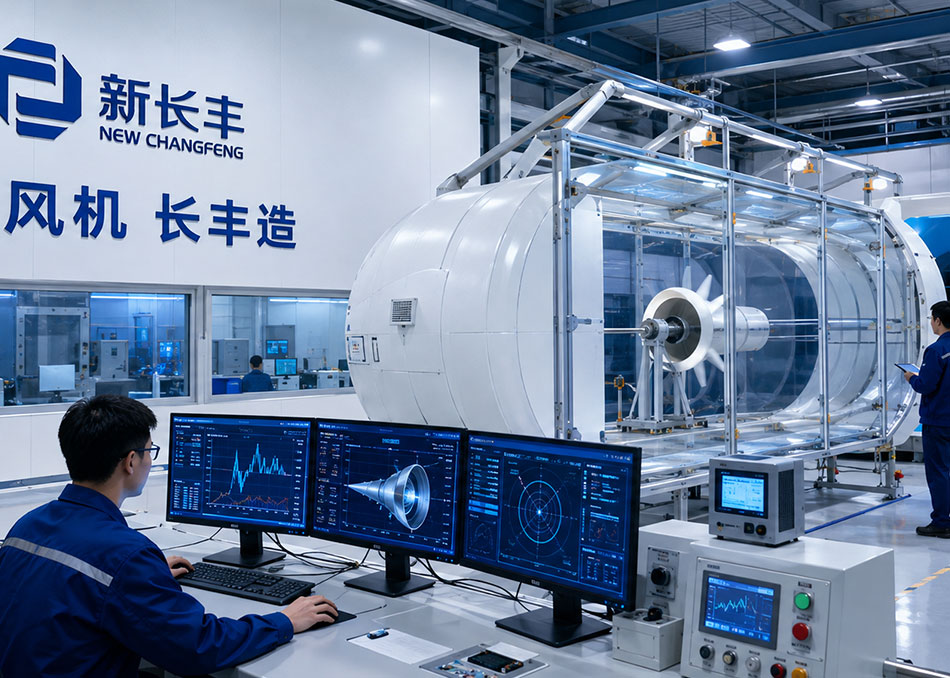
Summer heat in industrial plants rarely comes from a single source. Machine heat, dense occupancy, and solar gain through the roof stack up through the day, while dust, odors, and oil mist in some workshops make the air harder to work in. Natural ventilation alone often cannot establish a reliable air exchange path, so heat accumulates in stagnant zones, visibility drops, and worker comfort suffers. Negative pressure fans—wall- or window-mounted exhaust fans that combine mechanical extraction with directed makeup air—have become one of the most widely applied solutions for plant ventilation and cooling. This guide covers how they work, where they fit, how to select them, and what installation and maintenance require.
How Negative Pressure Fans Work and Why They Cool
The core of a negative pressure system is a high-airflow exhaust fan installed in a wall opening or window bay. When it runs, hot and contaminated indoor air is forced outdoors, placing the workshop under a slight negative pressure relative to outside. Outdoor air then flows in naturally through openings on the opposite side—doors, windows, louvers, or evaporative cooling pads—creating a continuous intake–passage–exhaust airflow pattern. Unlike ceiling or pedestal fans that merely stir indoor air, this approach exchanges indoor air with outdoor air and directly reduces accumulated heat load.
Cooling happens on two levels. First, ventilation cooling: continuous heat removal pulls indoor temperature toward the outdoor level. Second, when an evaporative medium such as a cooling pad is used at the intake, water evaporation absorbs heat and lowers the incoming air temperature below the outdoor dry-bulb temperature. The actual result depends heavily on airflow path design—if intake location, intake area, and fan layout do not match, short-circuiting or dead zones will undermine performance regardless of fan capacity.
- Mechanical exhaust: fans actively remove heat and contaminants instead of relying on buoyancy alone.
- Directed makeup air: intake openings on the opposite side establish a defined flow path across the workspace.
- Optional evaporative cooling: cooling pads at the intake reduce supply air temperature in dry climates.
- Air exchange, not air stirring: the system replaces indoor air rather than recirculating it.
Where Negative Pressure Ventilation Fits in Industrial Plants
Negative pressure fans suit large, open production halls where heat and contaminants are generated across a wide area: machining and stamping shops, injection molding and die-casting plants, packaging and assembly lines, warehousing and logistics facilities, and workshops with welding fume, oil mist, or dust. They are also a practical choice where ductwork is impractical due to building structure or cost, since the building envelope itself becomes the air distribution system.
The approach has limits. Spaces with strict positive-pressure requirements, cleanrooms, and areas handling hazardous or explosive atmospheres need engineered solutions that account for pressure balance, filtration, and safety classification. In humid climates, evaporative cooling delivers less temperature drop, so the design should emphasize air exchange rate and heat removal rather than relying on pad cooling alone. For plants with heavy fume or grease loading, exhaust air may require treatment before discharge to meet local emission requirements—relevant standards include GB 18483 for kitchen fume emission and GB 51251 for smoke and heat exhaust ventilation, alongside applicable local codes.
Selection Points for Plant Ventilation and Cooling
Selection starts with a heat balance, not a catalog page. Estimate the internal heat load from equipment, lighting, and occupants, add solar gain through the roof and walls, and set a target indoor temperature relative to local climate data. From there, determine the required air exchange rate and total exhaust airflow. Fan performance should be verified against GB/T 1236 test methods, and energy efficiency compared using GB 19761, so that quoted figures reflect standardized conditions rather than optimistic nameplate values.
Layout matters as much as capacity. Distribute exhaust fans along the leeward wall or roof, and provide intake area on the windward side or at the opposite end of the building. Intake area should be generously sized—an undersized intake throttles airflow and raises static pressure, reducing actual exhaust volume. Consider noise limits near property lines and worker areas, and plan for variable-speed control so fans can run at reduced output during mild weather. Where evaporative pads are used, ensure water quality and pad maintenance are manageable.
- Calculate heat load and required air changes before choosing fan count and size.
- Match intake opening area to exhaust airflow to avoid throttling losses.
- Verify performance data per GB/T 1236 and efficiency per GB 19761.
- Plan fan placement to sweep the occupied zone rather than short-circuit to the intake.
- Include controls, noise treatment, and maintenance access in the design.
Installation, Operation, and Maintenance
Installation quality determines whether the design performs. Fans should be mounted securely with vibration isolation, sealed at the wall penetration to prevent air bypass, and fitted with weather hoods or shutters where appropriate. Belt-driven and direct-drive units both require correct alignment and tensioning; electrical connections should follow local codes and include proper protection. Commissioning should include airflow verification—measuring actual exhaust volume against design—and adjustment of intake openings to balance the building pressure.
In operation, a simple schedule that starts fans before the heat of the day and runs them through peak hours is more effective than reactive switching. Maintenance is straightforward but should be routine: clean fan blades and shutters, check belts and bearings, verify motor current, inspect cooling pads for scale or algae, and confirm that intake openings remain unobstructed as storage or equipment layouts change over time. Documenting these checks supports reliable performance and safe operation.
Frequently Asked Questions
Q: Can negative pressure fans replace air conditioning in a factory?
A: In many large industrial halls, negative pressure ventilation with optional evaporative cooling provides substantial relief at far lower energy cost than full air conditioning. Where precise temperature and humidity control is required—such as certain electronics or pharmaceutical processes—it should be treated as a supplement to an engineered HVAC system, not a replacement.
Q: Why does my negative pressure fan run but the workshop still feels hot?
A: The most common causes are insufficient intake area, poorly positioned intake openings, or airflow short-circuiting between intake and exhaust. Heat removal depends on a complete flow path; if makeup air cannot enter freely on the opposite side, exhaust volume drops and stagnant zones remain. Review intake sizing and fan layout before adding more fans.
Q: How do I estimate how many fans a workshop needs?
A: Start with a heat-load calculation based on equipment, occupancy, lighting, and solar gain, then determine the air exchange rate needed to hold the target indoor temperature. Convert that to total exhaust airflow and divide by the verified airflow of the selected fan model. Because building geometry and climate vary, a site-specific calculation by an HVAC engineer is recommended.
Q: Are negative pressure fans suitable for dusty or oily workshops?
A: They are commonly used in such environments, but the exhaust air may need treatment—filters, mist eliminators, or purifiers—before discharge to meet emission requirements. Fan selection should also account for dust buildup on blades and motors, with a maintenance schedule that keeps performance stable.
Negative pressure fans remain a practical, energy-efficient backbone for industrial plant ventilation and cooling when they are designed around a real heat load and a complete airflow path. If you are planning a workshop cooling upgrade, XCFFJ can help match negative pressure fans, cooling pads, and controls to your building layout and process needs—contact our team to discuss your project.