
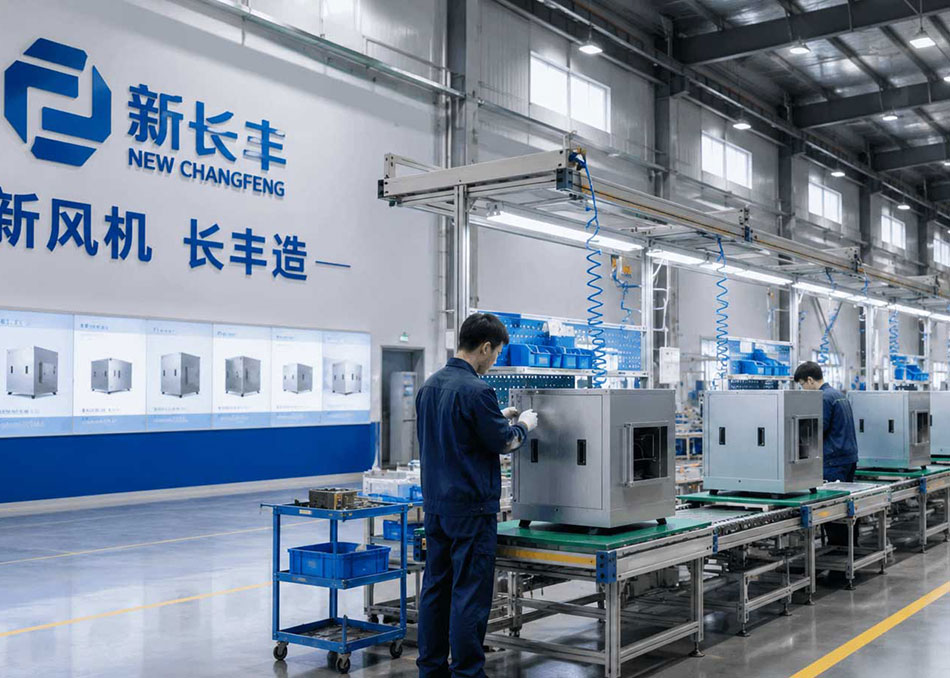
Mahjong parlors are a unique ventilation challenge: high occupant density, long dwell times, and a near-universal habit of keeping doors and windows shut while the air conditioner runs on internal recirculation. Four players plus onlookers crowd each table, cigarette smoke mixes with body heat and perspiration, and the result is a stale, stuffy, eye-stinging room. Operators often discover that air conditioning alone cannot fix it — guests get drowsy, complain of headaches, and leave early. The root cause is not cooling capacity but air exchange. A water-cooled fresh air unit addresses both sides of the problem at once: it supplies filtered outdoor air to balance exhaust, and it cools that incoming air without overloading the existing AC system.
Why Exhaust-Only Ventilation Fails in Mahjong Parlors
When a parlor decides to improve air quality, the first instinct is usually to install an exhaust fan and pull the dirty air out. The direction is correct, but exhaust without makeup air creates a new set of problems. When the exhaust volume exceeds the natural infiltration available, the room goes into negative pressure. Doors become hard to open, door gaps whistle, bathroom odors back-draft into the playing area, and — in mixed-use buildings — grease fumes from neighboring restaurants or garage exhaust can be drawn in through every crack.
From a ventilation engineering standpoint, any effective system must satisfy the principle of balanced supply and exhaust. Exhaust removes contaminated air; makeup air replaces it in a controlled way. Only when the two are coordinated does an orderly airflow pattern form. In a mahjong parlor, the pollution sources sit right at the breathing zone of seated players. If the supply air is delivered in the wrong location or direction, fresh air short-circuits straight to the exhaust before it ever reaches the occupants, and the effective ventilation rate collapses.
Temperature is the second constraint. In summer, blowing hot outdoor air directly into a cooled parlor is unacceptable — guests will feel uncomfortable and the AC will run continuously without catching up. This is exactly where a water-cooled fresh air unit earns its place: it provides the makeup air volume the room needs while tempering that air, so the ventilation upgrade does not turn into a comfort penalty.
How a Water-Cooled Fresh Air Unit Works
A water-cooled fresh air unit is essentially a dedicated outdoor air handling unit that uses water as the cooling medium. Outdoor air is drawn in through a filter stage that captures dust and coarse particulates, then passes across a cooling coil through which chilled water circulates. The coil absorbs sensible and latent heat from the air stream, lowering both temperature and moisture content before the air is delivered to the occupied space. Because the unit handles only the outdoor air load, it does not interfere with the recirculating indoor air conditioner — the two systems work in parallel.
The water side of the system can be served by a chiller, a cooling tower loop, or another available chilled-water source. This makes the unit adaptable to buildings that already have a central plant, and it avoids the electrical demand of a large direct-expansion compressor inside the parlor. For operators, the practical advantages are straightforward:
- Balanced ventilation: Supplies a controlled volume of outdoor air to match exhaust, eliminating negative-pressure symptoms such as door resistance and odor back-draft.
- Tempered supply air: Cools and dehumidifies incoming air so guests do not feel a hot draft in summer.
- Filtration: Reduces dust and airborne particles entering the playing area, which matters in a room with heavy cigarette smoke.
- Separation from indoor recirculation: The parlor's existing AC continues to handle the internal heat load, while the fresh air unit handles the ventilation load.
- Quiet, continuous operation: Designed for long running hours, which suits a venue that operates late into the night.
Designing the Airflow Pattern for a Mahjong Room
Equipment selection is only half the job. The placement of supply diffusers and exhaust grilles determines whether the system actually works. A common and effective approach is to introduce fresh air at low velocity near the occupied zone — along the perimeter or from floor-level or low-wall diffusers — and to locate exhaust points high and away from the supply, so the air sweeps across the room rather than dropping straight down onto players.
Exhaust should be positioned to capture smoke and heat where they accumulate: near the ceiling, above smoking areas if the venue permits smoking, and in restrooms and other secondary spaces that generate odors. The goal is a directed path from clean to dirty zones, with no dead corners where stale air lingers. In practice, this means treating the mahjong parlor as a series of pressure zones rather than a single open box.
It is also worth coordinating the fresh air unit with the kitchen exhaust if the parlor serves food or shares a building with a restaurant. Kitchen exhaust systems move large volumes of air and can easily pull a parlor into negative pressure if makeup air is not provided. A water-cooled fresh air unit can serve as a dedicated makeup air source for the parlor side, keeping the two pressure regimes independent.
Specifying and Installing the Right Unit
Because mahjong parlors vary widely in size, ceiling height, occupancy, and climate, there is no single specification that fits every project. A proper selection process starts with a ventilation calculation: determine the required outdoor air volume based on occupant count and floor area, then confirm the exhaust capacity, then size the fresh air unit to match. Fan performance should be verified according to recognized test standards such as GB/T 1236, and energy performance should be considered against GB 19761 where applicable.
Installation details that affect real-world results include:
- Duct routing: Keep supply ducts short and well-sealed to avoid pressure loss and condensation.
- Condensate management: The cooling coil produces condensate; drain lines must slope correctly and be trapped to prevent overflow or odor.
- Filtration maintenance: Filters load up quickly in smoking environments; establish a cleaning or replacement schedule from day one.
- Controls: A simple variable-speed control allows the unit to match occupancy — full airflow during peak hours, reduced airflow when the room is quiet.
- Noise: Locate the unit away from playing tables or use acoustic attenuation so conversation is not disrupted.
For venues in humid climates, dehumidification performance deserves particular attention. A unit that cools but does not remove moisture can leave the room feeling clammy. For venues in hot, dry regions, the same coil may provide adequate sensible cooling with less latent load, which changes the selection balance.
Frequently Asked Questions
Q: Can I just add a bigger exhaust fan instead of a fresh air unit?
A: A larger exhaust fan increases negative pressure and makes the symptoms worse — doors that resist opening, whistling gaps, and back-drafted odors from restrooms or neighboring spaces. Exhaust must be balanced with makeup air. A water-cooled fresh air unit provides that makeup air while also tempering it.
Q: Does a water-cooled fresh air unit replace the parlor's air conditioner?
A: No. It handles the outdoor air load — ventilation and the cooling/dehumidification of incoming fresh air. The existing air conditioner continues to handle the internal heat generated by people, lighting, and equipment. The two systems complement each other rather than compete.
Q: Will the unit help with cigarette smoke?
A: It improves general air quality by diluting and removing contaminated air through balanced ventilation, and its filtration stage captures some particulates. However, for heavy smoke, source capture and adequate exhaust placement remain important. The fresh air unit is part of a complete ventilation strategy, not a standalone smoke eliminator.
Q: What maintenance does it need?
A: Filter inspection and cleaning are the most frequent tasks, especially in smoking environments. The cooling coil should be checked periodically for dust buildup, condensate drains should be kept clear, and the water loop should be maintained according to the chiller or cooling tower schedule. A modest routine keeps performance stable and avoids surprise downtime.
Q: Is it suitable for an existing parlor, or only new construction?
A: It can be retrofitted. The main constraints are available ceiling or wall space for the unit and ductwork, and access to a chilled-water source. Many operators install the unit in a service area or on a rooftop and route ductwork to the playing floor. A site assessment is the best way to confirm feasibility.
Getting the Ventilation Right
Mahjong parlors live or die on repeat business, and guests notice air quality even when they cannot name it. A balanced ventilation system built around a water-cooled fresh air unit addresses the two complaints that drive customers away — stuffiness and heat — without creating the negative-pressure side effects of exhaust-only retrofits. The key is to treat supply and exhaust as one system, verify equipment performance against recognized standards, and design the airflow pattern around where people actually sit. XCFFJ manufactures water-cooled fresh air units and a full range of industrial and commercial ventilation equipment, and can help match a unit to your parlor's occupancy, climate, and existing mechanical systems. Visit www.xcffj.com to discuss your project.