
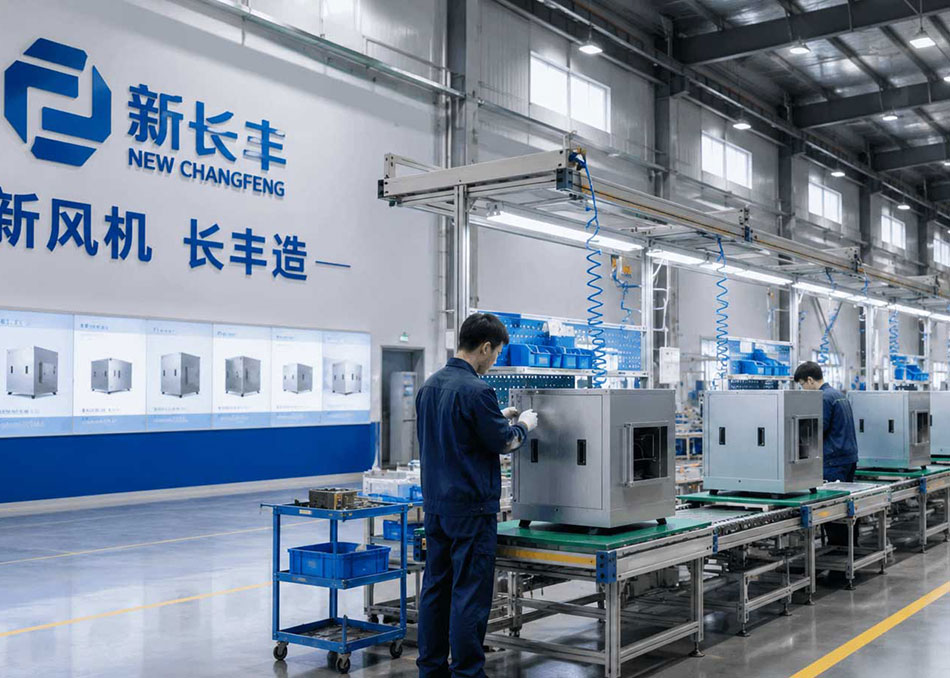
School canteen exhaust systems are often more demanding than those in commercial restaurants. Meal service is compressed into short, high-intensity windows, cooking lines are long, and the exhaust route frequently crosses multiple floors before reaching the roof. At the same time, canteens sit next to classrooms and dormitories, so noise and grease emissions must be controlled more tightly than in a standalone restaurant. Facility managers upgrading or building a canteen frequently report the same cluster of problems: weak exhaust, grease backdraft, insufficient makeup air, and fan noise disturbing nearby buildings. In most cases the root cause is not the purifier — it is fan selection and how the whole exhaust and makeup air system is matched. This article focuses on cabinet centrifugal fans in school canteen kitchen exhaust, covering selection logic, purification integration, makeup air strategy, and how to evaluate suppliers.
Why Cabinet Centrifugal Fans Suit School Canteen Kitchen Exhaust
School canteen exhaust is a classic high-temperature, high-grease, high-humidity duty. The airstream carries a heavy load of oil mist and water vapor. A standard axial fan generally develops limited static pressure, and it struggles to overcome the combined resistance of long duct runs, multiple elbows, grease filters, electrostatic precipitators, and fire dampers. The result is the familiar complaint that the hood "just can't pull." A cabinet centrifugal fan uses a multi-blade centrifugal impeller, which produces higher pressure for the same footprint and holds a stable exhaust volume across a system with significant local resistance. That is the fundamental reason cabinet centrifugal fans are widely specified in canteen exhaust systems.
The cabinet itself is also a noise and protection measure. The fan housing is lined with sound-absorbing material, and the motor is separated from the main airflow path. Compared with an exposed centrifugal fan, a cabinet unit is easier to keep within noise limits acceptable for a campus environment. For a canteen directly adjacent to a teaching building, this difference is often decisive in whether the system can be approved and operated without complaints.
It is important to be clear about the fan's role: in a canteen system the cabinet centrifugal fan provides the pressure and airflow that move grease-laden air from the hood, through the purification stage, and out the discharge point. It also supports the makeup air side of the balance. It does not replace the grease filter or the fume purifier — it makes them work as designed.
Matching the Fan to the Hood, Duct and Purifier
Fan selection starts with the system curve, not with a catalog number. The required airflow is driven by hood dimensions and cooking intensity; the required static pressure is driven by the duct layout and every component in the path. A canteen with a long horizontal run, several 90-degree elbows, a fire damper, and an electrostatic purifier may need substantially more pressure than a short direct run, even when the hood size is identical. Selecting a fan on airflow alone is one of the most common causes of underperformance.
Performance should be verified against recognized test methods. In China, fan aerodynamic performance is commonly tested to GB/T 1236, and fan energy efficiency is evaluated under GB 19761. For kitchen fume emission, GB 18483 sets the framework for purification and discharge. Where the exhaust duct passes through or near fire compartments, smoke and heat exhaust provisions under GB 51251 inform damper and duct design. Referencing these standards in a specification helps ensure that quoted performance is comparable between suppliers rather than a marketing figure.
Practical matching points for a school canteen:
- Airflow: Size the fan so that each hood maintains capture velocity at the cooking surface, with margin for filter loading over time.
- Static pressure: Add up duct friction, elbows, transitions, dampers, grease filters, and the purifier's rated resistance. Include a safety margin for grease buildup.
- Temperature: Confirm the fan and motor are rated for the actual exhaust temperature at the fan inlet, accounting for any upstream cooling or dilution.
- Purifier compatibility: Electrostatic and UV purifiers have specific airflow windows; a fan that pushes too much or too little air through them reduces purification efficiency.
- Motor and drive: For grease-laden airstreams, prefer arrangements where the motor is outside the hot, dirty airflow path, and confirm the enclosure rating suits a wet, greasy environment.
- Noise: Check sound pressure levels at the nearest sensitive receiver — classroom, dormitory, or adjacent canteen — not just at the fan outlet.
Purification and Makeup Air: Two Halves of One System
Exhaust without makeup air is a vacuum. In a tight, modern canteen building, a powerful exhaust fan will pull against closed doors and windows, reducing actual capture at the hood and causing doors to be hard to open. Worse, negative pressure can draw odors from floor drains or adjacent kitchens back into the dining area. Makeup air must be planned together with exhaust, not added as an afterthought.
A balanced approach typically combines mechanical makeup air with a controlled path. In canteens, tempered makeup air is often preferred because untreated outdoor air in winter or summer creates discomfort near the cooking line and wastes energy. Water-cooled fresh air units or evaporative cooling units can provide tempered makeup air in many climates, while dedicated fresh air cabinets help maintain a slight negative pressure in the kitchen relative to the dining hall — keeping odors in the kitchen rather than pushing them into the seating area.
On the purification side, the sequence matters. Grease filters remove the bulk of oil mist before the airstream reaches the electrostatic stage. If the fan is placed before the purifier, it must handle a heavily grease-laden airstream; if placed after, it handles cleaner but possibly warmer air. Each arrangement has trade-offs in maintenance frequency, fire risk, and fan life. For school canteens, where maintenance windows are short and staff may not be ventilation specialists, a layout that simplifies cleaning and reduces grease loading on the fan is usually worth the extra ductwork.
How to Evaluate Cabinet Centrifugal Fan Suppliers
The supplier question is really a system question. A manufacturer that only quotes a fan model without asking about hood length, duct route, purifier type, and makeup air strategy is unlikely to deliver a system that works on commissioning day. A capable supplier will ask for a layout, calculate the system resistance, and recommend a fan plus accessories that match the duty.
When comparing suppliers, look for evidence rather than adjectives:
- Test documentation: Ask how fan performance is verified and whether it aligns with GB/T 1236 or equivalent aerodynamic testing.
- Efficiency disclosure: Request efficiency information consistent with GB 19761 so operating cost can be estimated.
- Application experience: Prior school canteen, hotel kitchen, or institutional projects with similar duct complexity are more relevant than generic industrial references.
- System support: The ability to advise on makeup air, purifier matching, and noise control, not just sell a box fan.
- Service and spares: Availability of impellers, bearings, belts, and motors matters in a facility that cannot afford a long exhaust outage.
- Compliance awareness: Familiarity with GB 18483 for fume emission and GB 51251 where fire-rated ductwork is involved.
For international buyers, the same logic applies with local equivalents: verify airflow and pressure to a recognized test standard, confirm electrical and safety certifications for the destination market, and insist on a system-level selection rather than a component quote.
Common Mistakes in School Canteen Exhaust Design
Most canteen exhaust failures are predictable. Oversizing the fan to "be safe" can push air through the purifier too fast, reducing residence time and purification efficiency, while increasing noise and energy use. Undersizing the makeup air path creates negative pressure that undermines the exhaust it is meant to support. Neglecting grease accumulation in the duct raises fire risk and steadily shifts the system curve until the fan is operating far from its design point.
Other frequent issues include placing the fan where service access is difficult, using flexible duct in long runs where it adds resistance and collects grease, and ignoring the noise path through the ductwork into adjacent spaces. A short commissioning check — measuring airflow at each hood, static pressure across the system, and sound levels at nearby receivers — catches many of these problems before the canteen opens.
FAQ
Q: Can a cabinet centrifugal fan handle the grease and heat in a school canteen exhaust?
A: Yes, when it is selected for the actual temperature and grease loading, and when the system includes proper grease filtration upstream. The cabinet design protects the motor and reduces noise, but maintenance — cleaning impellers and checking bearings — is still required to keep performance stable.
Q: Why does my canteen exhaust feel weak even though the fan runs?
A: The most common causes are insufficient makeup air, a system resistance higher than the fan's rated pressure, or grease buildup in ducts and filters. Check the makeup air path first, then measure static pressure and compare it with the fan curve.
Q: Should the fan be installed before or after the fume purifier?
A: It depends on the purifier type, exhaust temperature, and maintenance strategy. Placing the fan after the purifier generally reduces grease loading on the impeller, while placing it before may suit certain high-temperature layouts. The decision should be made as part of the system design, not as a default.
Q: How do I reduce fan noise near classrooms?
A: Choose a cabinet centrifugal fan with internal sound attenuation, locate it away from sensitive receivers where possible, use proper duct silencers and vibration isolation, and avoid oversizing the fan, which increases both noise and energy use.
Q: What information should I give a supplier for an accurate quote?
A: Provide hood dimensions and cooking equipment layout, duct route with lengths and fittings, purifier type and rated resistance, available electrical supply, ambient and exhaust temperature conditions, and any noise limits. A supplier who asks for these details is more likely to deliver a working system.
Summary
In school canteen kitchen exhaust, the cabinet centrifugal fan is the pressure source that makes the whole system work — but only when it is matched to the hood, duct, purifier, and makeup air strategy. Prioritize system-level selection, verify performance against recognized standards such as GB/T 1236 and GB 19761, plan makeup air together with exhaust, and choose suppliers who ask about your layout before quoting a model. XCFFJ manufactures cabinet centrifugal fans and related ventilation, purification, and cooling equipment for school canteens, hotels, factories, and warehouse logistics. To discuss a canteen exhaust and makeup air layout, visit www.xcffj.com.