
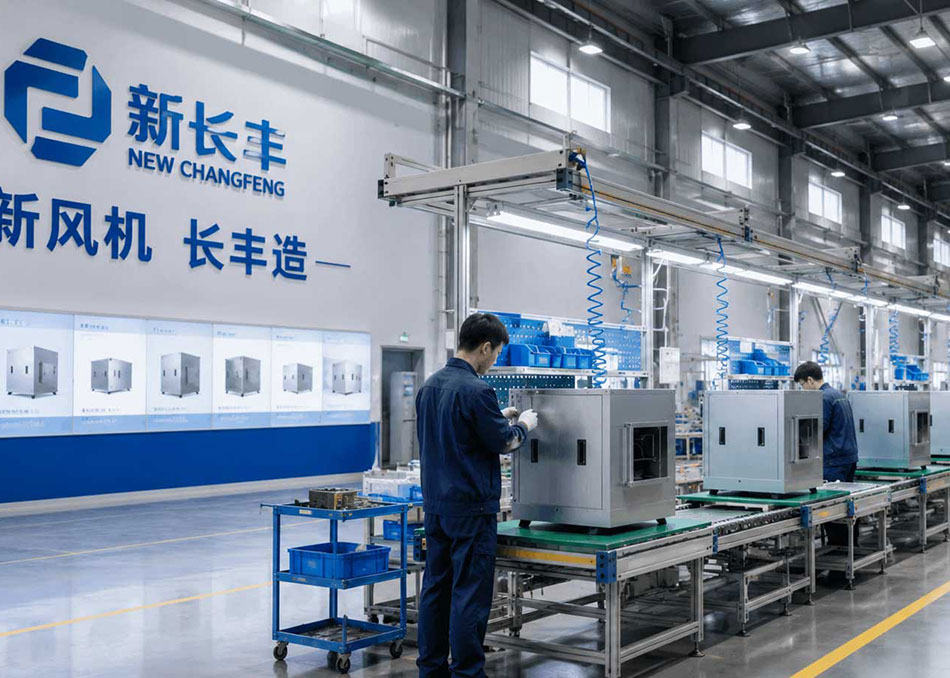
Stuffy back-of-house conditions, cooking fumes drifting into the dining area, swing doors pulled tight against their frames, exhaust hoods that seem to lose suction the harder they run—these are familiar complaints in commercial kitchens. In most cases the exhaust fan is not undersized. The real problem is make-up air. When a kitchen exhaust system operates at high load, it pulls a large volume of air out of the space and creates a pronounced negative pressure. Without organized fresh air supply, that pressure imbalance triggers a chain of consequences: weak exhaust, odor backdraft, doors that won't close properly, and staff who feel the heat all shift long. A water-cooled fresh air unit addresses this exact link in the ventilation chain—delivering directed make-up air to balance negative pressure while using evaporative water cooling to turn that incoming air into a cooler, more comfortable supply. The result is negative pressure control and kitchen cooling handled together rather than as separate problems.
How Negative Pressure Forms in a Commercial Kitchen—and Why Make-Up Air Comes First
Exhaust hoods and their fans continuously remove large volumes of air from the kitchen. By the basic principle of air balance, the air removed must be replaced by an equal volume of incoming air; otherwise, indoor static pressure falls below outdoor pressure and negative pressure develops. The immediate effect is that replacement air can only enter through uncontrolled paths—door gaps, pass-through windows, floor drains, and other openings. These air streams are untreated and disordered: they carry in dust and odors, and they disturb the capture airflow at the hood face, which is exactly when cooking fumes begin to escape into adjacent spaces.
From a ventilation engineering standpoint, the kitchen exhaust system and the make-up air system should be designed as one integrated assembly. GB 51251, the Chinese technical standard for smoke control and exhaust systems in buildings, sets clear requirements for air distribution in supply and exhaust systems, and its core logic applies equally to kitchen ventilation: organized exhaust must be paired with organized make-up air. Supply outlets should be positioned so they do not blow directly toward the exhaust hood, where they would interfere with fume capture. Make-up air volume should be coordinated with exhaust volume so the kitchen maintains a slight negative pressure relative to the dining area—enough to keep odors contained, but not so deep that exhaust performance and door operation suffer.
This is why simply adding a larger exhaust fan often makes things worse. A stronger fan deepens the negative pressure, increases the velocity of uncontrolled infiltration, and pulls more untreated hot, humid outdoor air through every gap in the envelope. The fix lies on the supply side, not the exhaust side.
The Role of the Water-Cooled Fresh Air Unit in Negative Pressure Control
A water-cooled fresh air unit combines two functions in a single piece of equipment. First, it acts as a dedicated make-up air source: it draws in outdoor air and delivers it to targeted positions within the kitchen, giving the exhaust system a controlled, organized supply to work against. Second, it treats that air through evaporative water cooling, lowering the supply air temperature before it reaches the occupied zone. Instead of dumping hot outdoor air into an already overheated kitchen, the unit introduces cooler, fresher air where it is needed most.
Because the unit supplies air in a directed manner, it helps stabilize the pressure relationship between the kitchen and surrounding areas. With a properly sized and positioned supply, the exhaust hoods recover their capture efficiency, fumes stay inside the hood rather than spilling over the edge, and the kitchen holds a controlled slight negative pressure instead of an uncontrolled deep one. The same airflow that solves the pressure problem also improves the thermal environment—an important point in kitchens where radiant heat from cooking equipment and poor air movement make summer conditions difficult.
Evaporative cooling is particularly well suited to kitchen make-up air because it consumes far less energy than mechanical refrigeration and introduces a high volume of fresh outdoor air rather than recirculating air. This aligns with the intent of GB 19761, the Chinese energy efficiency standard for fans, which encourages efficient air-moving equipment, and with the broader principle that ventilation systems should deliver required air changes at the lowest practical energy cost.
Design and Installation Points That Determine Whether the System Works
Equipment selection is only part of the outcome. How the make-up air system is laid out determines whether negative pressure is genuinely resolved or merely shifted around.
- Match supply to exhaust: Calculate make-up air volume against the actual exhaust volume of the hoods and fans, allowing for a controlled pressure differential between kitchen and dining areas rather than a complete balance.
- Position supply outlets away from hood faces: Direct supply air toward aisles, work zones, and the lower occupied zone, not across the hood capture area, to avoid disturbing fume capture.
- Prioritize the hottest workstations: Route cooler supply air to cooking lines, dishwashing areas, and other high-heat zones where staff comfort and equipment cooling matter most.
- Keep the water cooling system maintained: Evaporative cooling performance depends on clean pads, media, or heat exchange surfaces and a reliable water supply; fouling reduces cooling output and airflow.
- Coordinate with the fume purification system: Kitchen exhaust purification equipment, typically designed to meet GB 18483 emission requirements for cooking fume, works best when hood capture airflow is stable—which depends on proper make-up air.
- Verify fan performance against GB/T 1236: Fan performance testing per GB/T 1236 provides a reliable basis for confirming that selected equipment delivers the required airflow at the actual system resistance.
In new-build projects, the make-up air ductwork and outdoor air intake should be planned alongside the exhaust system from the start. In retrofit projects, a common approach is to add a dedicated water-cooled fresh air unit with its own intake and distribution ducting, allowing the existing exhaust system to operate closer to its design point without a full redesign.
Where This Approach Fits: Applications and Practical Benefits
The combination of negative pressure control and evaporative cooling is relevant wherever commercial kitchens run high-volume exhaust: hotel kitchens, school and institutional canteens, restaurant chains, central kitchens, and food processing facilities with hot cooking operations. In each case, the underlying physics is the same—exhaust without organized make-up air creates pressure problems that no amount of exhaust capacity can solve.
Practically, operators who address make-up air often report improvements across several dimensions at once: hoods capture fumes more reliably, odors stop migrating into dining rooms and neighboring spaces, doors and curtains behave normally, and kitchen staff experience a noticeably cooler working environment during hot weather. Because the cooling is evaporative rather than refrigerant-based, operating energy demand for the make-up air treatment remains modest compared with air-conditioning the entire kitchen volume.
It is worth emphasizing that no single device guarantees a result on its own. The water-cooled fresh air unit is the supply-side component of a balanced ventilation strategy; its effectiveness depends on correct sizing, thoughtful air distribution, and ongoing maintenance of both the supply and exhaust sides of the system.
Frequently Asked Questions
Q: Can't I just increase the exhaust fan size to fix a hot, smoky kitchen?
A: Increasing exhaust capacity without adding make-up air usually worsens negative pressure. The stronger fan pulls more untreated air through gaps and openings, increases drafts, and can further disrupt hood capture. The correct sequence is to establish organized make-up air first, then confirm that exhaust capacity matches the hood design.
Q: Does a water-cooled fresh air unit replace a kitchen air conditioner?
A: Not exactly—they serve different purposes. A water-cooled fresh air unit delivers cooled outdoor air to balance exhaust and improve the kitchen environment, and it is especially effective for make-up air applications. A kitchen air conditioner typically treats recirculated air for spot cooling. In many kitchens the two are complementary, with the fresh air unit handling ventilation load and pressure balance.
Q: How much negative pressure should a commercial kitchen maintain?
A: The goal is a controlled slight negative pressure relative to dining and adjacent occupied spaces—enough to keep cooking fumes and odors from migrating outward, but not so much that exhaust performance, door operation, or staff comfort is affected. The appropriate value depends on hood design, exhaust volume, and building layout, and should be established during ventilation system design rather than by trial and error.
Q: Is evaporative cooling suitable for kitchens in humid climates?
A: Evaporative cooling performance depends on ambient wet-bulb conditions, so effectiveness varies by climate and season. In humid regions, the achievable temperature drop is smaller, but the unit still provides essential make-up air and ventilation—functions that remain valuable regardless of the cooling benefit. System design should account for local climate data.
Summary
Kitchen negative pressure is a supply-side problem, and treating it as one is the key to solving both fume control and staff comfort. A water-cooled fresh air unit delivers organized make-up air to balance exhaust, stabilizes hood capture, and uses evaporative cooling to introduce cooler fresh air into the hottest zones—addressing ventilation and cooling in a single, energy-conscious step. If your kitchen struggles with weak exhaust, fume spillage, or heat stress, reviewing the make-up air strategy is the place to start. To discuss equipment selection and system layout for your project, contact XCFFJ or visit www.xcffj.com.