
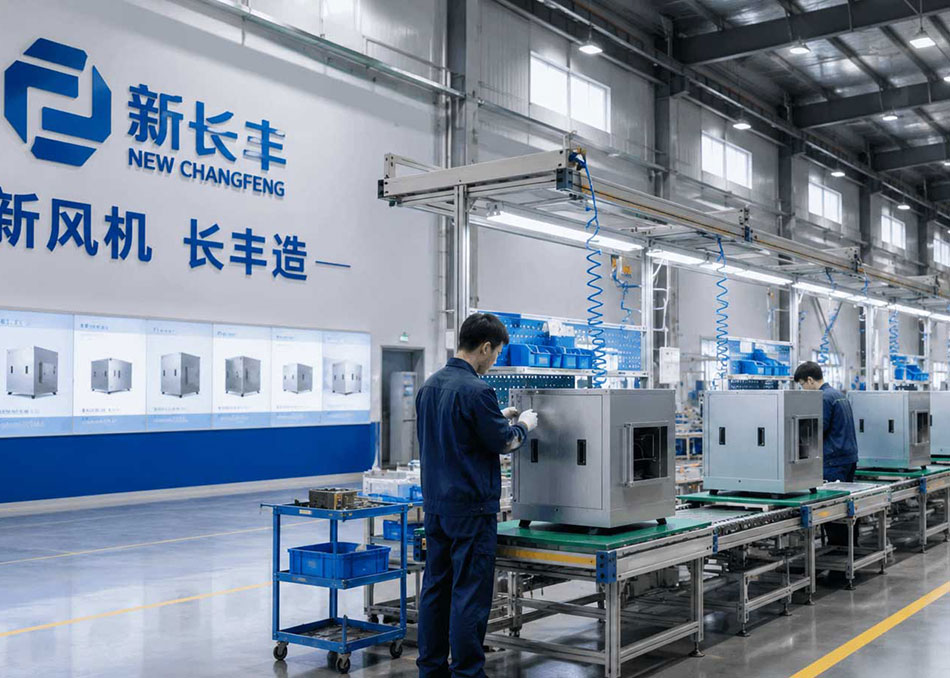
During peak service, a commercial kitchen may run multiple exhaust fans, fume purifiers and makeup air devices at the same time. When exhaust airflow clearly exceeds makeup airflow, the kitchen goes negative: doors become hard to push open, cooking fumes drift back into the dining area, burner flames get pulled sideways, and hood capture efficiency drops. The fix is not to keep adding exhaust power — it is to establish a controllable makeup air system. The water-cooled fresh air unit is designed around exactly this need: solving kitchen negative pressure through balanced ventilation and makeup air, combining cooling with air supply to stabilize kitchen pressure while improving the working environment.
How Negative Pressure Forms in a Commercial Kitchen
Kitchen ventilation is fundamentally a balance: every cubic meter of air exhausted must be replaced. The exhaust side — hoods, fume purifiers, ductwork and roof fans — pushes smoke, heat and moisture outdoors. If the makeup side relies only on natural infiltration through doors and windows, the available inlet area is limited and resistance is high. The exhaust system then "steals" air from the interior, dropping kitchen pressure below that of the outdoors and adjacent dining areas.
The consequences cascade. Hood face velocity falls, so fumes spread into the kitchen and front-of-house before they can be captured. Gas burners need air for combustion; under negative pressure, combustion becomes incomplete, flames turn yellow, and energy consumption rises. Standards such as GB 51251 on smoke control and exhaust systems emphasize proper airflow organization — supply and exhaust should be designed as a matched pair to avoid short-circuiting or insufficient makeup air.
The key to solving kitchen negative pressure is therefore not more exhaust power, but a makeup air volume that maintains a sensible ratio to exhaust volume, delivered at the right location and temperature.
What a Water-Cooled Fresh Air Unit Does
A water-cooled fresh air unit is a dedicated outdoor-air handler that cools incoming air using a water-cooled heat exchanger rather than a conventional refrigerant circuit. It draws in outside air, passes it through filtration and a water-cooled coil, and supplies tempered fresh air directly into the kitchen. Because the cooling medium is water, the unit can reject heat to a cooling tower or external water loop, which is useful in buildings where condensing units cannot be placed near the kitchen.
In negative-pressure applications, the unit serves two functions simultaneously. First, it is the controlled makeup air source: by supplying a defined volume of outdoor air, it reduces the pressure differential that causes doors to fight back and fumes to migrate. Second, it cools that air before it enters the workspace, so the makeup air does not simply dump outdoor heat into an already hot kitchen.
Typical design considerations include:
- Airflow matching: Supply air volume is set as a proportion of total exhaust volume, so the kitchen remains slightly negative relative to the dining area but not starved of air.
- Supply location: Air should be introduced near the cooking line but away from hood capture zones, avoiding short-circuiting directly into the exhaust.
- Filtration: Incoming air passes through filters to protect the coil and keep the supply stream clean.
- Water circuit: The cooling loop requires a reliable water source, cooling tower or chiller connection, with freeze protection in cold climates.
Why Water-Cooled Fresh Air Beats Simple Makeup Air
A basic makeup air fan solves pressure but not comfort. In summer, it pulls hot, humid outdoor air into a kitchen that is already fighting heat from burners, ovens and fryers. The result is a workspace that feels worse, not better, and staff may disable the makeup fan entirely.
A water-cooled fresh air unit addresses this by tempering the supply air. Because the coil is water-cooled, the unit can be compact and located indoors or in a plant room, avoiding the noise and heat rejection problems of outdoor condensing units. This matters in dense urban buildings, hotels and school canteens where rooftop or facade space is limited.
From an energy perspective, the approach aligns with GB 19761 fan energy efficiency requirements: a properly sized makeup air unit reduces the tendency to oversize exhaust fans, lowering total system power. It also supports GB 18483 kitchen fume emission compliance by maintaining hood capture efficiency, so more fume is captured and treated rather than escaping.
Design and Operating Checklist
Getting negative pressure under control requires more than selecting a unit. The following points are worth verifying during design and commissioning:
- Measure actual exhaust volume from all hoods and fans under real operating conditions, not just nameplate values.
- Set makeup air volume to maintain a slight negative pressure — enough to contain odors, not enough to starve burners.
- Balance across zones: If the kitchen has multiple hood lines, distribute makeup air to avoid local dead zones.
- Interlock controls: Makeup air should start with the exhaust system and modulate with it, so pressure stays stable as cooking load changes.
- Commission with a pressure gauge: Verify the pressure differential between kitchen and dining area, and adjust dampers accordingly.
In real projects, the most common mistake is treating makeup air as an afterthought. Once the exhaust system is installed and the kitchen goes negative, operators compensate by cracking doors or adding window fans, which creates uncontrolled paths and defeats fume capture. A dedicated water-cooled fresh air unit provides a controlled, tempered supply that can be tuned and maintained.
Frequently Asked Questions
Q: How do I know if my kitchen has a negative pressure problem?
A: Common signs include doors that are hard to open or close, cooking odors drifting into the dining room, hoods that seem to lose suction during peak hours, and gas flames that burn yellow or lift off the burner. A simple pressure gauge reading between kitchen and adjacent spaces can confirm it.
Q: Can I just increase exhaust fan power to clear fumes faster?
A: Increasing exhaust without matching makeup air usually makes negative pressure worse. Hood capture efficiency depends on airflow patterns, not raw exhaust volume. The better approach is to balance supply and exhaust so the hood can capture fumes at the source.
Q: Does a water-cooled fresh air unit require a cooling tower?
A: It requires a heat rejection path for the water loop — typically a cooling tower, chiller or existing building water system. The exact configuration depends on the building. In some cases an air-cooled variant may be more practical, but water cooling allows a more compact indoor unit.
Q: What maintenance does the unit need?
A: Regular filter cleaning or replacement, coil inspection and cleaning, water quality checks for the cooling loop, and verification of fan and damper operation. Maintenance intervals depend on kitchen grease loading and outdoor air quality.
Q: Is a water-cooled fresh air unit suitable for small kitchens?
A: Yes, provided the unit is sized correctly. Small kitchens may need a lower-capacity unit or a shared makeup air strategy. The principle is the same: supply tempered outdoor air to balance exhaust without overcooling or overpressurizing the space.
Getting Kitchen Pressure Under Control
Negative pressure in commercial kitchens is a system design issue, not a fan problem. The water-cooled fresh air unit addresses it by combining controlled makeup air with cooling, so the kitchen stays balanced, fumes stay captured, and staff work in a more comfortable environment. XCFFJ manufactures water-cooled fresh air units and a full range of ventilation equipment for factory, kitchen and commercial applications. For projects involving kitchen negative pressure, fume purification or makeup air design, contact our team to discuss the right configuration for your site.