
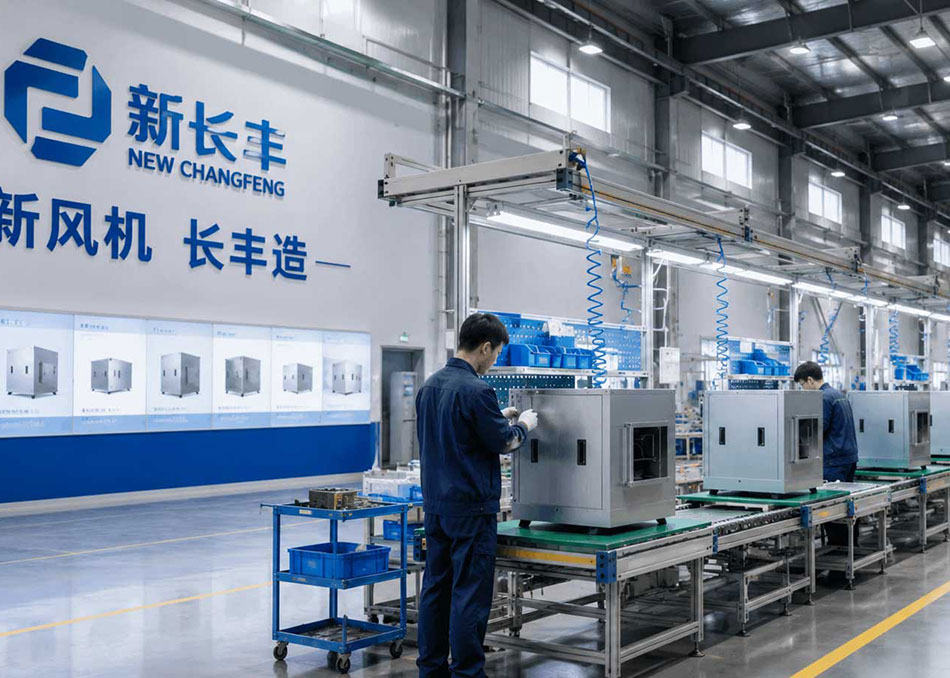
Internet cafés are among the most densely occupied commercial spaces around. Rows of gaming stations run continuously, heat builds from monitors and PC towers, doors and windows stay shut for security and climate control, and split air conditioners recirculate the same indoor air. The result is a familiar complaint from owners and customers alike: the room may technically hit its temperature setpoint, yet it still feels stuffy, stale, and hard to breathe.
Many operators assume that high-capacity water-cooled fresh air units belong only in restaurant kitchens. That assumption deserves a second look. The same technical profile that makes these units effective in commercial kitchens — high air exchange volume, evaporative cooling, and positive-pressure supply — maps directly onto the ventilation and cooling needs of internet cafés. And the negative-pressure exhaust role these units support in kitchen environments offers a useful engineering template for organizing makeup air in gaming venues. This article walks through the airflow principles, selection considerations, and practical implementation points.
Why Internet Cafés Struggle: It Is Not a Cooling Problem, It Is an Air Exchange Problem
Heat loads in an internet café come from two distinct sources. The first is sensible and latent heat from people and equipment — every occupied seat and every running PC adds to the total. The second is the steady accumulation of carbon dioxide, odors, and airborne dust in a sealed space. Conventional split systems and cabinet air conditioners only handle the first category, and only partially: they cool indoor air in a closed loop without introducing outdoor air. This is recirculation cooling, and it has a hard ceiling.
As occupancy rises, the cooling load climbs, but the age of the air — how thoroughly it has been refreshed — does not improve. The room ends up in the classic condition where the thermostat reads acceptable while the human experience does not. Ventilation engineering offers a clearer path: establish a deliberate supply-and-exhaust relationship. Mechanical supply introduces outdoor air that has been cooled and filtered, creating slight positive pressure indoors, which pushes hot, stale air out along planned exhaust routes. That is precisely the operating logic of a water-cooled fresh air unit.
- Recirculation cooling lowers temperature but leaves CO₂, odors, and humidity to accumulate.
- Fresh air supply with evaporative cooling addresses temperature and air quality together.
- Positive-pressure organization prevents uncontrolled infiltration and gives exhaust a defined path.
What a Water-Cooled Fresh Air Unit Actually Does
A water-cooled fresh air unit draws in outdoor air, passes it through a cooling and filtration section, and delivers it into the space as conditioned supply air. The evaporative cooling stage uses water evaporation to reduce the dry-bulb temperature of the incoming airstream — an energy-efficient approach well suited to hot, dry, or moderately humid climates. Because the unit handles outdoor air rather than recirculated air, it directly improves air exchange rather than simply redistributing the existing load.
In commercial kitchens, these units are often deployed as part of a negative-pressure strategy: the kitchen exhaust hoods pull air out aggressively, and the fresh air unit supplies makeup air so the space does not starve for air or draw uncontrolled infiltration through every gap. That same supply-side discipline applies to internet cafés. Gaming halls typically run exhaust fans or dedicated smoke exhaust, and without a planned makeup air source, the space develops strong negative pressure — doors become hard to open, odors migrate in from adjacent spaces, and exhaust performance degrades.
Relevant standards frame the engineering expectations. Fan performance is characterized under GB/T 1236, fan energy efficiency falls under GB 19761, and where smoke and heat exhaust systems are involved, GB 51251 governs design. For venues that serve food or operate adjacent kitchens, GB 18483 sets the benchmark for kitchen fume emission. Specifying equipment against these references keeps the design defensible and the performance verifiable.
Applying Kitchen Negative-Pressure Thinking to Internet Café Airflow
The kitchen lesson is simple: exhaust and supply must be designed as a pair. In an internet café, the exhaust side might be general mechanical exhaust, dedicated smoke exhaust, or a combination. The supply side is where the water-cooled fresh air unit earns its place. By delivering a defined volume of treated outdoor air, the unit keeps the space from going deeply negative, stabilizes exhaust performance, and ensures that the air customers breathe is actually being replaced rather than merely chilled.
Layout matters as much as capacity. Supply air should be distributed so that it reaches occupied zones without dumping directly onto customers or short-circuiting straight to exhaust grilles. In dense seating layouts, a ducted distribution with directional diffusers works better than a single large outlet. Exhaust points should be positioned to capture heat and odors where they concentrate — near equipment clusters and ceiling high points — so that the positive-pressure supply pushes stale air toward the intended exit rather than into corridors or neighboring tenant spaces.
- Balance supply and exhaust so the space sits at slight positive pressure, not strongly negative.
- Route supply air to occupied zones; avoid short-circuiting to exhaust returns.
- Place exhaust intakes at heat and odor accumulation points.
- Coordinate with smoke exhaust design per GB 51251 where applicable.
Selection and Implementation Notes
Selection starts with an honest load and occupancy assessment. Airflow should be sized to the actual number of seats, equipment density, and local climate rather than copied from another venue. Because evaporative cooling performance depends on ambient wet-bulb conditions, the unit's suitability varies by region — in humid climates, supplemental dehumidification or a different cooling strategy may be needed. Noise is another practical constraint: units should be located and mounted so that operating sound does not intrude on customer areas, and ductwork should be designed to avoid excessive resistance.
Maintenance planning belongs in the specification stage. Evaporative cooling media, filters, and water systems require regular attention; neglected units lose efficiency and can become sources of odor. A service schedule agreed at installation protects both performance and air quality. Finally, verify performance claims against test standards and request documentation rather than relying on nominal figures.
Frequently Asked Questions
Q: Can a water-cooled fresh air unit replace an internet café's air conditioning entirely?
A: Not necessarily. The unit conditions outdoor air and improves ventilation, but internal heat loads from people and equipment may still require supplemental cooling depending on climate and density. Many venues use the fresh air unit for ventilation and cooling support alongside existing air conditioning.
Q: Why does the kitchen negative-pressure example matter for a gaming venue?
A: It illustrates the principle that exhaust without planned makeup air creates problems — starved exhaust, uncontrolled infiltration, and doors that resist opening. Applying the same supply-and-exhaust discipline keeps an internet café's ventilation balanced and effective.
Q: Is evaporative cooling suitable in every climate?
A: No. Performance depends on ambient humidity and wet-bulb temperature. In hot, dry conditions it is highly effective; in consistently humid climates, the achievable temperature reduction is smaller and the design may need adjustment.
Q: What standards should I reference when specifying equipment?
A: GB/T 1236 for fan performance testing, GB 19761 for fan energy efficiency, GB 51251 for smoke and heat exhaust design, and GB 18483 where kitchen fume is involved. These provide a verifiable basis for comparing equipment and validating design choices.
Internet café ventilation is ultimately an airflow organization problem, not just a temperature problem. Water-cooled fresh air units — proven in demanding kitchen environments where negative-pressure control and makeup air are essential — offer a practical, standards-aligned way to bring real air exchange and evaporative cooling into dense gaming spaces. To discuss unit selection, layout, or documentation for your project, contact XCFFJ and our team will help you match equipment to your venue's actual needs.