
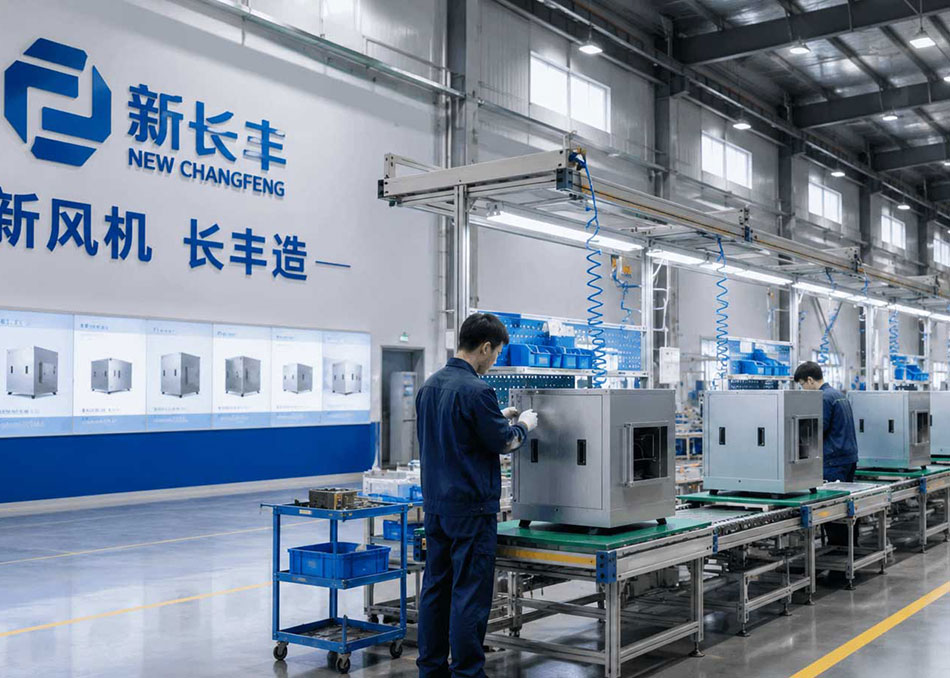
Commercial kitchens and internet cafes may seem like different worlds, but they share a common ventilation challenge: enclosed spaces with high occupant and equipment density, continuous internal heat and pollutant generation, and insufficient natural ventilation. In kitchens, installing only an exhaust hood and fan without a proper makeup air path creates strong negative pressure, leading to poor exhaust, fume backdraft, and flames pulled off-center. In internet cafes, relying solely on recirculating air conditioning traps body heat, carbon dioxide, and odors, hurting customer experience and occupancy rates. This article explores how water-cooled fresh air units can solve both problems by balancing exhaust and makeup air while delivering cooled, filtered fresh air.
1. The Shared Pain Points of Kitchen and Internet Cafe Ventilation
Both commercial kitchens and internet cafes face similar ventilation dilemmas: relatively sealed spaces, high densities of people and equipment, continuous internal heat loads and pollutants, and severely limited natural ventilation. In a kitchen, if only an exhaust hood and fan are installed without a rational makeup air path, strong negative pressure develops. This causes poor exhaust, fume backdraft, and flames being drawn off-center. In an internet cafe, relying solely on air conditioning recirculation means body heat, carbon dioxide, and odors cannot be expelled, affecting customer experience and occupancy rates.
Therefore, ventilation system design cannot focus on a single piece of equipment; it must coordinate four stages: exhaust, makeup, purification, and cooling. The core of kitchen exhaust system design is establishing a stable negative pressure gradient to efficiently remove cooking fumes. For internet cafes, the core is continuously introducing treated fresh air to remove indoor residual heat and odors. Water-cooled fresh air units become a key device connecting exhaust makeup and fresh air cooling under this logic.
2. Core of Kitchen Exhaust System Design: Balancing Negative Pressure and Makeup Air
According to GB 51251 Technical Standard for Smoke Control and Exhaust Systems in Buildings and common practices in commercial kitchen fume control, the exhaust system must ensure exhaust volume exceeds makeup air volume to maintain slight negative pressure, preventing fumes from escaping into dining areas. However, negative pressure should not be excessive: too much negative pressure leads to insufficient makeup air, reduced hood suction, incomplete combustion, drained floor drain water seals, and even impacts on adjacent areas. The reasonable approach is to maintain a negative pressure gradient of about 5–10 Pa between the kitchen and dining area, with makeup air volume at 80–90% of exhaust volume.
Makeup air must be filtered and, in summer, cooled; otherwise, the kitchen becomes unbearably hot, and staff may resort to opening windows, disrupting the negative pressure balance. Traditional makeup air units often fail to provide both cooling and filtration, leading to high energy consumption and poor comfort. Water-cooled fresh air units address this by combining cooling, filtration, and air supply in one compact unit, making them ideal for kitchen makeup air.
3. Internet Cafe Ventilation and Cooling: The Role of Water-Cooled Fresh Air Units
Internet cafes typically have high occupant density, with each person generating significant heat and moisture. Recirculating air conditioning alone cannot remove odors or carbon dioxide, and long-term operation leads to stuffy, stale air. The solution is to introduce ample fresh air while expelling an equal amount of exhaust air. Water-cooled fresh air units draw in outdoor air, filter it, cool it via a water-cooled coil, and supply it to the space. This creates a slight positive pressure in the cafe, preventing odors from adjacent areas and ensuring a comfortable environment.
Unlike traditional fresh air units that rely on direct expansion coils, water-cooled units use chilled water from a cooling tower or chiller, offering higher energy efficiency and lower operating costs. They can also be integrated with exhaust systems to recover cooling energy. For internet cafes, this means a continuous supply of cool, clean air without overburdening the air conditioning system.
4. Integrating Kitchen Exhaust and Internet Cafe Ventilation: A Unified Approach
Although kitchens and internet cafes differ, the underlying ventilation principles are the same: control pollutants at the source, maintain pressure balance, and provide treated makeup air. In kitchens, the exhaust hood captures fumes, and the water-cooled fresh air unit provides cooled makeup air to maintain negative pressure. In internet cafes, exhaust fans remove stale air, and the water-cooled fresh air unit supplies cooled fresh air to maintain positive pressure. Both scenarios benefit from a design that considers the entire air loop, not just isolated components.
When designing such systems, engineers should reference GB/T 1236 for fan performance testing, GB 19761 for fan energy efficiency, and GB 18483 for kitchen fume emission limits. Water-cooled fresh air units should be selected based on cooling load, fresh air volume, and external static pressure, with proper filtration to protect coils and ensure indoor air quality.
5. Key Considerations for Selecting Water-Cooled Fresh Air Units
- Cooling capacity: Match the unit's cooling capacity to the space's heat load, including occupants, lighting, and equipment.
- Air volume: Ensure sufficient fresh air to meet ventilation requirements and maintain pressure balance.
- Filtration: Use multi-stage filtration (e.g., primary and medium efficiency) to protect the coil and improve indoor air quality.
- Noise level: Choose units with low noise, especially for internet cafes where quiet operation is essential.
- Energy efficiency: Look for units with high energy efficiency ratios and variable speed options for part-load operation.
- Maintenance: Design for easy access to filters and coils for cleaning and service.
FAQ
Q: Can a water-cooled fresh air unit replace a kitchen exhaust hood?
A: No. The exhaust hood captures fumes at the source, while the water-cooled fresh air unit provides cooled makeup air. Both are needed to maintain proper negative pressure and comfort.
Q: How does a water-cooled fresh air unit differ from a regular fresh air unit?
A: Water-cooled units use chilled water to cool the air, which is often more energy-efficient than direct expansion, especially for large capacities. They also require a cooling water source, such as a cooling tower or chiller.
Q: What maintenance does a water-cooled fresh air unit require?
A: Regular cleaning or replacement of filters, coil cleaning, and checking water flow and temperature. Proper maintenance ensures efficient operation and long service life.
Q: Can I use a water-cooled fresh air unit in an internet cafe without a chiller?
A: It requires a chilled water source. If a chiller is not available, consider a direct expansion fresh air unit or connect to an existing chilled water system.
Designing effective ventilation for commercial kitchens and internet cafes requires a holistic approach that balances exhaust and makeup air while ensuring comfort and energy efficiency. Water-cooled fresh air units offer a versatile solution for both scenarios, providing cooled, filtered fresh air to maintain pressure balance and indoor air quality. For more information on selecting the right unit for your project, visit www.xcffj.com or contact our team of ventilation specialists.