
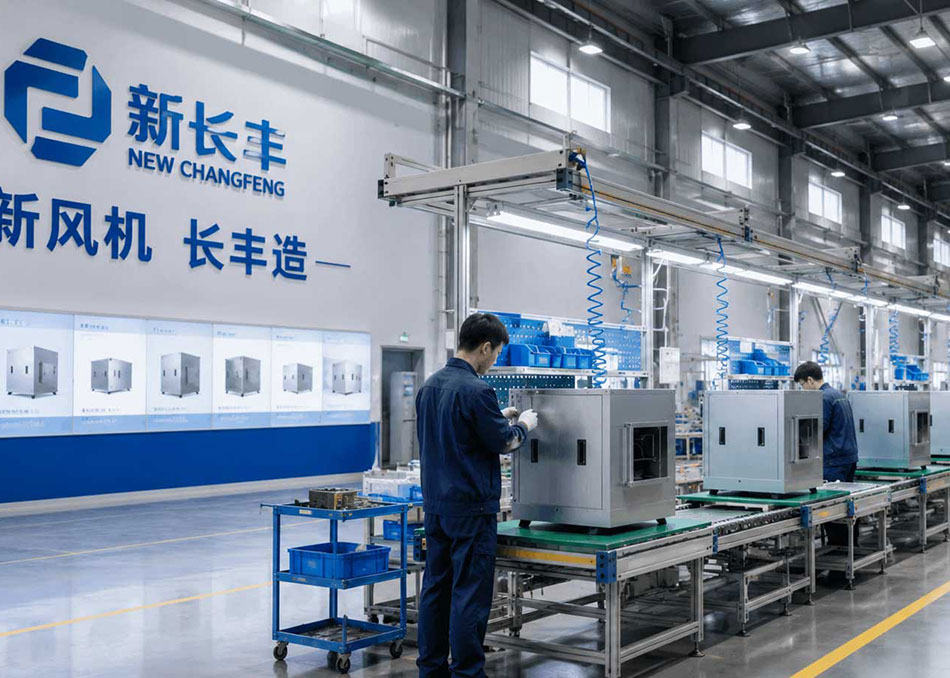
Ventilation problems in commercial kitchens are rarely about exhaust capacity alone. Operators often invest in hoods, grease filters, and exhaust fans, only to find flames pulling away from burners, grease smoke drifting into the dining room, doors that stick or swing on their own, and staff working in stifling heat. In most cases these symptoms trace back to one root cause: negative pressure in the back-of-house. Engineering experience with water-cooled fresh air units and commercial ventilation systems shows that exhaust and make-up air must be designed as a pair. Without a controlled supply of replacement air, even a strong exhaust system cannot run stably. This article examines the make-up air challenge in food service kitchens and explains how water-cooled fresh air units address it.
How Negative Pressure Forms in a Kitchen — and Why Make-Up Air Is Mandatory
When a kitchen exhaust system runs, hoods and exhaust fans continuously remove large volumes of air from the space. The basic principle of airflow balance requires that this air be replaced in equal measure. If it is not, indoor pressure drops below outdoor pressure and negative pressure develops.
The consequences are predictable. Outdoor air rushes in through unintended paths — door and window gaps, floor drains, flue connections — producing chaotic airflow patterns. Combustion appliances starve for air, leading to flame lift, yellow tips, and incomplete combustion. Hood capture efficiency falls, and grease-laden air escapes from the hood edges into front-of-house and adjacent spaces.
From a standards perspective, GB 51251 (Technical Standard for Smoke Control and Exhaust Systems in Buildings) sets out clear make-up air logic for ventilation and smoke exhaust, and kitchen ventilation design should follow the same supply-exhaust balance principle. Commercial kitchens are high-heat, high-humidity, high-grease environments, so make-up air cannot simply be untreated outdoor air dumped into the space — it needs to be conditioned, filtered, and delivered where it is needed.
Why a Water-Cooled Fresh Air Unit Fits the Kitchen Environment
A water-cooled fresh air unit brings in outdoor air, cools it through a water-cooled coil, and supplies it to the kitchen in a controlled manner. Compared with simply opening a door or installing a plain supply fan, the approach offers several practical advantages in a back-of-house setting.
- Temperature control: Outdoor air is cooled before delivery, so make-up air does not add to the heat load near the cooking line — a common complaint when untreated air is introduced.
- No condensing unit in the kitchen: Because heat is rejected through a water circuit, the unit avoids adding a hot condenser and its noise directly into an already crowded, greasy space.
- Filtration and cleanliness: Supply air passes through filtration, reducing dust and airborne particles drawn into the cooking zone.
- Controlled distribution: Supply air can be directed to the perimeter or low-level zones rather than blown directly onto burners, preserving flame stability and hood capture.
- Balance with exhaust: The unit can be sized and interlocked with the exhaust system so that supply tracks exhaust demand, maintaining a slight negative pressure relative to the dining area while eliminating excessive negative pressure in the kitchen.
Fan performance for such units should be verified against GB/T 1236 (Industrial Fans — Performance Testing), and motor efficiency should be evaluated in line with GB 19761 (Minimum Allowable Values of Energy Efficiency and Energy Efficiency Grades for Fans). Specifying to these standards helps ensure that the delivered airflow and energy consumption match the design intent.
Sizing and Selection: Getting Make-Up Air Right
Correct sizing starts with the exhaust side. The total exhaust volume of hoods and fans under normal operating conditions defines the make-up air requirement. A common design approach is to supply a substantial majority of the exhaust volume through conditioned make-up air, leaving the remainder to be drawn through transfer paths from adjacent spaces — enough to keep the kitchen slightly negative relative to the dining room, but not so negative that doors become hard to open or combustion suffers.
Several factors deserve attention during selection:
- Hood capture and airflow interaction: Supply diffusers should not create cross-drafts across hood faces. Placement at the perimeter or at low level is often preferable to ceiling supply directly above the cooking line.
- Water circuit design: Cooling capacity depends on the available chilled water or cooling water temperature and flow. Confirm the water source, temperature, and quality with the unit supplier before finalizing the model.
- Noise: Back-of-house staff work long shifts near the equipment. Fan speed, duct velocity, and unit placement all affect sound levels; ask for sound data and plan ductwork accordingly.
- Grease and humidity exposure: Although the unit supplies clean air, the surrounding kitchen environment is aggressive. Specify appropriate filtration and plan access for cleaning and maintenance.
- Controls and interlock: The make-up air unit should start with the exhaust system and modulate with it, so balance is maintained across part-load conditions rather than only at design point.
Installation and Commissioning: Where Good Design Succeeds or Fails
Even a well-selected unit can underperform if installation details are ignored. Ductwork should be sized for low pressure loss and sealed to prevent leakage into ceiling voids. Outdoor air intakes must be located away from grease exhaust discharges and trash areas, and protected from rain and debris. Water connections need proper insulation to prevent condensation in humid climates.
Commissioning is the step that confirms the design actually works. Measure exhaust airflow at each hood, measure supply airflow at the unit and at diffusers, and verify the pressure relationship between kitchen and dining areas. Check burner performance under operating conditions. Confirm that the unit responds correctly when exhaust fans are switched on and off. Document the balanced condition so future maintenance can restore it.
Ongoing maintenance should include filter changes, coil cleaning, water circuit checks, and periodic airflow verification. Grease-laden environments punish neglected equipment, and a make-up air unit that loses airflow quietly undermines the entire kitchen ventilation strategy.
FAQ
Q: Can I just open a door or window for make-up air instead of installing a unit?
A: While some transfer air is normal, relying on doors and windows leads to uncontrolled paths, drafts, pest entry, and uncomfortable conditions near the cooking line. It also makes balance unpredictable as weather and exhaust operation change. A dedicated make-up air unit provides filtered, conditioned air at a controlled rate, which supports stable combustion, hood capture, and staff comfort.
Q: How do I know whether my kitchen has a negative pressure problem?
A: Common signs include doors that are hard to open or pull themselves shut, grease smoke escaping hood edges, burner flames that lift or burn yellow, odors pulled from drains, and staff complaining of heat and stuffiness despite the exhaust running. A simple pressure measurement between kitchen and dining area, combined with airflow measurements at hoods and supply points, will confirm the diagnosis.
Q: Does a water-cooled fresh air unit require a chiller?
A: It requires a source of cooling water at an appropriate temperature and flow. Depending on the building, this may be a central chilled water system, a dedicated water-cooling arrangement, or another available water circuit. The specific requirement should be confirmed with the supplier based on the unit model and local conditions.
Q: Will cooled make-up air increase energy costs significantly?
A: Make-up air is required regardless of how it is delivered; the question is whether it is conditioned and controlled. Unconditioned air adds heat load and discomfort, while uncontrolled infiltration is difficult to manage. A properly sized unit with efficient fans and interlocked controls lets the system operate closer to design balance. Energy performance should be evaluated using fan efficiency standards such as GB 19761 and the actual operating profile of the kitchen.
Summary
Negative pressure in commercial kitchens is a design problem, not an equipment failure. Exhaust and make-up air must be planned together, and the make-up air must be filtered, conditioned, and delivered without disrupting hood capture or burner stability. Water-cooled fresh air units offer a practical way to meet that requirement in hot, greasy back-of-house environments. XCFFJ supplies water-cooled fresh air units and a full range of commercial ventilation equipment for restaurants, hotel kitchens, school canteens, and similar facilities. To discuss make-up air planning for your kitchen project, visit www.xcffj.com or contact our team.