
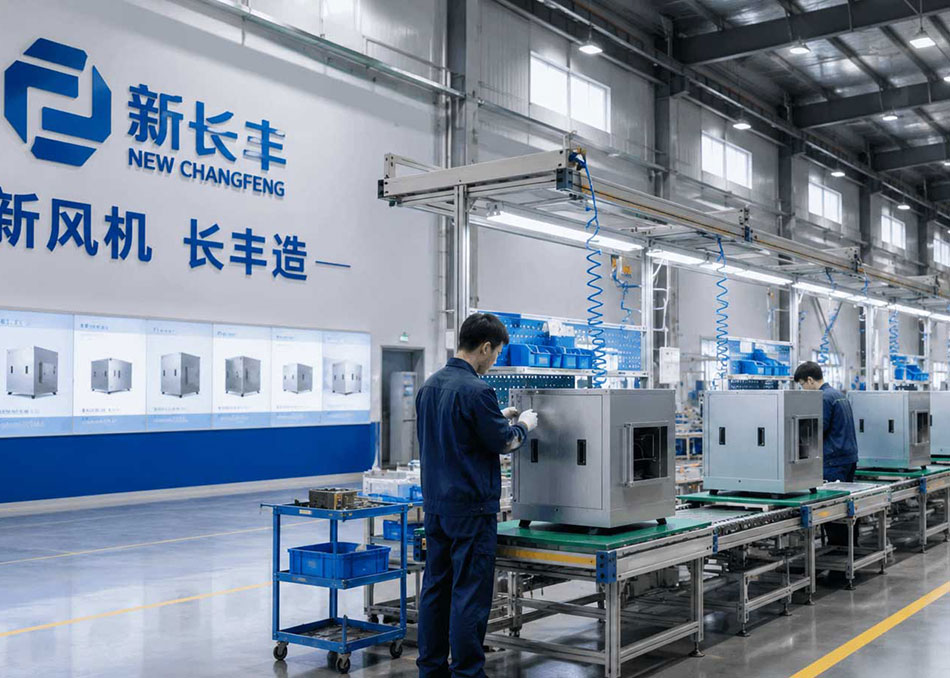
School canteens in Guangdong operate under conditions that punish poorly specified exhaust systems: hot, humid air for most of the year; a long rainy season; and kitchens where multiple cooking stations—steamers, woks, deep fryers—run at the same time. When the exhaust fan is undersized or mismatched, the results are predictable: grease-laden air spills into the dining area, walls and ceilings collect sticky deposits, and the kitchen becomes a negative-pressure box where doors are hard to open and burners struggle to draw combustion air. In this environment, the cabinet centrifugal fan has become a common workhorse for canteen exhaust, thanks to its compact footprint, useful pressure reserve, and suitability for centralized fume extraction. This article explains how to select one correctly, with the twin goals of fume purification and makeup air organization in mind.
Start with the Scenario: Three Realities of Guangdong School Canteen Exhaust
School canteens differ from ordinary restaurants. Meals are served in narrow time windows, so the exhaust system must handle sudden peaks in cooking fume rather than a steady trickle. At the same time, campuses tend to have stricter expectations for noise, odor, and safety. A fan that merely “pulls air out” is not enough; it must help the system capture, clean, and discharge reliably—and do so quietly enough for a school setting.
Guangdong’s climate amplifies the difficulty. In hot, humid conditions, water vapor and grease combine in the exhaust stream, making condensation and sticky buildup more likely inside ducts and fan housings. During the rainy season, if makeup air is poorly organized, the kitchen can become stuffy and excessively negative, creating a chain reaction: doors are hard to open, gas burners perform poorly, and exhaust effectiveness drops. For these reasons, selecting a cabinet centrifugal fan should never be based on a single number—it must be considered as part of the whole exhaust and purification system.
Three scenario-specific factors stand out:
- Peak fume loads: Concentrated meal service means fume generation spikes. The fan must deliver stable pressure under variable flow, not just a high free-air number.
- Humidity and grease: High humidity encourages condensation, while grease deposits can imbalance the impeller and reduce efficiency. Easy access for cleaning is not a luxury—it is a maintenance requirement.
- Campus sensitivity: Noise, odor, and visible grease discharge affect the dining environment and surrounding air quality. The exhaust system should be designed to mitigate all three.
Match the Fan to the Exhaust System, Not the Other Way Around
A cabinet centrifugal fan is typically installed downstream of the kitchen hood and fume purification stage, drawing air through ductwork and discharging it to a safe location. Because it is a centrifugal design, it can generate higher static pressure than a typical axial fan of similar size—useful when duct runs are long, when there are multiple bends, or when a fume purifier and silencer add resistance. That pressure reserve is why these fans are often chosen for centralized canteen exhaust.
However, the fan’s performance must be matched to the actual system resistance. If the selected fan’s pressure curve is too steep or too flat for the ductwork and purification components, the result can be either insufficient capture at the hood or excessive energy use. This is where industry standards help. In China, fan performance is commonly tested and rated according to GB/T 1236, which provides a basis for comparing airflow and pressure data. Energy performance can be evaluated against GB 19761, the fan energy efficiency standard. For kitchen fume discharge, GB 18483 sets emission requirements that the overall system—including purification—must meet. And where the exhaust duct passes through or near fire-rated zones, GB 51251 (smoke and heat exhaust) principles may inform duct routing and fire safety measures.
In practice, the selection process should flow like this:
- Estimate the required exhaust volume based on hood dimensions, cooking equipment type, and the number of simultaneous cooking stations. Local exhaust hood standards often provide a starting point, but the final figure should account for the actual menu and cooking intensity.
- Calculate system resistance across the hood, ductwork, purification unit, silencer, and discharge outlet. Include fittings, bends, and grease buildup allowance.
- Select a cabinet centrifugal fan whose performance curve delivers the required airflow at that resistance, with a reasonable margin for filter loading and future adjustments.
- Plan makeup air to replace the exhausted volume. Without it, negative pressure will undermine the whole system.
Fume Purification and Makeup Air: Two Halves of One System
Exhaust without purification simply moves the problem outdoors. In a school setting, that can mean complaints from neighbors and potential non-compliance with emission rules. A typical canteen exhaust train includes hood capture, a grease filter or baffle, an electrostatic fume purifier (or similar technology), and the cabinet centrifugal fan, followed by discharge. The fan must be compatible with the upstream purification equipment—both in terms of pressure loss and in terms of material and cleaning requirements.
Electrostatic purification, for example, can remove a high percentage of grease and smoke particles, but it adds resistance and requires regular cleaning. If the fan is selected without accounting for that resistance, airflow will drop as the purifier loads, and the hood will begin to spill. Similarly, if the fan is mounted before the purifier in a “push” configuration, it may handle grease-laden air, which affects maintenance intervals. Many canteen designs place the fan after the purifier to reduce grease exposure, but this requires the fan to handle the additional pressure drop.
Makeup air is equally important. In a tightly sealed kitchen, exhausting large volumes of air creates negative pressure that fights the exhaust fan and can cause backdrafting of combustion gases. Makeup air can be supplied through dedicated fresh air units, door/window louvres, or a combination. In Guangdong’s humid climate, untreated outdoor air can introduce moisture and heat, so some canteens use a water-cooled fresh air unit or a silent fresh air cabinet to temper and filter incoming air. The goal is to maintain a slight negative pressure in the kitchen relative to the dining area—enough to contain odors but not so much that doors are difficult to open or burners starve for air.
Practical Selection and Maintenance Checklist
Because school canteens operate on tight schedules and cannot afford frequent breakdowns, the fan and its installation should be evaluated for serviceability as much as for performance. The following checklist reflects lessons from real installations.
- Verify performance data. Ask for fan curves based on GB/T 1236 or equivalent testing. Avoid relying on a single point rating.
- Check energy efficiency. A fan that meets GB 19761 efficiency levels can reduce operating costs over years of daily use.
- Confirm material and construction. For humid, greasy environments, corrosion-resistant coatings and drainage provisions help extend service life.
- Plan for cleaning access. Impeller and housing should be accessible for grease removal. Consider a fan with a cleanout port or removable panels.
- Address noise early. Select a fan with appropriate sound levels for the location, and use vibration isolation and flexible connectors. If needed, add a duct silencer.
- Coordinate with fire safety. Duct routing, fire dampers, and fan shutdown logic should follow GB 51251 principles where applicable.
- Balance the system. After installation, measure airflow at hoods and adjust dampers to ensure even capture across all cooking stations.
- Schedule maintenance. Establish a cleaning routine for filters, purifier cells, and fan internals. Grease buildup is the enemy of both performance and fire safety.
FAQ: Cabinet Centrifugal Fans for School Canteens
Q: Can a cabinet centrifugal fan handle both fume exhaust and general kitchen ventilation?
A: It is usually dedicated to fume exhaust because grease-laden air requires specific cleaning and fire safety measures. General ventilation, especially makeup air, is better handled by separate units such as fresh air cabinets or axial fans. Mixing the two can complicate purification and maintenance.
Q: How do I know if my canteen needs a cabinet centrifugal fan versus a simpler axial fan?
A: The deciding factor is system resistance. If the exhaust route includes long ducts, multiple bends, a fume purifier, or a silencer, the higher static pressure capability of a centrifugal fan is often necessary. Axial fans are more suited to short, straight runs with low resistance.
Q: What maintenance does a cabinet centrifugal fan require in a humid climate?
A: Regular inspection and cleaning of the impeller and housing are essential to prevent grease and moisture buildup, which can cause imbalance, corrosion, and reduced performance. Check drains and seals, and ensure the motor is protected from moisture. The frequency depends on cooking volume, but a monthly check during peak operation is a reasonable starting point.
Q: Does the fan alone ensure compliance with kitchen fume emission standards?
A: No. Emission compliance depends on the entire system—hood capture, purification efficiency, duct design, and discharge location. The fan’s role is to move air reliably through that system. GB 18483 and local regulations should guide the overall design.
Conclusion
Selecting a cabinet centrifugal fan for a Guangdong school canteen is a system design exercise, not a catalog lookup. The hot, humid climate and concentrated meal service demand a fan that can deliver stable pressure, resist grease and moisture, and operate quietly. By matching the fan to calculated system resistance, integrating it with proper fume purification and makeup air, and planning for maintenance from day one, canteen operators can achieve reliable exhaust that keeps the kitchen comfortable and the campus air clean. For assistance in specifying a cabinet centrifugal fan or a complete canteen exhaust and makeup air solution, contact XCFFJ—our team can help you review your kitchen layout and select equipment that fits your actual operating conditions.