
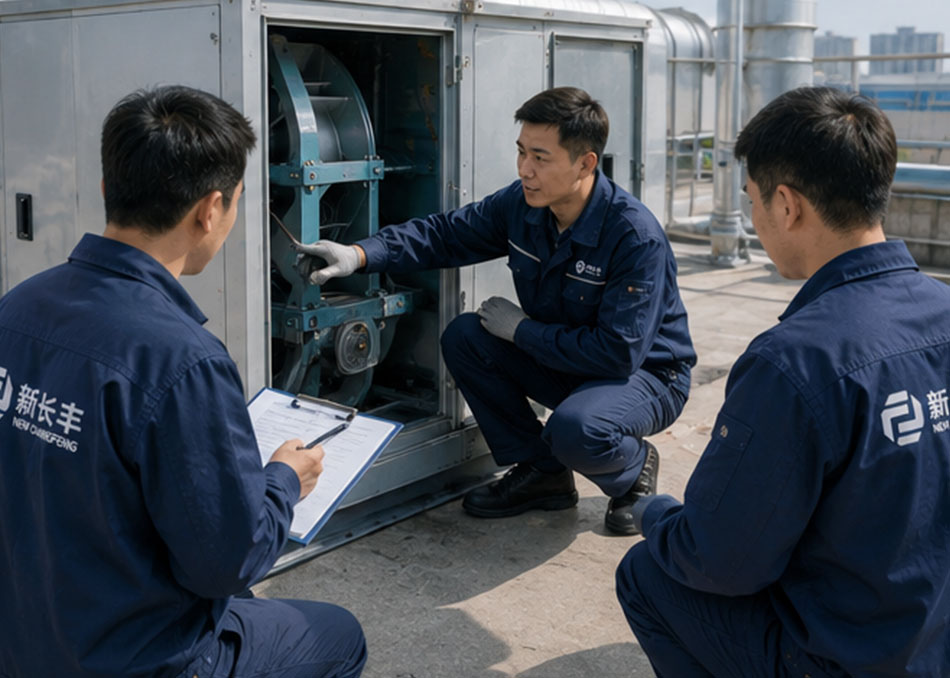
Factory ventilation looks straightforward on paper, but two problems dominate real-world projects: mismatched fan selection and poor installation details. Centrifugal fans excel at overcoming duct resistance, making them ideal for fume extraction and purification systems. Negative pressure fans are designed for whole-area air exchange in large workshops. Used together, they cover both local fume extraction and general ventilation. This article focuses on installation essentials for centrifugal fans in factory ventilation and fume purification applications.
Understanding the Roles: Centrifugal Fans vs. Negative Pressure Fans
In factory ventilation systems, centrifugal fans and negative pressure fans are not interchangeable—they serve different purposes. Centrifugal fans generate higher pressure through impeller rotation, enabling them to push air through long ducts, bends, purification equipment, and exhaust lines. This makes them essential for workshop fume extraction, dust collection downstream, and fresh air supply where resistance must be overcome. Cabinet centrifugal fans, DT cabinet centrifugal fans, and multi-wing centrifugal fans are common choices in these systems.
Negative pressure fans, by contrast, are mounted on exterior or side walls. They extract air to create a slight negative pressure indoors, drawing fresh air in through opposite doors, windows, or inlets. Their strengths lie in large coverage areas and relatively simple installation, making them suitable for hot, stuffy workshops with concentrated odors. When welding fumes, oil mist, or process exhaust are present, centrifugal fans paired with purification equipment handle local fume extraction first, while negative pressure fans manage overall air exchange—forming a "local extraction + general ventilation" combination.
Installation Essentials for Centrifugal Fans in Fume Extraction Systems
Proper installation of centrifugal fans directly affects extraction efficiency and system longevity. Start by confirming the fan's role in the system: is it handling clean air supply, or is it positioned downstream of purification equipment? For fume extraction, the fan should be placed after the purifier to avoid contaminant buildup on impeller blades, which can cause imbalance and vibration.
Duct design matters. Keep duct runs as short and straight as possible, minimizing bends and transitions. Every elbow adds resistance, reducing effective airflow. Use smooth, airtight ducting and seal all joints to prevent fume leakage—a common complaint in poorly installed systems. Flexible connectors at fan inlet and outlet help isolate vibration and noise. Ensure the fan is mounted on a level, rigid base with anti-vibration pads. For outdoor installations, weatherproof covers and drainage for condensation are necessary.
Electrical connections must follow local codes, with proper grounding and overload protection. For variable-speed fans, verify that the controller matches motor specifications. After installation, check rotation direction—centrifugal fans are directional, and reversed rotation drastically reduces performance. Finally, balance the system: adjust dampers or fan speed to achieve the desired extraction at each hood without overloading the motor.
Negative Pressure Fan Installation: Key Points for Whole-Area Ventilation
Negative pressure fans work best when paired with adequate inlet openings on the opposite side of the workshop. The rule of thumb: inlet area should be sufficient to avoid excessive negative pressure, which can starve the fan and reduce airflow. Install fans on the leeward side of the building when possible, and ensure they are not blocked by obstacles.
Mounting height and angle affect air distribution. For hot air removal, install fans high on the wall where heat accumulates. For general air exchange, a slight downward angle can improve mixing. Use sturdy frames and vibration isolators to minimize noise and structural stress. Regular maintenance—cleaning blades, checking belts, and lubricating bearings—keeps performance consistent. In dusty environments, consider filters or protective screens to prevent debris from entering the fan.
Integrating Centrifugal and Negative Pressure Fans for Optimal Results
The most effective factory ventilation strategies combine both fan types. Centrifugal fans handle localized, high-resistance tasks such as welding fume extraction or oil mist removal, often integrated with electrostatic precipitators or media filters. Negative pressure fans then manage overall air changes, removing residual heat, humidity, and odors. This layered approach ensures compliance with workplace air quality standards and improves employee comfort.
System design should consider airflow balance: the total exhaust capacity of negative pressure fans must be matched by adequate makeup air inlets. Otherwise, negative pressure can become excessive, causing doors to be hard to open and reducing fan efficiency. Controls can be simple switches or advanced variable-frequency drives for demand-based operation. Regular performance checks—using anemometers or differential pressure gauges—help identify duct leaks, clogged filters, or fan wear before they impact production.
Frequently Asked Questions
Q: Can I use a negative pressure fan alone for fume extraction?
A: Negative pressure fans are not ideal for fume extraction because they cannot overcome the resistance of long ducts and purification equipment. They are best for general ventilation. For fume extraction, a centrifugal fan is required to handle the pressure drop through hoods, ducts, and filters.
Q: How do I know if my centrifugal fan is installed correctly?
A: Check rotation direction (it should match the arrow on the casing), verify that airflow is sufficient at each extraction point, and listen for unusual vibration or noise. Also ensure all duct joints are sealed and the fan is securely mounted with vibration isolators.
Q: What maintenance does a centrifugal fan need?
A: Regularly inspect and clean the impeller to prevent imbalance from dust buildup. Check belts for tension and wear (on belt-driven models), lubricate bearings per the manufacturer's schedule, and verify electrical connections. In fume extraction systems, replace or clean filters upstream to protect the fan.
Q: Can I install a negative pressure fan on a wall with windows?
A: Yes, but ensure the windows on the opposite side can serve as air inlets. If the same wall has windows, they may short-circuit the airflow. It's better to install negative pressure fans on a solid wall and provide dedicated inlets on the opposite side.
Proper installation and integration of centrifugal and negative pressure fans are critical for effective factory ventilation and fume purification. By understanding their distinct roles and following best practices, you can achieve a safer, more comfortable, and compliant workplace. For tailored solutions, consult with ventilation equipment specialists who can assess your specific layout and contaminant profile.