
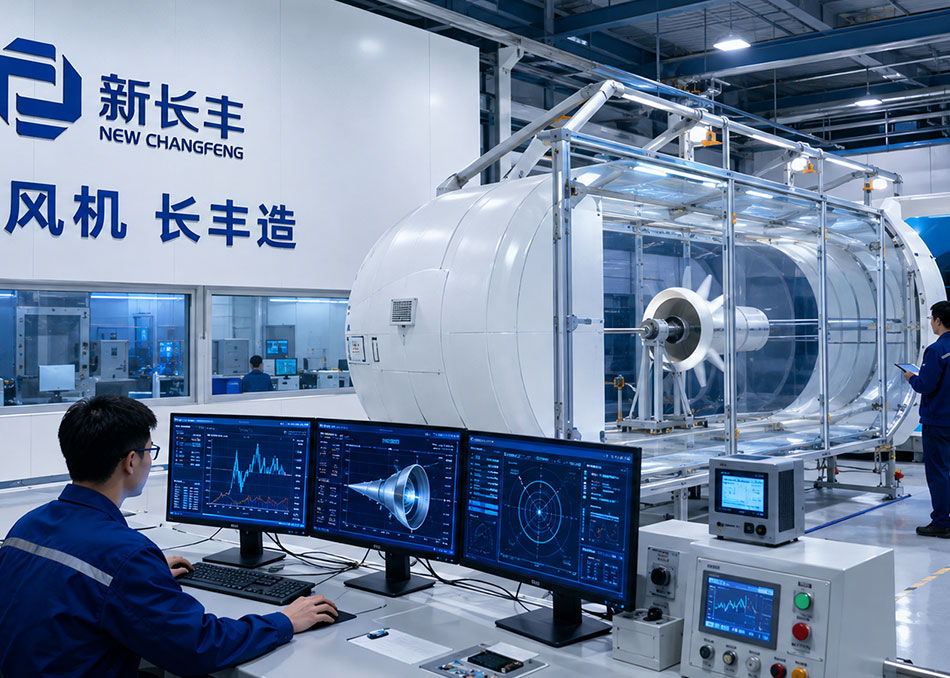
When buying a centrifugal fan, the two most common parameters are airflow and pressure, but many users only look at airflow, assuming a bigger number means stronger suction. In fact, airflow is how much air is delivered per unit time, while pressure is the fan's ability to push air against system resistance. Only the effective airflow under a given pressure really determines how the equipment performs once connected to ductwork.
The same fan does not always output a fixed airflow. The longer the duct, the more elbows, and the higher the filter or purifier resistance, the higher the system resistance — and the actual operating airflow usually falls. So the manufacturer's performance curve is more useful than a single maximum-airflow number. The essence of selection is placing the intersection of the system resistance curve and the fan performance curve in a sensible operating region.
Take kitchen exhaust: the hood, duct, elbows, purifier and high-rise discharge all produce pressure loss. If you estimate airflow only from the number of cookers without calculating static pressure, the unit may move a lot of air when free-running but fail once the duct is connected. Industrial exhaust is the same — long duct runs or multi-branch systems often need higher static pressure.
Too much airflow is not good either. Excessive airflow raises duct velocity, noise and energy use, and in a kitchen it can cause severe negative pressure that pulls cold air out of the dining room. Choosing too much pressure when system resistance is low can push the fan off its efficient operating point, again causing energy and noise problems. So sensible selection aims for a close match with a modest margin.
The Xin Changfeng site offers DT cabinet centrifugal fans, GX high-pressure cabinets, 11-62A multi-wing centrifugal fans, 4-72, A3-48, C3-48 and XBF series, covering different resistances and applications. When purchasing, prepare at least six items: purpose, target airflow, static pressure, air media, installation conditions and noise limits. If you do not yet have airflow and pressure data, provide the space size, duct length, number of elbows and equipment configuration so technicians can help estimate. Understanding the relationship between airflow and pressure is the first step to avoiding a fan that is either too big or too small.
When buying a centrifugal fan, the two most common parameters are airflow and pressure, but many users only look at airflow, assuming a bigger number means stronger suction. In fact, airflow is how much air is delivered per unit time, while pressure is the fan's ability to push air against system resistance. Only the effective airflow under a given pressure really determines how the equipment performs once connected to ductwork.
The same fan does not always output a fixed airflow. The longer the duct, the more elbows, and the higher the filter or purifier resistance, the higher the system resistance — and the actual operating airflow usually falls. So the manufacturer's performance curve is more useful than a single maximum-airflow number. The essence of selection is placing the intersection of the system resistance curve and the fan performance curve in a sensible operating region.
Take kitchen exhaust: the hood, duct, elbows, purifier and high-rise discharge all produce pressure loss. If you estimate airflow only from the number of cookers without calculating static pressure, the unit may move a lot of air when free-running but fail once the duct is connected. Industrial exhaust is the same — long duct runs or multi-branch systems often need higher static pressure.
Too much airflow is not good either. Excessive airflow raises duct velocity, noise and energy use, and in a kitchen it can cause severe negative pressure that pulls cold air out of the dining room. Choosing too much pressure when system resistance is low can push the fan off its efficient operating point, again causing energy and noise problems. So sensible selection aims for a close match with a modest margin.
The Xin Changfeng site offers DT cabinet centrifugal fans, GX high-pressure cabinets, 11-62A multi-wing centrifugal fans, 4-72, A3-48, C3-48 and XBF series, covering different resistances and applications. When purchasing, prepare at least six items: purpose, target airflow, static pressure, air media, installation conditions and noise limits. If you do not yet have airflow and pressure data, provide the space size, duct length, number of elbows and equipment configuration so technicians can help estimate. Understanding the relationship between airflow and pressure is the first step to avoiding a fan that is either too big or too small.