
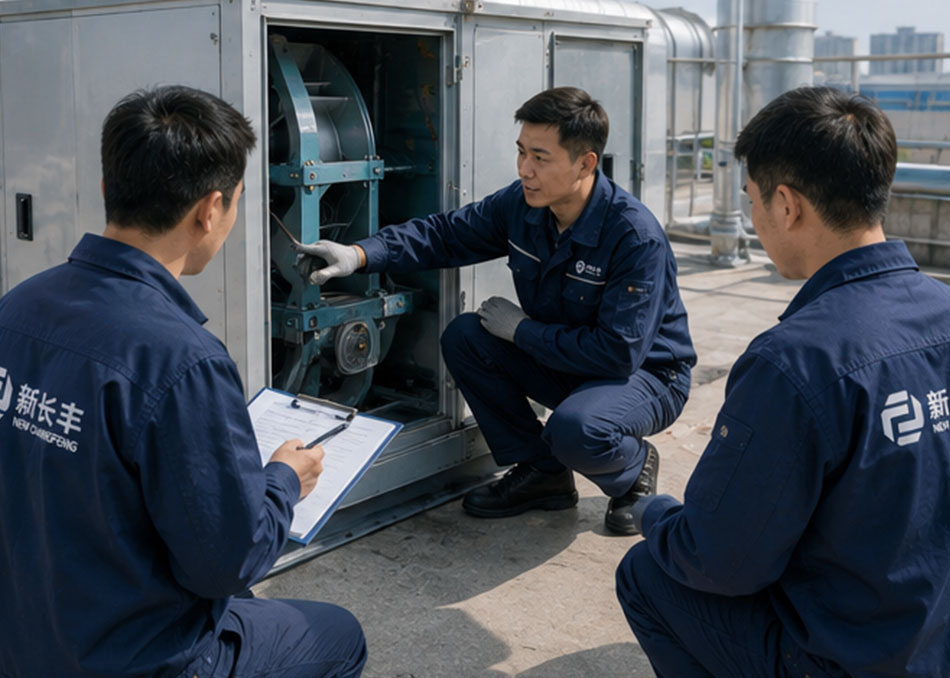
In industrial plants, commercial kitchens, warehouses, and logistics centers, ventilation is often overlooked until problems surface: stifling heat, lingering odors, grease-laden air escaping into dining areas, or insufficient makeup air that cripples exhaust performance. Many managers focus on primary exhaust equipment but neglect the other half of airflow organization—supply and makeup air. Axial fans, with their compact structure, flexible installation, and suitability for ducted supply/exhaust, are a common choice for ventilation systems. This article, centered on the theme “fume purification · ventilation and makeup air,” outlines selection and manufacturer considerations for axial fans in ventilation applications, serving plant managers, kitchen operators, and HVAC contractors.
Why Ventilation Systems Need Axial Fans
Ventilation is essentially the orderly exchange of indoor and outdoor air. Exhaust equipment removes contaminated air, but without adequate makeup air, negative pressure develops—reducing exhaust volume, causing grease backdrafts, and making doors hard to open. Axial fans move air parallel to the fan axis and are ideal for wall, window, or short-duct installation, handling supply, makeup, and general exhaust tasks. They act as the “air intake” of a ventilation system.
Technically, axial fans deliver high airflow at relatively low static pressure, making them suitable for straight-through ventilation paths with low resistance. When a system must overcome the resistance of long ducts or purification equipment, centrifugal fans are more appropriate. In practice, a common approach is to use cabinet centrifugal fans or fume purification units for main exhaust, while axial fans handle makeup air and localized ventilation.
Key Selection Criteria for Axial Fans
Selecting the right axial fan requires balancing airflow, pressure, noise, and energy efficiency. Start by calculating the required air volume based on room volume and air changes per hour, then account for system resistance. Axial fans perform best in low-resistance systems; if resistance is high, consider a centrifugal fan or a hybrid approach.
Noise is another critical factor, especially in commercial kitchens and areas near occupied spaces. Look for fans with aerodynamic blade design and low noise levels. Energy efficiency matters too: fans complying with GB 19761 (fan energy efficiency limits) help reduce operating costs. For grease-laden kitchen exhaust, choose models with easy-to-clean blades and corrosion-resistant finishes.
- Airflow and pressure: Match fan performance to calculated requirements; avoid oversizing or undersizing.
- Noise: Check sound pressure levels at operating conditions; consider variable-speed control for demand-based ventilation.
- Energy efficiency: Prioritize fans that meet or exceed GB 19761 efficiency grades.
- Durability: For kitchen exhaust, select models with grease-resistant coatings and robust bearings.
- Installation flexibility: Ensure the fan fits available wall/window openings or duct connections.
Integrating Axial Fans with Fume Purification and Makeup Air
In commercial kitchens, axial fans often serve as makeup air units, balancing the negative pressure created by exhaust hoods and purification systems. Without proper makeup air, exhaust hoods lose capture efficiency, leading to grease escape and odor complaints. Axial fans can be interlocked with exhaust systems to maintain slight negative pressure in the kitchen while preventing backdrafts.
For industrial fume purification, axial fans may supply air to dilution ventilation or assist in pushing fumes toward purification equipment. However, they should not be used to handle grease-laden air directly unless specifically designed for such duty. Coordinate axial fans with electrostatic precipitators or other purification devices to ensure compliance with GB 18483 (kitchen fume emission standard) and local regulations.
In warehouses and factories, axial fans can improve general ventilation and worker comfort. Pair them with evaporative air coolers or negative pressure fans for spot cooling and heat removal. Always verify that the fan’s airflow pattern supports the overall ventilation strategy—short-circuiting or dead zones can undermine performance.
Choosing a Reliable Axial Fan Manufacturer
When selecting a manufacturer, look beyond price. A reputable supplier offers technical support, performance data based on GB/T 1236 testing, and documentation for energy efficiency and safety. Check for experience in your industry—whether commercial kitchens, factories, or logistics—and ask for references or case studies.
XCFFJ (Shenzhen Xinchangfeng Dust Removal & Cooling Equipment Co., Ltd.) manufactures a range of ventilation equipment, including axial fans, cabinet centrifugal fans, negative pressure fans, and kitchen exhaust purifiers. With a focus on practical engineering and compliance with relevant standards, XCFFJ can help specify axial fans that integrate seamlessly with your exhaust and makeup air systems. Visit www.xcffj.com to learn more or discuss your project requirements.
FAQ
Q: Can axial fans be used for kitchen exhaust with heavy grease?
A: Standard axial fans are not ideal for grease-laden exhaust because grease can accumulate on blades and motors, reducing performance and creating fire risk. For kitchen exhaust, use dedicated grease-rated fans or centrifugal fans, and rely on axial fans primarily for makeup air or general ventilation.
Q: How do I determine the right airflow for my ventilation system?
A: Calculate the required air changes per hour based on room volume and usage. For kitchens, consider exhaust hood requirements and makeup air balance. Consult an HVAC engineer or use industry guidelines to size the fan, and account for duct resistance.
Q: What is the difference between axial and centrifugal fans for ventilation?
A: Axial fans move air parallel to the fan axis, providing high airflow at low pressure—suited for short, straight duct runs. Centrifugal fans draw air in axially and discharge radially, generating higher pressure for long ducts or systems with filters. Choose based on system resistance and application.
Proper ventilation is essential for safety, comfort, and compliance. By understanding the role of axial fans in makeup air and general ventilation, and by selecting a manufacturer that provides reliable performance data and support, you can build a system that works efficiently and stands the test of time. For tailored advice on axial fans and complete ventilation solutions, contact XCFFJ today.