
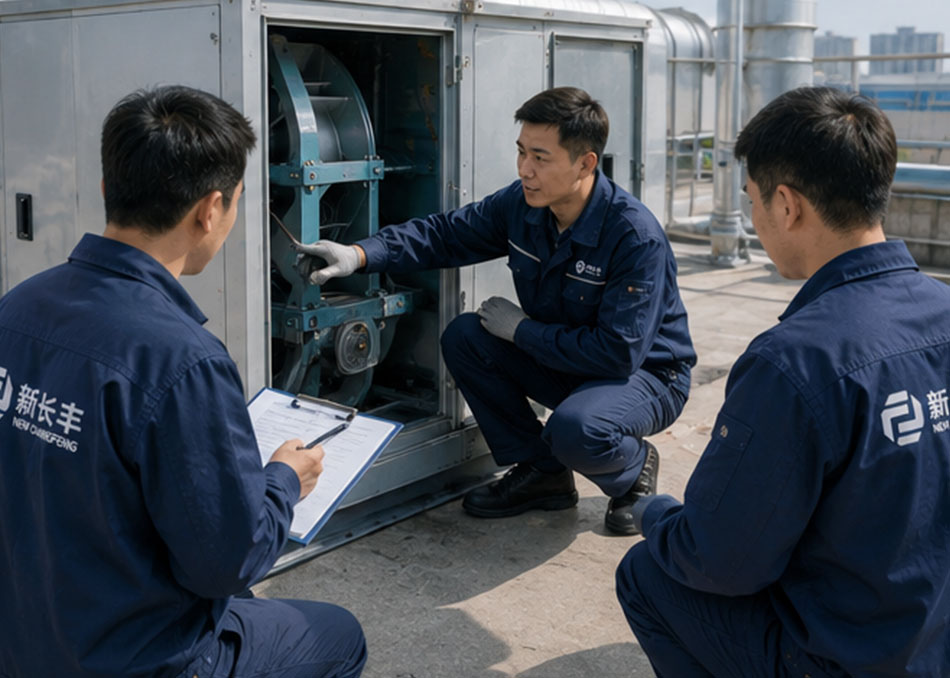
The 4-72 centrifugal fan is a common centrifugal ventilation device in industrial ventilation, used for general air delivery, industrial exhaust and duct-system matching. On the Xin Changfeng site, the 4-72 series is positioned for industrial exhaust and ducted air delivery. For factory users, whether the 4-72 fits cannot be judged by the words industrial exhaust alone — confirm the conveyed media, temperature, dust content, corrosiveness, and the required airflow and pressure.
Industrial exhaust differs from catering oil fume. Welding smoke, process exhaust, hot air, dust and equipment heat all have very different characteristics. If the media contains heavy particles, corrosive gas or high-temperature fume, the fan's materials, sealing, motor position and protection rating may need special design. So clarify what is being exhausted before choosing the fan structure. A general ventilation fan should not be forced to run beyond its design conditions.
The second step is to calculate the effective airflow. Whole-workshop air change can be estimated from space volume, heat load and air changes per hour; local extraction is determined by the hood size, the source release rate and the capture distance. Once airflow is set, calculate static pressure from duct length, elbows and filters. Only when both airflow and pressure are satisfied will the end achieve stable suction.
When the 4-72 connects to a duct, keep the inlet airflow as uniform as possible. An elbow too close to the inlet, a sudden size reduction or asymmetric inlet flow adds turbulence and hurts efficiency. The outlet side should also avoid sharp transitions. Base, vibration isolation, flexible connections and motor cooling must be handled at construction — especially for continuously running factory projects, where long-term reliability matters most.
In industrial ventilation, the 4-72 is just one of many options. If duct resistance is high, evaluate the GX high-pressure cabinet; for general equipment matching, compare A3-48, C3-48 or other series. Xin Changfeng recommends providing the workshop size, pollution-source type, duct layout, target airflow and static pressure before fixing the model. A correctly chosen industrial exhaust fan affects not just whether there is airflow, but also energy use, noise, equipment life and the improvement of the production environment.