
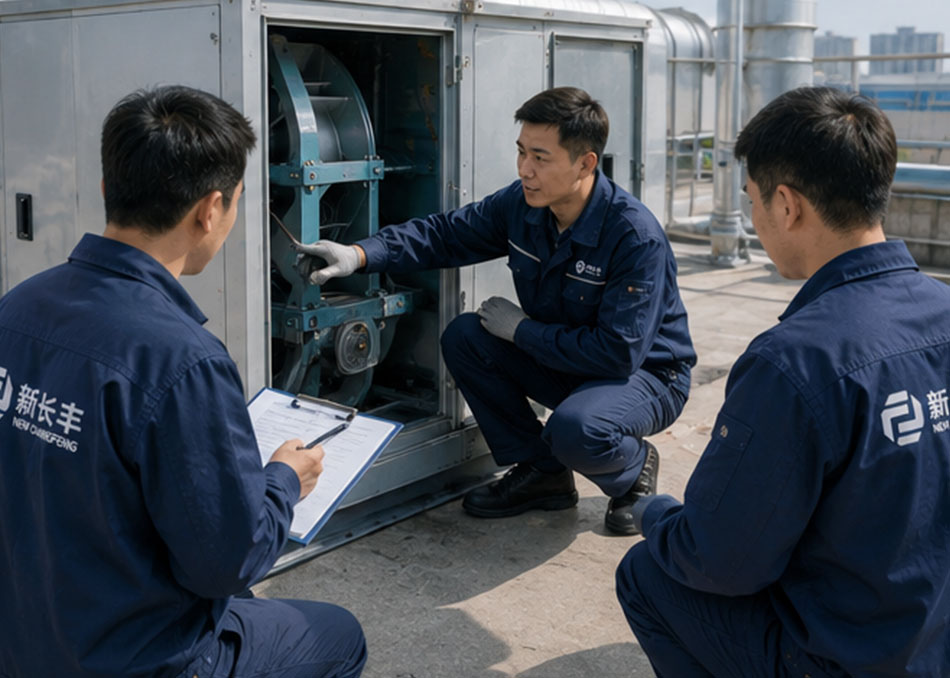
School canteens present a unique ventilation challenge: meal periods are short and intense. Within one or two hours, multiple cooking stations fire up simultaneously—steaming, stir-frying, deep-frying, and boiling—causing fume generation to spike rapidly. If the exhaust system is undersized, lacks static pressure, or has poorly designed ductwork, the result is smoke spillage, odour migration into corridors, a sweltering kitchen, and even backdraft at the stove. Many canteen retrofit projects focus only on fan motor power during procurement, overlooking system resistance, duct length, elbow count, and purifier pressure drop. The fan may look powerful on paper, but once installed it simply cannot pull. Selecting the right core equipment is critical—and the DT cabinet centrifugal fan is one of the most common choices for school canteen exhaust purification. This article explains the technical parameters of DT cabinet centrifugal fans, the selection logic, and common pitfalls, helping facility managers, engineering firms, and procurement staff make informed decisions.
Why School Canteen Exhaust Systems Fail—and How DT Cabinet Centrifugal Fans Help
Unlike commercial restaurant kitchens that operate continuously, school canteens concentrate cooking into a narrow window. This means the exhaust system must handle a sudden, heavy load. A fan that performs adequately during light cooking may falter when all burners are on. The key is to match the fan's pressure–volume curve to the actual system resistance, not just the motor rating.
DT cabinet centrifugal fans are designed for exactly this kind of demanding, variable-load scenario. Their belt-driven or direct-driven multi-blade impellers generate higher static pressure than axial fans, making them better suited to overcoming the resistance of long ducts, grease filters, and electrostatic purifiers. When selected correctly, they maintain strong suction even during peak meal times, preventing smoke from escaping into the dining area.
Understanding DT Cabinet Centrifugal Fan Technical Parameters
When reviewing a DT cabinet centrifugal fan datasheet, several parameters determine whether it will perform in a school canteen exhaust system. Here are the key ones and what they mean in practice:
- Air volume (m³/h): The volume of air the fan can move per hour. It must be sufficient to capture fumes at the hood and carry them through the ductwork. Undersizing leads to smoke spillage; oversizing wastes energy and may cause noise.
- Static pressure (Pa): The fan's ability to overcome system resistance. School canteen systems often include hood filters, long horizontal ducts, multiple elbows, and purification equipment—each adds resistance. A fan with insufficient static pressure will deliver far less air than its rated volume once installed.
- Power (kW): The motor's rated output. It should be matched to the required air volume and pressure, with a reasonable safety margin. Higher power alone does not guarantee better performance if the impeller and casing are not optimised for the duty point.
- Noise level (dB): School canteens are often near teaching buildings or dining areas. Low-noise operation is important. Cabinet construction and impeller balance help reduce noise, but duct design and installation also play a role.
- Efficiency: Compliant with GB 19761 fan energy efficiency standards. Higher efficiency means lower operating costs over the school year.
It is important to note that catalogue values are measured under standard laboratory conditions (GB/T 1236). Actual performance depends on the system effect—how the fan is installed, the duct layout, and the condition of filters. Always request a system curve analysis or consult the manufacturer for a selection based on real operating resistance.
Matching DT Cabinet Centrifugal Fans to School Canteen Exhaust Purification Systems
A typical school canteen exhaust system includes: hoods, grease filters, ductwork, a purification unit (electrostatic or UV), and the fan. The fan must be selected to handle the total pressure drop of all components at the required airflow. For example, if the purification unit adds resistance, the fan's operating point shifts to a lower airflow unless it has enough static pressure reserve.
DT cabinet centrifugal fans are often placed after the purifier in a draw-through configuration, which keeps the fan out of the grease-laden airstream and simplifies maintenance. However, this means the fan handles cleaned but still humid air—corrosion-resistant construction may be advisable. Alternatively, a push-through arrangement can be used, but the fan must then be rated for grease exposure and cleaning.
In school canteens, redundancy is sometimes considered for critical exhaust paths, but budget constraints often limit this. A better approach is to select a fan with a slight performance margin and ensure regular cleaning of filters and purifiers to keep resistance within design limits. Variable frequency drives (VFDs) can also help match fan speed to actual cooking load, saving energy during off-peak hours.
Installation and Maintenance Best Practices for DT Cabinet Centrifugal Fans
Even the best fan will underperform if installed poorly. Follow these guidelines to ensure reliable operation:
- Minimise duct resistance: Keep duct runs as short and straight as possible. Use gradual bends instead of sharp elbows. Ensure duct diameter matches fan inlet/outlet to avoid turbulence.
- Provide proper access: Leave space around the fan for inspection, belt tensioning (if belt-driven), and cleaning. Cabinet fans typically have removable panels for this purpose.
- Vibration isolation: Use spring or rubber isolators to prevent vibration transmission to the building structure, which can cause noise complaints.
- Regular maintenance: Check belts for wear, clean impeller if grease accumulates, and verify motor current draw. A clogged impeller reduces performance and can unbalance the fan.
- Compliance: Ensure the system meets local fire and smoke exhaust codes, such as GB 51251 where applicable, especially if the exhaust duct passes through fire-rated zones.
For school canteens, scheduling maintenance during holidays is practical. A well-maintained DT cabinet centrifugal fan can provide years of dependable service, keeping the kitchen comfortable and compliant with emission standards like GB 18483.
Frequently Asked Questions
Q: What is the difference between a DT cabinet centrifugal fan and a regular axial fan for canteen exhaust?
A: Axial fans move air parallel to the fan shaft and are good for low-resistance, high-volume applications. DT cabinet centrifugal fans use a centrifugal impeller to generate higher static pressure, making them better at overcoming ductwork, filters, and purifier resistance—common in school canteen exhaust systems. They are also typically quieter and more compact for the same duty.
Q: Can I just replace my old fan with a higher-power DT cabinet centrifugal fan to solve smoke spillage?
A: Not necessarily. Smoke spillage often indicates insufficient airflow at the hood, which can be caused by undersized ducts, excessive elbows, or clogged filters. Increasing motor power without addressing system resistance may not solve the problem and can increase noise and energy use. A proper system evaluation is recommended before upsizing.
Q: How do I know what size DT cabinet centrifugal fan my school canteen needs?
A: The fan must be selected based on the required exhaust air volume (determined by hood size and cooking load) and the total system static pressure (calculated from duct length, fittings, filters, and purifier). This is typically done by an HVAC engineer using fan selection software. Catalogue parameters alone are not enough; always request a selection based on your actual system layout.
Q: Are DT cabinet centrifugal fans compliant with energy efficiency regulations?
A: Many models are designed to meet GB 19761 fan energy efficiency standards. When selecting, ask the manufacturer for efficiency data and choose a fan that operates near its best efficiency point at your required duty. Using a VFD can further reduce energy consumption during partial-load operation.
Choosing the right DT cabinet centrifugal fan for a school canteen exhaust system is about matching performance to real-world resistance, not just picking a big motor. By understanding the key parameters, accounting for system effects, and following proper installation and maintenance practices, facility managers can ensure a smoke-free, comfortable dining environment. For assistance with fan selection or to learn more about XCFFJ's range of ventilation and purification equipment, visit www.xcffj.com or contact our technical team.