
Commercial kitchens — especially those running heavy wok cooking — put their exhaust systems through conditions that ordinary ventilation equipment was never designed to handle. Instant bursts of oil-laden smoke, high temperatures, entrained moisture and particulate matter all combine to create one of the toughest air-moving environments in any building. The result is a familiar set of complaints: grease escaping into the dining area, weak exhaust that never quite clears the hood, and noise and energy costs that keep climbing. For these reasons, the DT cabinet centrifugal fan has become a common choice for kitchen exhaust and make-up air systems, often paired with a water-cooled fresh air unit. This article explains how both machines work and what matters when specifying them for a kitchen exhaust purification system.
Why Kitchen Exhaust Depends on Centrifugal Pressure, Not Just Air Volume
The defining difference between kitchen exhaust and general ventilation is system resistance. Exhaust air must travel through the hood, ductwork, a fume purifier, possibly a silencer, a fire damper, multiple elbows and finally the discharge point on the roof or wall. Every one of those components adds pressure loss, and those losses accumulate.
Axial fans move large volumes of air but generate relatively low static pressure. In a kitchen with long duct runs and several bends, that limitation shows up as smoke that will not pull away from the hood and cannot be pushed all the way to the discharge point. A DT cabinet centrifugal fan works differently: air enters the impeller and is accelerated outward, converting velocity into static pressure. That higher pressure capability is what allows the fan to overcome a complex, resistance-heavy network and deliver greasy exhaust reliably to the purifier and the final discharge.
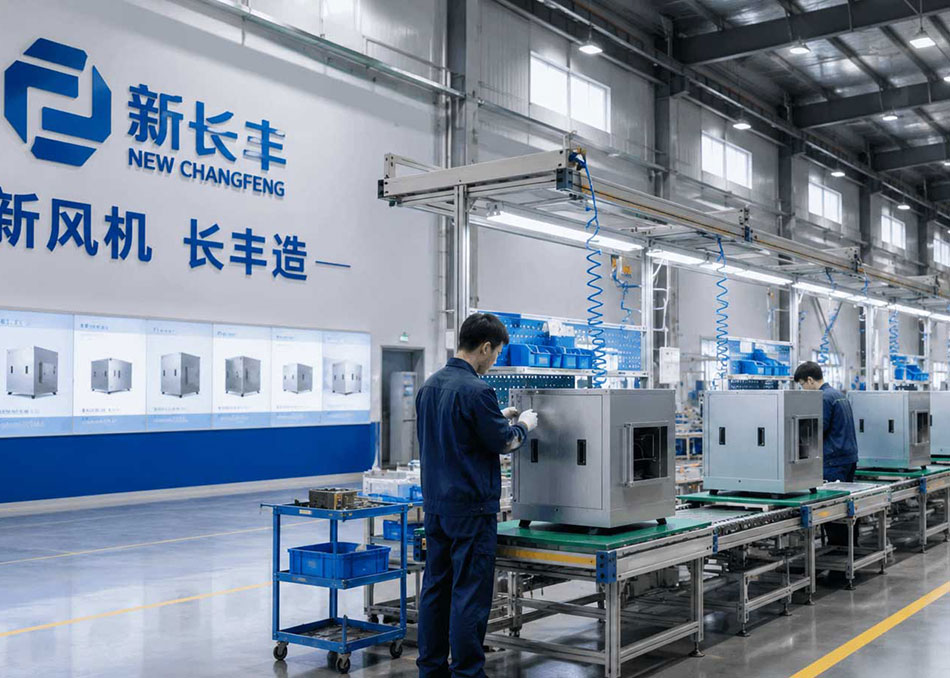
In practical terms, the cabinet format also helps. The fan is enclosed in a box-type housing, which contains noise, protects the impeller and motor from grease and dust, and makes the unit easier to integrate into a packaged exhaust purification skid alongside a fume purifier.
Inside the DT Cabinet Centrifugal Fan
A typical DT cabinet centrifugal fan consists of a box housing, a multi-blade centrifugal impeller, a drive system (belt-driven or direct-coupled), and a motor mounted within or adjacent to the cabinet. The multi-blade impeller is designed to move relatively large air volumes while maintaining useful pressure, which suits the mixed airflow of a kitchen exhaust system.
Because kitchen exhaust carries grease and moisture, the fan's placement in the system matters. Positioning the fan downstream of the purifier reduces the grease load reaching the impeller, which supports longer service intervals and more stable performance over time. Belt-driven configurations allow the fan speed to be adjusted through pulley selection, giving designers a way to match actual measured system resistance rather than relying on nominal assumptions.
Two standards are worth referencing during selection and verification. GB/T 1236 covers fan performance testing, and GB 19761 addresses fan energy efficiency. Together they provide a basis for comparing catalogued performance against tested performance and for evaluating whether a given fan meets efficiency expectations for its duty point.
The Role of Water-Cooled Fresh Air Units in Kitchen Make-Up Air
Every cubic meter of air exhausted from a kitchen must be replaced. If make-up air is not supplied deliberately, the kitchen will draw it from wherever it can — through doorways, dining areas, or back through the exhaust system itself, which collapses hood capture velocity and lets smoke escape. A water-cooled fresh air unit addresses this by supplying tempered make-up air while also removing heat.
The operating principle is straightforward. The unit draws in outdoor air, passes it across a cooling coil through which chilled water circulates, and delivers cooled, filtered air into the kitchen. Because the cooling medium is water rather than a direct-expansion refrigerant circuit, the unit can be connected to an existing chiller plant or a dedicated water chiller, and it avoids the refrigerant handling requirements of DX equipment. In hot climates and in kitchens where wok burners radiate intense heat, this combination of ventilation and sensible cooling directly improves working conditions.
Correct balancing is essential. Supply air should be slightly less than exhaust volume so the kitchen remains under negative pressure relative to adjacent spaces. That negative pressure is what keeps cooking odours and grease from migrating into the dining room, while still allowing the hood to capture fumes effectively. GB 18483, the national standard for cooking fume emissions, sets limits that the combined exhaust and purification system must satisfy at the discharge point.
Design and Selection Points That Determine Real-World Performance
Kitchen exhaust systems fail for predictable reasons, and most of them trace back to specification decisions made before installation.
- Calculate total system resistance, not just duct length. Include hood, purifier, silencer, fire damper, elbows, and discharge termination in the pressure budget.
- Match fan pressure to the worst-case path. The fan must still perform when filters load and resistance rises between cleaning cycles.
- Place the fan to minimise grease exposure. Downstream of the purifier is generally preferable where layout permits.
- Balance supply and exhaust. Slightly negative kitchen pressure protects the dining area without starving the hood.
- Address noise at the source and in the path. Cabinet construction, vibration isolation, and duct silencers all contribute.
- Verify against applicable standards. GB/T 1236 for performance, GB 19761 for efficiency, GB 18483 for emission limits, and GB 51251 where smoke and heat exhaust considerations apply.
It is also worth noting that a DT cabinet centrifugal fan used in a smoke exhaust role may need to satisfy additional requirements under GB 51251, depending on how the system is classified. Designers should confirm the intended duty — normal kitchen exhaust, emergency smoke exhaust, or both — before finalising equipment selection.
Frequently Asked Questions
Q: Can a DT cabinet centrifugal fan be used without a fume purifier?
A: It can move the air, but it will not reduce emissions. Kitchen exhaust must meet the limits in GB 18483, so a purifier — typically electrostatic or a comparable technology — is normally required in the exhaust path. The fan's role is to provide the pressure needed to move air through that purifier and the rest of the system.
Q: Why not use a cheaper axial fan instead?
A: Axial fans are effective where resistance is low and duct runs are short. Commercial kitchen exhaust rarely meets those conditions. Once a purifier, silencer, fire damper and several elbows are in the path, the pressure demand usually exceeds what an axial fan can deliver, resulting in poor capture at the hood.
Q: Does a water-cooled fresh air unit replace the exhaust fan?
A: No. They perform opposite functions. The exhaust fan removes contaminated air; the fresh air unit supplies tempered replacement air. Both are needed, and they must be balanced against each other for the kitchen to stay under slight negative pressure.
Q: How often does a kitchen exhaust fan need cleaning?
A: Frequency depends on cooking volume, fuel type and the position of the fan in the system. Heavier wok cooking and higher grease loading require more frequent inspection. Placing the fan downstream of the purifier reduces grease accumulation and extends cleaning intervals.
Summary
Effective kitchen exhaust comes down to matching pressure capability to real system resistance and balancing exhaust against make-up air. The DT cabinet centrifugal fan provides the static pressure needed to push greasy, moisture-laden air through purifiers and long duct runs, while a water-cooled fresh air unit supplies cooled replacement air that keeps the kitchen comfortable and the hood working as intended. Specifying both against recognised standards — GB/T 1236, GB 19761, GB 18483 and GB 51251 where applicable — gives the best chance of a system that performs on day one and still performs after a year of heavy cooking.
If you are planning a kitchen exhaust purification or make-up air system, XCFFJ manufactures DT cabinet centrifugal fans, water-cooled fresh air units and related ventilation equipment for commercial kitchens, canteens, hotels and food service facilities. Contact us to discuss your project requirements.