
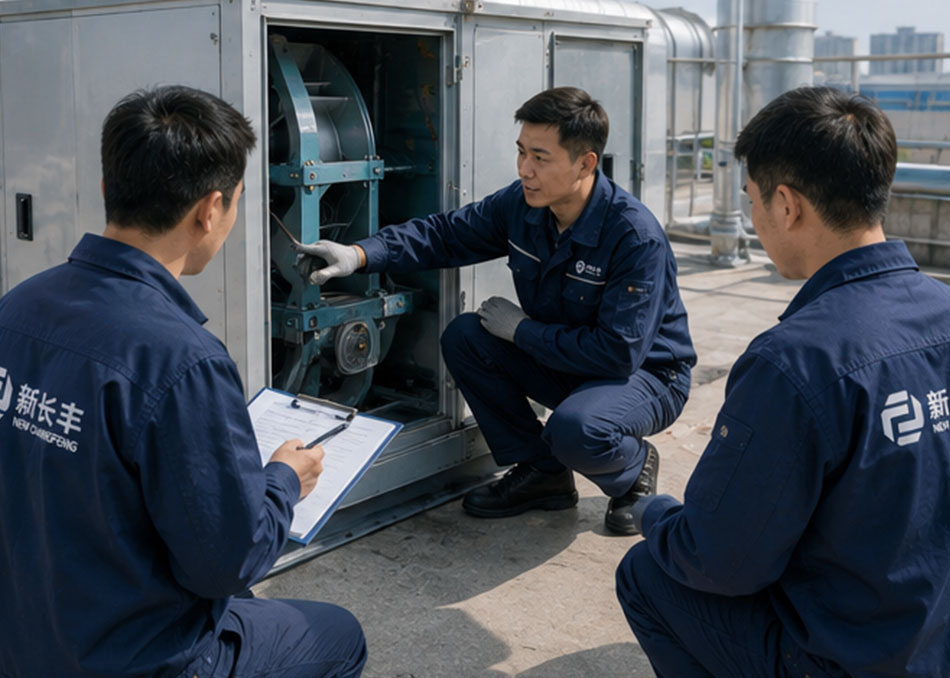
Workshop heat, lingering odors, and unvented smoke and dust are daily realities for many factory managers. Especially during hot summer months, steel-structure workshops often reach indoor temperatures noticeably higher than outdoors, leading to reduced employee efficiency, equipment cooling challenges, and poor air quality—problems that cannot be solved by simply adding more floor fans. Negative pressure fans, as a mature solution for industrial ventilation and cooling, have been widely adopted in workshop ventilation scenarios in recent years. At the same time, there is much discussion about brands such as Lanchang, and procurement staff often wonder: how to choose negative pressure fans, what distinguishes brands, and how to design workshop ventilation properly. This article clarifies the principles, selection, and common issues of negative pressure fans in workshop ventilation.
Why Negative Pressure Fans Are Suited for Workshop Ventilation
The core logic of negative pressure ventilation is straightforward: install negative pressure fans on one side of the workshop to exhaust air outward, creating a relatively low-pressure zone inside. Outdoor air is then drawn in through doors, windows, or air inlets on the opposite side, forming a continuous airflow. Unlike relying solely on fans to stir indoor air, negative pressure ventilation achieves air exchange—expelling hot air, dust, and odors while bringing in fresh air, rather than merely circulating air within the space.
Technically, negative pressure fans often use axial impeller structures, combined with louvers and a gravity shutter mechanism. When the fan stops, the louvers close to reduce backflow and prevent insects from entering. Performance evaluation can refer to GB/T 1236 Fan Performance Testing, and energy efficiency should meet the准入 requirements of GB 19761 Minimum Allowable Values of Energy Efficiency for Fans.
Key Selection Factors for Workshop Ventilation
Choosing the right negative pressure fan involves more than picking a brand. Several factors must be considered to ensure effective ventilation and energy savings.
- Air Volume and Air Changes: Determine the required air volume based on workshop volume and desired air changes per hour. For general workshops, 5–10 air changes per hour are common; higher rates may be needed for heat or pollutant-intensive areas.
- Static Pressure and Duct Design: Account for resistance from ducts, louvers, and external wind. Ensure the fan can overcome system static pressure while maintaining airflow.
- Energy Efficiency: Select fans that comply with GB 19761 energy efficiency standards to reduce operating costs.
- Noise Levels: Consider noise limits, especially for workshops near residential areas or with strict noise regulations.
- Durability and Maintenance: Look for corrosion-resistant materials, easy-to-clean designs, and reliable motor protection.
- Brand and Support: While brand reputation matters, focus on technical support, warranty, and availability of spare parts. Brands like Lanchang may offer specific advantages, but always verify performance data and certifications.
Design and Installation Best Practices
Proper design and installation are critical to realizing the benefits of negative pressure ventilation. The goal is to create a uniform airflow pattern that sweeps through the entire workspace, avoiding dead zones.
Position exhaust fans on the leeward side or at high points where hot air accumulates, and provide ample inlet openings on the opposite side. Inlets should be sized to minimize resistance—typically, inlet area should be at least 1.5 times the fan area. Distribute fans evenly to prevent short-circuiting, where fresh air exits directly without mixing. Consider using adjustable louvers or dampers to balance airflow.
For workshops with partitions or obstacles, use multiple smaller fans rather than one large unit to ensure coverage. Installation height and angle affect airflow direction; consult with ventilation engineers to optimize layout. Also, integrate with existing HVAC or exhaust systems to avoid conflicts.
Common Issues and Solutions
Even with proper selection and installation, issues may arise. Here are typical problems and how to address them:
- Insufficient Air Exchange: Check for blocked inlets, undersized fans, or excessive static pressure. Clean louvers and filters regularly.
- Hot Spots: Improve air distribution by adding circulation fans or adjusting fan positions.
- Noise Complaints: Install vibration isolators, use slower-speed fans, or add acoustic enclosures.
- Corrosion or Dust Buildup: Choose fans with protective coatings and implement routine cleaning schedules.
- Energy Waste: Use variable frequency drives (VFDs) to match fan speed to demand, and ensure fans operate only when needed.
FAQ
Q: What is the difference between negative pressure fans and regular exhaust fans?
A: Negative pressure fans are designed to create a systematic negative pressure across the entire workshop, drawing fresh air through designated inlets. Regular exhaust fans may only remove air locally without controlled inlet paths, leading to uneven ventilation. Negative pressure fans often include louvers and are optimized for higher air volume and pressure.
Q: How do I calculate the required air volume for my workshop?
A: Multiply the workshop volume (length × width × height) by the desired air changes per hour. For example, a workshop of 1,000 m³ with 8 air changes per hour requires 8,000 m³/h total air volume. Distribute this across multiple fans, considering static pressure and fan performance curves. Always consult a ventilation engineer for precise calculations.
Q: Are negative pressure fans suitable for workshops with explosive dust or gases?
A: Standard negative pressure fans are not suitable for hazardous environments. For explosive dust or gases, use explosion-proof fans certified for such atmospheres, and ensure proper grounding and wiring. Consult local safety regulations and experts.
In summary, negative pressure fans offer an effective and energy-efficient solution for workshop ventilation and cooling when properly selected, designed, and maintained. By focusing on air volume, static pressure, efficiency, and installation best practices, factories can create a comfortable and safe working environment. For tailored advice and high-quality ventilation equipment, including negative pressure fans, contact XCFFJ—our team can help you design the optimal solution for your workshop.