
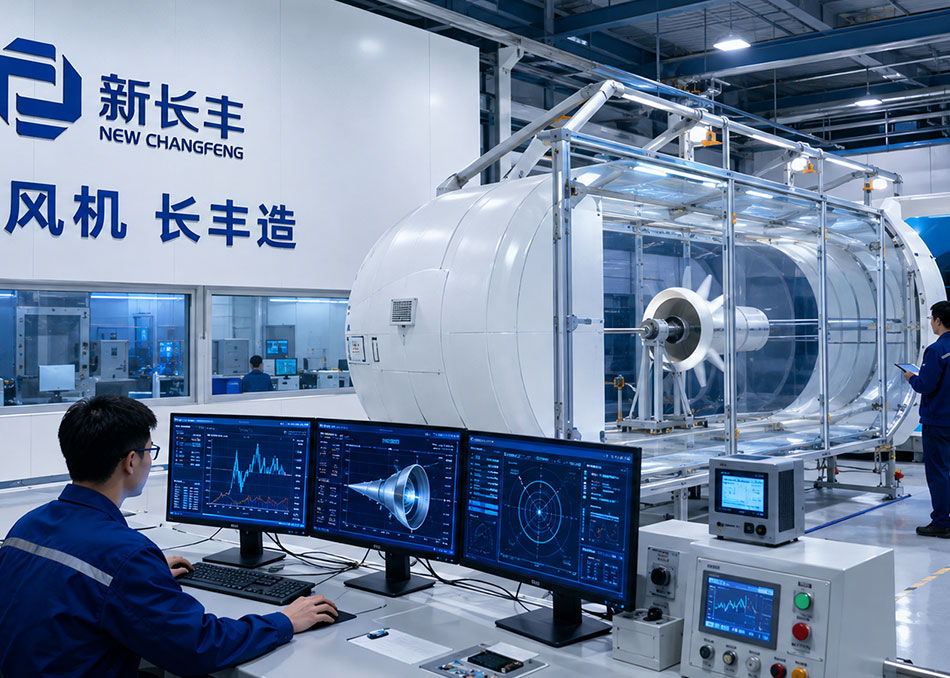
Commercial kitchen exhaust systems face three persistent challenges: grease-laden fumes escaping into dining areas, inadequate exhaust flow, and noise complaints from neighboring properties. Operators often assume the solution is a more powerful fan and repeatedly replace equipment—only to find the problem persists. The real issue usually lies in system matching and installation practices. This article focuses on the centrifugal fan as the primary workhorse for kitchen exhaust purification, clarifies how negative pressure fans fit into the overall ventilation strategy, and answers the common question: how should a negative pressure fan be installed?
Why Centrifugal Fans Are the Backbone of Kitchen Exhaust Systems
Kitchen exhaust is not ordinary air. It carries high temperatures, oil mist, and particulate matter, and it often must travel through long duct runs to reach a purifier before being discharged. This demands a fan with significant pressure capability to overcome duct friction, fitting losses, and the resistance of purification equipment.
Centrifugal fans generate pressure through the centrifugal force created by a rotating impeller. Their high pressure coefficient and relatively stable airflow make them well-suited for medium-to-long duct systems. That is why they are the default choice for commercial kitchen exhaust. By contrast, negative pressure fans—typically axial-flow devices—move large volumes of air at low static pressure. They excel at whole-room ventilation and cooling in open workshops, not at driving air through complex exhaust networks.
From a standards perspective, exhaust system design should follow the principles of GB 51251 (Technical Standard for Smoke Control and Exhaust Systems in Buildings) for duct and resistance calculations. Fan performance should be verified according to GB/T 1236 (Fan Performance Testing), and energy efficiency can be referenced against GB 19761 (Minimum Allowable Values of Energy Efficiency for Fans). Selecting equipment that meets these benchmarks helps ensure the system performs as intended over its service life.
Matching the Centrifugal Fan to the Exhaust System
A centrifugal fan is only as effective as the system it serves. Before choosing a model, calculate the total system resistance: straight duct length, elbows, transitions, grease filters, and the purifier itself. The fan's operating point must sit on its performance curve at the airflow and pressure the system actually requires—not at a nominal rating measured under ideal conditions.
Equally important is the fan's placement relative to the kitchen hood and the purifier. In most designs, the fan is installed downstream of the grease filter and upstream of the discharge point, but the exact arrangement depends on whether the purifier is in-line or end-of-line. A centrifugal fan that is oversized for the ductwork can cause excessive velocity, noise, and grease carryover; undersized, it will fail to capture fumes at the hood.
For kitchen applications, consider these practical points:
- Select a fan with a pressure curve that matches the system resistance at the design airflow.
- Prefer backward-curved impellers for higher efficiency and better resistance to grease buildup.
- Ensure the motor is rated for the ambient temperature and grease-laden environment, or mounted out of the airstream.
- Include access doors for cleaning and inspection, as grease accumulation will degrade performance over time.
- Verify sound power levels and plan for vibration isolation and acoustic treatment if the fan is near occupied spaces.
Negative Pressure Fans: Role and Installation in Kitchen Environments
Negative pressure fans are not a substitute for a centrifugal exhaust fan in the grease exhaust path. Instead, they serve a complementary role: supplying or exhausting large volumes of air to maintain comfortable conditions, dilute heat, and prevent odors from migrating into dining areas. In a commercial kitchen, a negative pressure fan is often used as a make-up air unit or as a general exhaust fan for the surrounding prep or dishwashing areas.
Installation of a negative pressure fan must respect several fundamentals:
- Location: Mount on an exterior wall or roof where discharged air will not be drawn back into the building or cause nuisance to neighbors. Avoid recirculation zones near intake vents.
- Structural support: Ensure the wall or roof structure can handle the fan's weight and vibration. Use appropriate brackets, isolation mounts, and weatherproof flashing.
- Airflow path: Provide a clear, unobstructed path for both intake and discharge. Keep the fan away from corners or obstructions that cause turbulence and reduce effective airflow.
- Electrical and controls: Wire the fan to a dedicated circuit with proper overload protection. If integrated with the kitchen exhaust system, interlock controls so make-up air operates whenever the exhaust fan runs.
- Maintenance access: Leave enough space for cleaning blades, checking bearings, and servicing the motor without dismantling ductwork.
Remember that negative pressure fans move air by creating a pressure differential. If the building envelope is too tight or make-up air is insufficient, the fan will struggle to perform and may cause backdrafting of flues or doors that are hard to open. Always balance exhaust and supply air volumes.
Purification and Compliance: Beyond the Fan
Centrifugal fans are the engine of the exhaust system, but they do not purify the air by themselves. Grease and smoke must be removed before discharge to meet environmental regulations. In many regions, this means installing a grease filter at the hood, followed by an electrostatic precipitator or other purification device. GB 18483 (Emission Standard of Cooking Fume) provides a reference for acceptable emission limits, and local authorities may impose stricter requirements.
The fan must be selected to handle the additional pressure drop of the purification equipment. If a purifier is added later without re-evaluating the fan, airflow will drop and capture efficiency will suffer. For this reason, it is wise to design the system with some margin and to choose a centrifugal fan with a steep performance curve that can accommodate minor resistance increases without a large loss of flow.
Noise is another compliance consideration. Centrifugal fans can be significant noise sources, especially at higher speeds. Selecting a fan with a lower sound power level, installing vibration isolators, and using flexible duct connectors are practical steps. If the fan is located near a property line, additional acoustic enclosure or silencers may be necessary.
Frequently Asked Questions
Q: Can I use a negative pressure fan alone for kitchen exhaust?
A: No. Negative pressure fans are axial-flow devices with low static pressure. They cannot overcome the resistance of grease filters, long duct runs, and purifiers typical in commercial kitchens. A centrifugal fan is required for the grease exhaust path. Negative pressure fans are best used for general ventilation or make-up air.
Q: How do I know what size centrifugal fan I need?
A: The fan must be sized to the system's total airflow and pressure requirements. Calculate the airflow needed for proper hood capture velocity, then add up all pressure losses: duct friction, elbows, filters, and purifier. Select a fan whose performance curve intersects this operating point. A qualified ventilation engineer can perform these calculations using GB/T 1236 test data.
Q: Where should the negative pressure fan be installed?
A: Install it on an exterior wall or roof with a clear discharge path away from intakes and neighbors. Ensure structural support, weatherproofing, and maintenance access. For make-up air, position it to deliver air into the kitchen or adjacent spaces without creating drafts or discomfort. Always interlock it with the exhaust system to maintain balanced pressure.
Q: What maintenance does a centrifugal fan need in a kitchen environment?
A: Grease buildup is the main enemy. Inspect and clean the impeller and housing regularly according to the manufacturer's schedule. Check belts, bearings, and motor condition. Ensure drain points for grease are clear. A well-maintained fan maintains its performance and extends service life.
Conclusion
Effective commercial kitchen exhaust relies on a properly matched centrifugal fan, not simply a bigger motor. Understanding the distinct roles of centrifugal and negative pressure fans, calculating system resistance, and following sound installation practices are the keys to solving fume escape, poor exhaust, and noise issues. For assistance in selecting the right centrifugal fan or planning your kitchen ventilation system, contact XCFFJ—our team can help you specify equipment that meets performance and efficiency standards.