
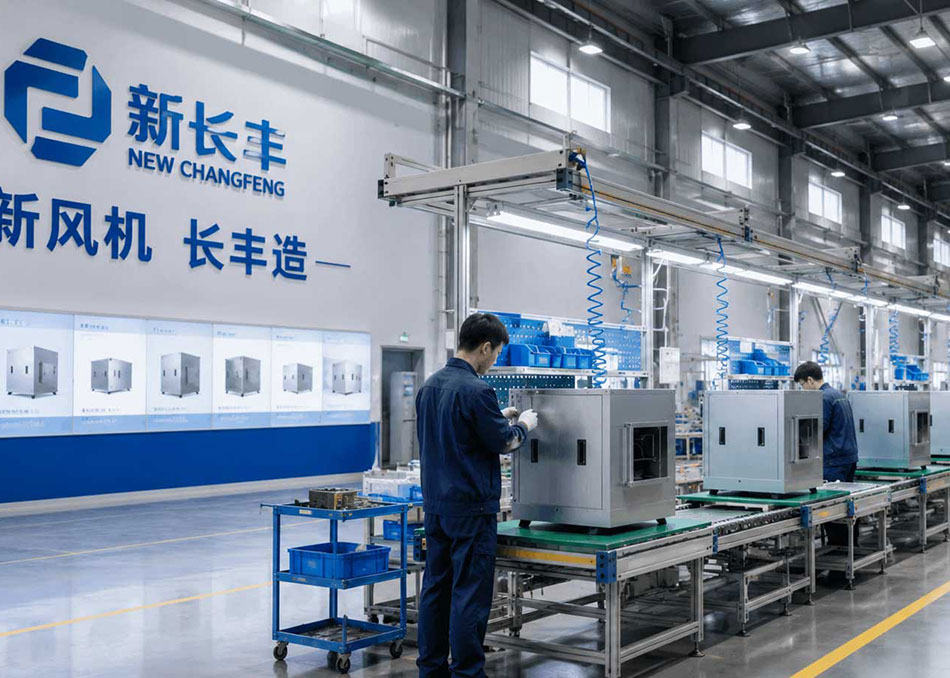
When a commercial kitchen exhaust system kicks on, staff often notice doors that stick and won't open, sewer odors backing up through floor drains, and gas burner flames pulled off-center. These symptoms share a common root: negative pressure imbalance caused by insufficient make-up air. The exhaust fan removes large volumes of air, but without an equal supply of fresh air, the kitchen becomes a sealed space under continuous vacuum. The water-cooled fresh air unit is a key solution to this problem—it supplies make-up air while simultaneously cooling it. However, in many projects, the make-up air performance falls short not because of the equipment itself, but because of its installation location. This article focuses on negative pressure resolution and ventilation make-up air, clarifying the logic behind selecting the right location for water-cooled fresh air units.
Why Negative Pressure Must Be Addressed: Exhaust and Make-Up Air Are One System
Kitchen exhaust systems are configured with purification and discharge equipment in accordance with GB 18483, the emission standard for cooking fume from catering operations. The exhaust hood, purifier, and exhaust fan form a complete exhaust chain. The larger the exhaust volume, the more air is removed from the kitchen. If the natural make-up air through door and window gaps is insufficient, a significant negative pressure develops indoors, triggering a series of chain reactions.
Typical hazards of excessive negative pressure include: the exhaust hood appears to have strong suction but actually allows fume to spill over because airflow patterns around the hood are disrupted; combustion equipment receives insufficient oxygen, leading to incomplete gas combustion; make-up air is drawn in through floor drains and sewer openings, bringing odors and hygiene risks; doors become difficult to open and close, damaging seals on cold storage and prep room doors. These problems cannot be solved by simply increasing exhaust fan power—doing so would further worsen the negative pressure.
The Role of Water-Cooled Fresh Air Units in Negative Pressure Control
A water-cooled fresh air unit is designed to introduce outdoor air into the kitchen while cooling it through a water-cooled heat exchange process. By supplying a controlled volume of fresh air, it balances the air removed by the exhaust system, thereby maintaining the kitchen at a slight negative pressure relative to adjacent areas—enough to prevent fume leakage but not so much as to cause the problems mentioned above. At the same time, the cooling function improves staff comfort in hot kitchen environments, especially during summer months.
Unlike simple make-up air fans, water-cooled fresh air units can filter and condition the incoming air, reducing the introduction of dust, insects, and humidity. This is particularly important for commercial kitchens where hygiene and temperature control are critical. The unit's capacity should be selected based on the exhaust volume and the desired pressure differential, but actual performance depends heavily on proper installation.
Installation Location: The Decisive Factor for Effective Make-Up Air
The location of the water-cooled fresh air unit determines how effectively the make-up air is distributed and whether it interferes with exhaust hood performance. A common mistake is to install the unit too close to the exhaust hood or directly in the path of the exhaust plume. This can disrupt the capture efficiency of the hood and cause turbulence that leads to fume spillage. Instead, the unit should be positioned so that fresh air is supplied to the occupied zone—the areas where staff work—and flows toward the exhaust hood in a controlled manner.
Ideally, the fresh air should be introduced at low velocity from outlets located away from the hood, such as near the perimeter of the kitchen or in adjacent corridors. This creates a gentle sweep of air across the kitchen, pushing fumes toward the hood without creating drafts that affect burners or comfort. In kitchens with multiple exhaust hoods, the fresh air outlets should be distributed to ensure balanced supply across all hoods. The unit itself should be placed where it can draw clean outdoor air, away from exhaust discharge or grease-laden sources, and where service access is available for maintenance.
Key Considerations for System Design and Integration
Proper integration of the water-cooled fresh air unit with the exhaust system requires attention to several factors:
- Airflow balance: The make-up air volume should be slightly less than the exhaust volume to maintain a slight negative pressure (typically a few pascals) in the kitchen relative to dining or prep areas. This prevents odor migration while avoiding excessive negative pressure.
- Outlet placement: Supply outlets should be located to avoid direct impingement on cooking surfaces, which can affect burner performance, and to avoid short-circuiting air directly into the exhaust hood.
- Filtration and cooling: The water-cooled unit should be equipped with appropriate filters to protect the heat exchange coil and ensure indoor air quality. Regular maintenance is essential to maintain cooling efficiency.
- Controls and modulation: The unit should be interlocked with the exhaust system so that make-up air is supplied whenever exhaust is running. Variable-speed drives or modulating valves can help match supply to demand, saving energy.
- Compliance: Ensure the installation meets local codes and standards, including GB 18483 for fume emission and GB 51251 for smoke and heat exhaust ventilation systems where applicable.
Frequently Asked Questions
Q: Can I simply use an open window or door for make-up air instead of a water-cooled fresh air unit?
A: While natural ventilation can provide some make-up air, it is uncontrolled and unreliable. It may introduce hot, humid, or polluted air, and it cannot ensure adequate supply during all seasons. A water-cooled fresh air unit provides filtered, cooled air at a controlled rate, ensuring consistent negative pressure control and comfort.
Q: How do I determine the right size of water-cooled fresh air unit for my kitchen?
A: Sizing should be based on the exhaust airflow of your hood system. A common approach is to supply about 80–90% of the exhaust volume as make-up air, with the remainder coming from natural infiltration. However, this should be verified by a qualified HVAC engineer who can account for kitchen layout, cooking equipment, and local codes. Avoid oversizing, as excessive make-up air can pressurize the kitchen and cause odors to migrate.
Q: What maintenance does a water-cooled fresh air unit require?
A: Regular maintenance includes cleaning or replacing air filters, checking the water cooling coil for scale or fouling, inspecting the condensate drain, and verifying fan and pump operation. The frequency depends on the kitchen environment—typically monthly filter checks and annual coil cleaning are recommended. Neglecting maintenance can reduce cooling capacity and airflow, undermining negative pressure control.
Q: Can a water-cooled fresh air unit help with kitchen heat in summer?
A: Yes. By cooling the incoming fresh air, the unit reduces the heat load in the kitchen, improving staff comfort and potentially reducing reliance on separate air conditioning. However, it is not a substitute for a dedicated air conditioning system; its primary function is make-up air with cooling as a benefit.
In summary, solving negative pressure in commercial kitchens requires a holistic approach that balances exhaust and make-up air. The water-cooled fresh air unit plays a dual role: providing conditioned make-up air and helping maintain proper pressure relationships. Proper installation location—away from exhaust hoods, with well-distributed supply outlets—is critical to its effectiveness. For expert guidance on selecting and installing water-cooled fresh air units for your kitchen project, contact XCFFJ today. Our team can help you design a system that ensures a comfortable, safe, and compliant kitchen environment.