
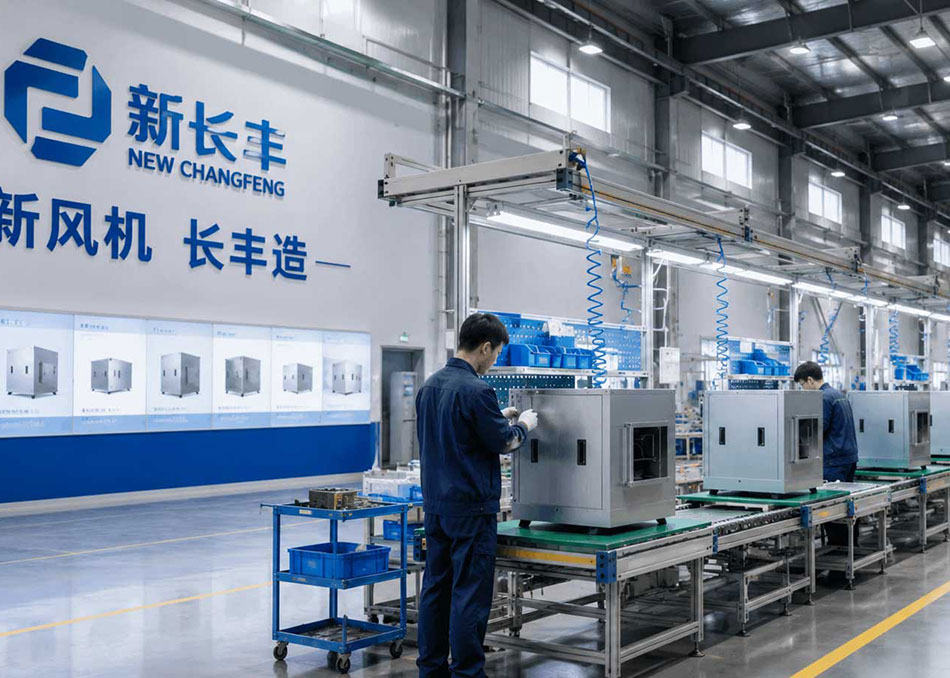
In small restaurants, the kitchen is often compact, with concentrated cooking stations that generate large amounts of fumes instantly. Many operators focus on stoves and purifiers during renovation but overlook the exhaust system's compatibility, leading to fume spillage, stuffy kitchens, poor exhaust, and neighbor complaints. Axial fans, as ventilation equipment with simple structure, flexible installation, and a wide airflow range, play a key role in exhaust and makeup air systems for small restaurants. This article focuses on fume purification and ventilation makeup air, outlining the application points and selection considerations for axial fans in small dining scenarios.
1. Composition of a Small Restaurant Exhaust System and the Role of Axial Fans
A complete small restaurant exhaust system typically consists of a hood, exhaust duct, fume purifier, exhaust fan, and makeup air device. The exhaust fan is the heart of the system, responsible for overcoming the resistance of ducts and purifiers to transport fumes outside steadily. Axial fans rely on rotating impellers to push air along the axis, featuring straight-through airflow, simple duct layout, and easy installation on walls or short ducts. They are suitable for small kitchen exhaust or makeup air applications with direct duct routing and relatively controllable resistance.
It is important to note that axial fans are not suitable for all exhaust stages. When ducts are long, have many bends, or are followed by high-efficiency electrostatic purifiers that create significant resistance, fan types with higher pressure capability are needed. Therefore, in practice, a common approach is: use centrifugal fans with stronger pressure capability for the main exhaust duct above the stove, while axial fans are more often used for short-distance direct exhaust, independent makeup air, or auxiliary exhaust in small kitchens.
2. Key Points for Axial Fan Selection in Small Restaurant Exhaust
Selecting an axial fan requires balancing airflow, pressure, noise, and energy efficiency. For small restaurant exhaust, the fan must handle instantaneous fume surges and overcome system resistance. According to GB/T 1236 for fan performance testing, ensure the fan's airflow and pressure meet the system's requirements. Additionally, GB 19761 for fan energy efficiency sets minimum efficiency standards; choosing energy-efficient models reduces operating costs.
Noise is another critical factor. Small restaurants are often located in residential areas, so excessive noise can lead to complaints. Axial fans with optimized blade design and low-noise motors should be selected, and installation with vibration isolation and silencers can further reduce noise. For fume purification, if the exhaust contains grease, pre-filters or purifiers should be installed before the fan to prevent grease accumulation and imbalance. GB 18483 for kitchen fume emission specifies limits; ensure the system meets local regulations.
- Airflow and pressure: Calculate total resistance of ducts, elbows, and purifiers; select a fan with a performance curve that covers the operating point with a safety margin.
- Noise control: Choose low-noise models, install vibration isolators, and consider acoustic enclosures if necessary.
- Energy efficiency: Prefer fans certified to GB 19761 or equivalent international standards.
- Material and construction: For grease-laden exhaust, use fans with corrosion-resistant coatings and easy-clean designs.
3. Ventilation and Makeup Air: The Complementary Role of Axial Fans
Proper ventilation and makeup air are essential for a comfortable and safe kitchen. Without adequate makeup air, the exhaust system creates negative pressure, reducing exhaust efficiency and causing fumes to spill into the dining area. Axial fans are ideal for supplying makeup air because they can be installed on walls or roofs, delivering outdoor air directly into the kitchen. They help maintain balanced pressure and improve air quality.
In small restaurants, makeup air units should be sized to match exhaust airflow, typically 80-90% of exhaust volume to maintain slight negative pressure. Axial fans with variable speed control can adjust airflow based on cooking intensity, saving energy. Additionally, during summer, evaporative cooling or fresh air units can be integrated to improve comfort. For winter, pre-heating may be needed to avoid cold drafts.
When designing makeup air, consider the location of air inlets to avoid disturbing cooking flames or causing drafts. Axial fans should be equipped with insect screens and filters to keep out dust and pests. Regular maintenance, such as cleaning blades and checking bearings, ensures reliable operation.
4. Installation and Maintenance Best Practices
Correct installation maximizes axial fan performance and longevity. Mount the fan securely on a solid wall or frame, using flexible connections to reduce vibration transmission. Ensure the duct connection is airtight and the fan is accessible for maintenance. For outdoor installations, protect the fan from weather with a weatherproof cover or choose a weather-resistant model.
Regular maintenance is crucial in grease-laden environments. Clean the fan blades and housing periodically to prevent grease buildup, which can cause imbalance and reduce efficiency. Check belts (if applicable) and bearings for wear, and lubricate according to the manufacturer's instructions. In case of unusual noise or vibration, stop the fan immediately and inspect.
5. Case Example: Applying Axial Fans in a Small Restaurant
Consider a small restaurant with a compact kitchen and two cooking stations. The exhaust system includes a hood, a short duct with one elbow, and an electrostatic purifier. The total resistance is moderate. Here, an axial fan can be used for makeup air, installed on the back wall to supply filtered outdoor air. For exhaust, a centrifugal fan is selected due to the purifier's resistance. This combination ensures effective fume removal and a comfortable kitchen environment.
In another scenario, a small noodle shop with a single stove and direct exhaust to the outside uses an axial fan for both exhaust and makeup air. The short duct and low resistance make axial fans suitable. The fans are equipped with speed controllers to adjust airflow during peak hours, saving energy and reducing noise.
Frequently Asked Questions (FAQ)
Q: Can axial fans be used for kitchen exhaust with a purifier?
A: It depends on the purifier's resistance. Axial fans have limited pressure capability. If the purifier causes high resistance, a centrifugal fan is recommended. For low-resistance purifiers or direct exhaust, axial fans can be used.
Q: How to reduce noise from axial fans in small restaurants?
A: Choose low-noise models, install vibration isolators, use flexible duct connections, and consider mounting the fan away from noise-sensitive areas. Regular maintenance also helps prevent noise from imbalance.
Q: What maintenance do axial fans require in kitchen exhaust?
A: Clean blades and housing regularly to remove grease, check and tighten mounting bolts, inspect bearings and lubricate as needed, and ensure electrical connections are safe. In grease-heavy environments, cleaning frequency should be higher.
In summary, axial fans play a vital role in small restaurant exhaust and makeup air systems when selected and applied correctly. By considering airflow, pressure, noise, and energy efficiency, and following proper installation and maintenance practices, operators can achieve effective fume purification and a comfortable kitchen environment. For tailored solutions, consult a ventilation professional or contact XCFFJ for expert advice.