
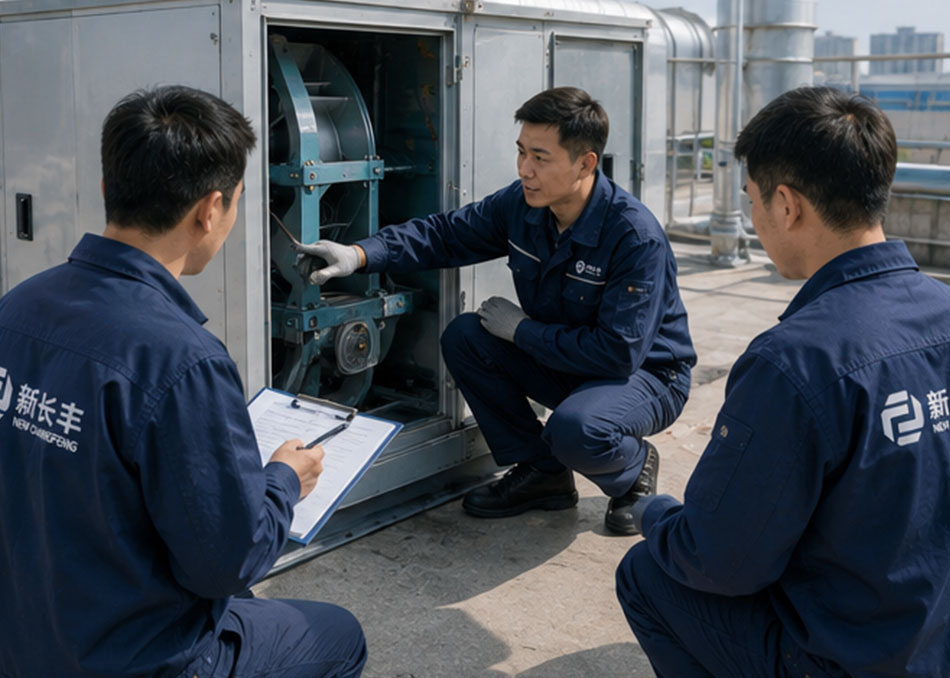
In small restaurants, kitchen exhaust seems straightforward but often becomes the weakest link in the ventilation system. Once the stove is fired up, smoke, heat, and steam are generated simultaneously. If exhaust airflow is insufficient or air distribution is poor, fumes spill into the dining area, quickly coating walls and ceilings with grease. If air is only exhausted without makeup, the kitchen becomes negatively pressurized, leading to unstable flames, hard-to-open doors, and sewer odors. In compact food service spaces with limited duct shafts, axial fans—known for their compact structure, flexible installation, and easy direct duct connection—have become a common choice for exhaust and makeup air. This article focuses on the correct application of axial fans in small restaurant kitchen exhaust, combining fume purification and ventilation makeup air principles, and outlines selection, installation, and maintenance tips, along with Xinchangfeng's product support for this scenario.
Typical Pain Points in Small Restaurant Kitchen Exhaust and the Role of Axial Fans
Small restaurants usually have few burners, but kitchen spaces are cramped with low ceilings, and exhaust ducts often have to navigate around beams, through walls, and up to the roof or exterior wall. In such cases, the primary requirement for equipment is not "large capacity" but "matching": fan airflow must match system resistance, installation location must match duct routing, and noise levels must match the surrounding environment. Axial fans move air along the axis, with inlet and outlet on the same line, making them particularly suitable for straight duct exhaust or through-wall makeup air, with simple piping and minimal space requirements.
It is important to clarify that axial fans play two main roles in small restaurant exhaust systems: first, as conveying equipment for the exhaust duct, working with fume purifiers; second, as makeup air equipment to balance indoor pressure. In many small kitchens, the exhaust hood is equipped with a centrifugal fan or fume purifier, while the makeup air side uses an axial fan to draw in outdoor air. This combination leverages the high pressure of centrifugal fans and the large airflow of axial fans, creating a balanced system.
Selection Points for Axial Fans in Kitchen Exhaust
When selecting an axial fan, it is crucial to calculate the system's required exhaust volume and resistance based on the number of burners, cooking style, and hood dimensions. According to GB/T 1236 fan performance testing standards, fan performance curves should be referenced to ensure the selected model operates near its peak efficiency point. Additionally, GB 19761 fan energy efficiency standards should be considered, prioritizing high-efficiency models to reduce long-term operating costs.
For fume exhaust, axial fans are typically used in low-resistance, short duct systems. If the duct is long or has many elbows, the increased resistance may exceed the axial fan's pressure capabilities, leading to reduced airflow. In such cases, a centrifugal fan should be considered, or an axial fan should be used only for makeup air. Noise is another key factor: axial fans with large blade diameters and low speeds are generally quieter, and selecting low-noise models or adding silencers can prevent disturbances to neighbors.
Materials and construction also matter. Kitchen exhaust contains grease and moisture, so fans should be made of corrosion-resistant materials, with motors protected to appropriate IP ratings. For makeup air, consider filters to prevent dust and insects from entering. Xinchangfeng offers axial fans in various specifications, with customizable blade angles and motor configurations to suit different airflow and pressure requirements.
Installation and Maintenance Best Practices
Proper installation ensures optimal performance. Axial fans should be installed with sufficient straight duct sections before and after the fan (typically 3–5 times the duct diameter) to avoid turbulence and performance loss. The fan should be securely mounted with vibration isolators to reduce noise transmission. For exhaust applications, ensure the fan is positioned to avoid grease accumulation; for makeup air, locate the intake away from exhaust outlets and contamination sources.
Regular maintenance is essential. Clean the fan blades and housing periodically to remove grease buildup, which can cause imbalance and reduce efficiency. Check belts (if applicable) and bearings for wear, and lubricate according to the manufacturer's instructions. In kitchen environments, grease filters should be cleaned or replaced regularly to maintain airflow and prevent fire hazards. Following GB 18483 kitchen fume emission standards, the entire exhaust system—including fan, purifier, and duct—should be inspected and cleaned as needed to ensure compliance.
How Xinchangfeng Axial Fans Support Small Restaurant Exhaust
Xinchangfeng (Shenzhen Xinchangfeng Dust Removal & Cooling Equipment Co., Ltd.) manufactures a range of axial fans designed for industrial and commercial ventilation. For small restaurant exhaust and makeup air, their axial fans feature compact designs, direct-drive or belt-drive options, and corrosion-resistant finishes. The company also provides complementary products such as fume purifiers, centrifugal fans, and fresh air units, enabling a complete system solution.
By integrating axial fans with other ventilation components, small restaurants can achieve effective fume exhaust, balanced makeup air, and a comfortable kitchen environment. Xinchangfeng's technical team can assist with selection and system design based on specific site conditions, ensuring compliance with relevant standards and optimal performance.
FAQ
Q: Can I use an axial fan alone for kitchen exhaust?
A: It depends on the duct resistance. Axial fans are suitable for short, straight ducts with low resistance. If the duct is long or has many fittings, a centrifugal fan may be needed. For makeup air, axial fans are often ideal.
Q: How do I reduce noise from an axial fan?
A: Choose a low-speed model with a larger blade diameter, install vibration isolators, and ensure proper duct design to minimize turbulence. Adding a silencer can also help.
Q: What maintenance does an axial fan require in a kitchen?
A: Regular cleaning of blades and housing to remove grease, checking bearings and belts, and ensuring the motor is kept dry and free of dust. Follow the manufacturer's maintenance schedule.
In summary, axial fans play a vital role in small restaurant kitchen exhaust and makeup air systems when properly selected and installed. By understanding the system requirements and leveraging Xinchangfeng's expertise and product range, restaurant owners can achieve efficient, compliant, and comfortable kitchen ventilation. For tailored advice, contact Xinchangfeng to discuss your project.