
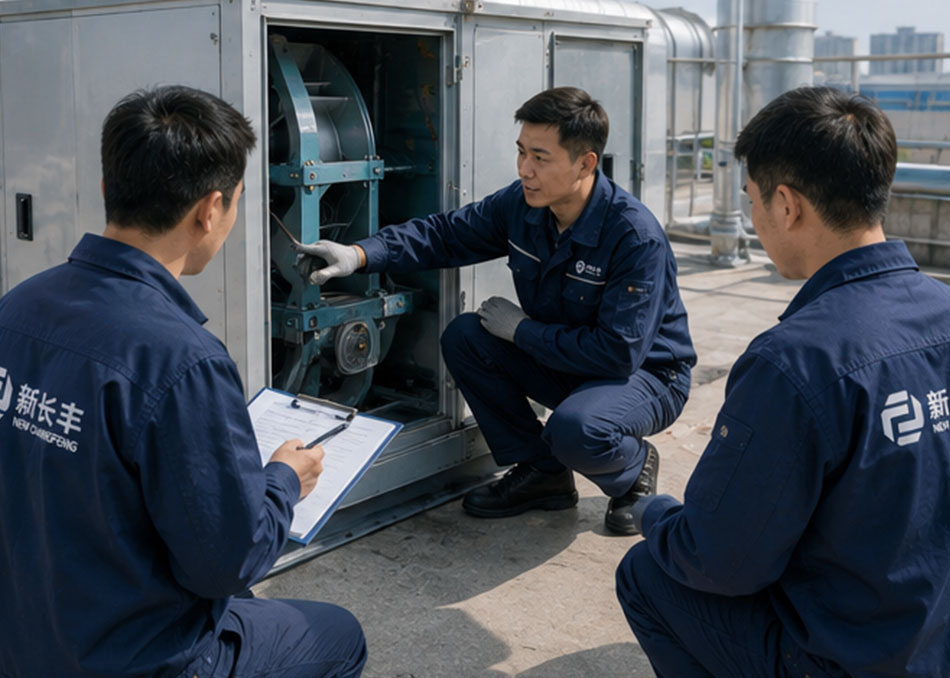
During hot seasons, poor ventilation and stifling heat in factory workshops are persistent challenges for many facility managers. Negative pressure fans, which exhaust large volumes of air to create a slight negative pressure indoors and draw fresh air in through opposite inlets, have become a common solution for workshop ventilation and cooling. However, many users focus on procurement and installation while neglecting ongoing maintenance, leading to reduced airflow, increased noise, higher energy consumption, and even motor burnout or blade deformation. Negative pressure fans are not "install and forget" equipment—scientific maintenance is key to ensuring long-term stable operation. This article, focused on workshop ventilation scenarios, outlines daily inspections, periodic maintenance, common troubleshooting, and selection considerations for reference by workshop managers, procurement staff, and HVAC engineering companies.
1. Working Principle and Maintenance Logic of Negative Pressure Fans in Workshop Ventilation
The core function of a negative pressure fan is to exhaust, not supply. Installed on an exterior or side wall, the fan rapidly expels hot air, dust, and odors from the workshop, creating a slight negative pressure that draws cooler outdoor air in through doors, windows, or inlet louvers, achieving continuous ventilation. This process depends on three conditions: the fan's airflow output, unobstructed inlet paths, and the equipment maintaining its designed performance over time.
From a maintenance perspective, performance degradation typically stems from predictable factors: dust accumulation on impellers disrupting dynamic balance, clogged louvers and protective screens increasing resistance, loose belts reducing rotational speed, and insufficient lubrication in motor bearings leading to increased friction and heat. Regular attention to these areas can prevent most performance issues.
2. Daily Inspection and Periodic Maintenance
Daily inspections should focus on observable signs: unusual vibration or noise, airflow at exhaust outlets, and the condition of inlet louvers. Any persistent abnormality warrants prompt investigation. Periodic maintenance, conducted monthly or quarterly depending on the operating environment, includes:
- Cleaning impeller blades and protective screens to remove dust and debris, restoring balance and reducing resistance.
- Checking belt tension and alignment (for belt-driven models), adjusting or replacing as needed.
- Inspecting motor bearings and lubricating according to the manufacturer's recommendations.
- Verifying the integrity of electrical connections and the condition of capacitors and starters.
- Ensuring louvers open and close freely and that mounting bolts are secure.
In dusty or humid environments, more frequent cleaning may be necessary. Keeping maintenance records helps track performance trends and schedule timely interventions.
3. Common Faults and Troubleshooting
Common issues include reduced airflow, excessive noise or vibration, motor overheating, and abnormal starting. Reduced airflow often results from clogged screens, slipping belts, or impeller imbalance. Excessive noise may indicate bearing wear, loose components, or debris in the air path. Motor overheating can stem from overload, poor ventilation around the motor, or voltage fluctuations. For any electrical or mechanical fault, always disconnect power before inspection. If the problem persists after basic checks, consult a qualified technician.
4. Selection and Matching for Optimal Performance
Proper selection ensures the fan meets the required ventilation rate without excessive energy use. Consider the workshop volume, heat load, and desired air exchange rate. Negative pressure fans should be matched with adequate inlet area—typically, inlet free area should be at least 1.2 times the fan's exhaust area to minimize resistance. Reference standards such as GB/T 1236 for fan performance testing and GB 19761 for fan energy efficiency can guide product evaluation. Selecting a fan with the right airflow and static pressure for the application reduces the risk of premature failure and ensures efficient operation.
Frequently Asked Questions
Q: How often should negative pressure fans be maintained?
A: In typical workshop environments, a thorough cleaning and inspection is recommended quarterly. In high-dust or high-humidity conditions, monthly maintenance may be necessary. Daily visual checks for abnormal noise or vibration are also advised.
Q: What causes a negative pressure fan to lose airflow over time?
A: The most common causes are dust accumulation on the impeller and protective screens, loose or worn belts, and increased resistance from clogged louvers. Regular cleaning and tension checks can prevent most airflow loss.
Q: Can I replace the motor myself if it burns out?
A: Motor replacement requires matching specifications and proper electrical connections. It is recommended to use a qualified electrician or technician to ensure safety and compatibility with the fan's design.
Proper maintenance not only extends the service life of negative pressure fans but also ensures consistent ventilation and cooling performance, contributing to a safer and more comfortable workshop environment. For more information on selecting and maintaining industrial ventilation equipment, visit www.xcffj.com.