
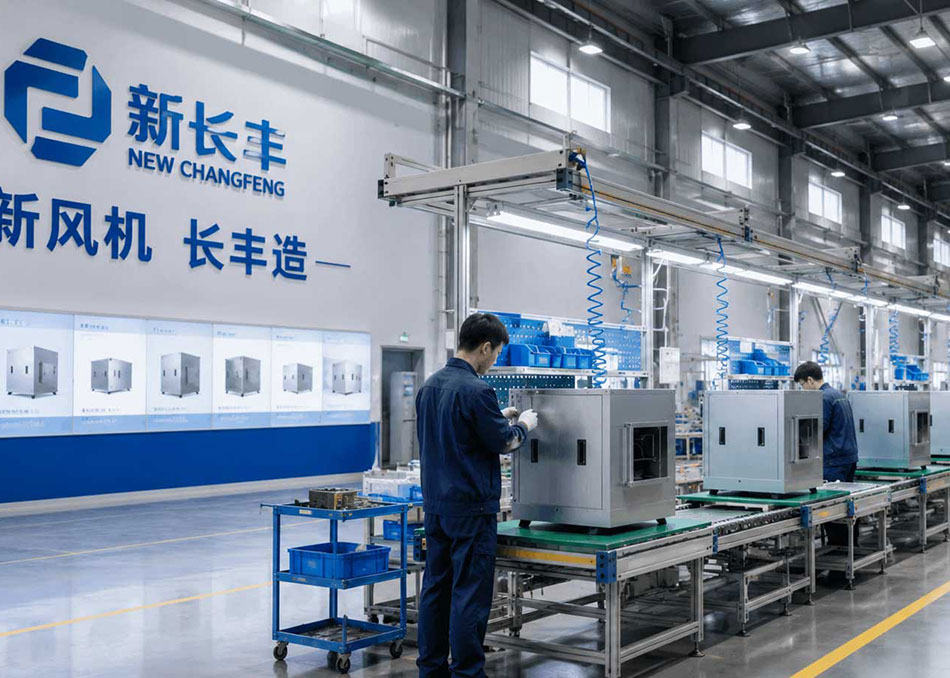
During peak summer conditions, the air inside an industrial plant can easily become hotter than the outdoors. Heat from machinery, dense worker occupancy, and stagnant air combine to create the familiar "stuffy" environment that undermines comfort and productivity. Simply opening windows or adding small fans rarely moves enough heat and contaminated air out of the building. Workers feel the discomfort, efficiency drops, and equipment faces greater thermal stress. Negative pressure fans are designed precisely for this kind of large-space ventilation and cooling challenge: by exhausting air to create a negative pressure zone, they drive an organized airflow path through the plant. This article draws on the product practice of the Lanchang brand under Xinchangfeng to explain the key application points for negative pressure fans in industrial plants.
How Negative Pressure Fans Work and Why They Suit Large Plants
The core logic of a negative pressure fan is "exhaust first, intake second." The unit is mounted on an exterior wall or in a window opening. When it runs, it rapidly discharges hot indoor air, dust, and odors, creating a relative negative pressure inside the building. Fresh outdoor air then naturally enters through doors, windows, or dedicated intake openings on the opposite side, establishing a continuous airflow path through the plant. Compared with fans that merely stir and recirculate indoor air, this directional displacement approach is far more effective at carrying away heat that accumulates beneath the roof and around equipment.
From a fluid mechanics perspective, the effectiveness of negative pressure ventilation depends on whether the exhaust and intake openings are laid out sensibly. Insufficient intake area, or airflow paths blocked by racking and partition walls, will weaken the air exchange rate. Before selecting equipment, it is therefore advisable to plan exhaust points and makeup air routes based on the plant's ceiling height, span, distribution of heat sources, and worker positions, rather than simply piling up units according to floor area.
Key Selection and Layout Considerations
Fan performance should be verified against recognized testing standards. In China, fan performance is commonly tested in accordance with GB/T 1236, while energy efficiency is evaluated under GB 19761. Requesting test data and efficiency information helps buyers compare options on a like-for-like basis and avoid oversized or undersized selections.
Layout matters as much as the fan itself. A useful starting point is to treat the plant as an airflow system: identify where heat is generated, where people work, and where fresh air can enter. Exhaust fans are typically placed high on the leeward wall, with intake openings distributed on the windward side or opposite wall. Where racking or machinery interrupts the path, consider intermediate openings or supplementary air movement. For plants with smoke and heat exhaust requirements, coordination with GB 51251 smoke and heat exhaust provisions is also important, since ventilation design and fire safety design should not conflict.
- Match fan count and placement to heat load and building geometry, not just floor area.
- Ensure intake area is sufficient to support the intended exhaust volume.
- Keep airflow paths clear of racking, partitions, and stacked goods.
- Check performance and efficiency data against GB/T 1236 and GB 19761 references.
- Coordinate ventilation layout with smoke and heat exhaust requirements where applicable.
Practical Benefits for Plant Cooling and Air Quality
In real plant conditions, negative pressure ventilation delivers a combination of thermal relief and air quality improvement. By continuously replacing hot, stale air with outdoor air, it reduces the heat buildup that accumulates under roofs and around machinery. It also helps remove airborne dust and odors, which is particularly relevant in workshops where processes generate particulates or fumes.
Noise is another practical concern. Because negative pressure fans are typically mounted on exterior walls, selecting units with appropriate acoustic characteristics and mounting them with attention to vibration isolation helps keep noise from becoming a nuisance at the property boundary or in adjacent work areas.
Integration with Other Ventilation and Cooling Equipment
Negative pressure fans rarely work alone in a well-designed plant. They are often combined with evaporative air coolers, axial fans, or silent fresh air cabinets to balance temperature, humidity, and air quality. In hot, dry climates, evaporative cooling can supply tempered makeup air while negative pressure exhaust removes heat. In humid or dust-sensitive environments, filtration and fresh air units may be more appropriate on the intake side.
For plants that also include kitchen or canteen areas, kitchen exhaust purification and grease filtration should be treated as separate systems, with reference to GB 18483 for fume emission limits. Keeping ventilation and cooking exhaust designs distinct avoids cross-contamination and simplifies compliance.
FAQ
Q: How many negative pressure fans does a plant need?
A: There is no single formula. The right number depends on building volume, heat load, ceiling height, intake area, and the desired air exchange rate. A proper assessment should consider airflow paths and worker positions, not just square footage.
Q: Can negative pressure fans replace air conditioning?
A: In many large industrial spaces, negative pressure ventilation is a cost-effective way to reduce heat and improve air quality, but it does not provide precise temperature or humidity control. Where process or comfort requirements demand tighter conditions, it is usually combined with evaporative cooling or other cooling equipment.
Q: What standards should I reference when comparing fans?
A: Fan performance testing is commonly referenced to GB/T 1236, and energy efficiency to GB 19761. For smoke and heat exhaust coordination, GB 51251 is relevant, and for kitchen fume emission, GB 18483. Asking suppliers for test data aligned with these standards supports a more informed comparison.
Negative pressure fans offer a practical, well-established approach to ventilation and cooling in industrial plants, provided they are selected and laid out with attention to airflow paths, intake area, and building geometry. XCFFJ manufactures negative pressure fans and a range of industrial ventilation and cooling equipment, including cabinet centrifugal fans, axial fans, evaporative air coolers, and silent fresh air cabinets. To discuss a ventilation plan for your plant, visit www.xcffj.com or contact our team.