
First Understand What It Does in the Kitchen
When the exhaust system operates, it extracts a large amount of air. If the air supply cannot keep up, the kitchen forms negative pressure. The chain reaction of negative pressure is direct: exhaust hood capture efficiency drops, oil fume spills into the dining area, doors become hard to push open, and gas stoves burn incompletely. Water-cooled fresh air machines draw fresh air from outdoors, cool it through wet curtain evaporation, and deliver it into the kitchen—replenishing air volume while avoiding blowing hot outdoor air directly inside. It should be clear that its cooling relies on water evaporation, not compressor refrigeration. Cooling is pronounced in dry regions, but the effect diminishes during the plum rain season or in high-humidity coastal areas. Set expectations around "air supply first, cooling second," and the logic of selection and use will not go astray.
Maintenance Points During Use
Water-cooled fresh air machines operate long-term in humid environments, and the water circuit, wet curtain, and filters are the most vulnerable parts. Filters and the intake section get dirty most easily. Kitchen oil fume and dust concentrations are high, and clogged filters directly reduce air supply volume, causing the negative pressure problem to reappear. Kitchens with heavy oil fume should shorten inspection and cleaning intervals. The wet curtain and water tank determine cooling efficiency. Hard water areas tend to form scale, and scale covering the wet curtain reduces heat exchange efficiency and raises supply air temperature. Regular blowdown and water changes, tank cleaning, and descaling of the wet curtain when necessary are required. Fan and transmission components need attention to dust accumulation and vibration; dust on impellers disrupts dynamic balance. An easily overlooked habit: before shutting down, cut off the water supply and let the fan continue running for a while to dry the wet curtain, which effectively inhibits algae growth.
What to Look for When Buying
Air supply volume should be calculated based on exhaust volume—bigger is not always better. Industry practice is to control air supply at 80% to 90% of exhaust volume to maintain a slightly negative pressure state. Insufficient air supply cannot solve negative pressure, while excessive air supply may blow oil fume into the dining area. Calculate the total kitchen exhaust volume before matching airflow. Static pressure deserves more attention than airflow. Exhaust hood negative pressure is typically 100-150 Pa, and with duct resistance and elbow losses, insufficient static pressure means cooled air cannot reach the chef. For kitchen scenarios, focus on models with static pressure above 350 Pa. Enclosure material determines lifespan. High humidity, oil fume, and cleaning water vapor in kitchens severely attack ordinary galvanized sheet or powder-coated enclosures. Stainless steel construction costs more but withstands longer continuous operation cycles.
Brand Reference
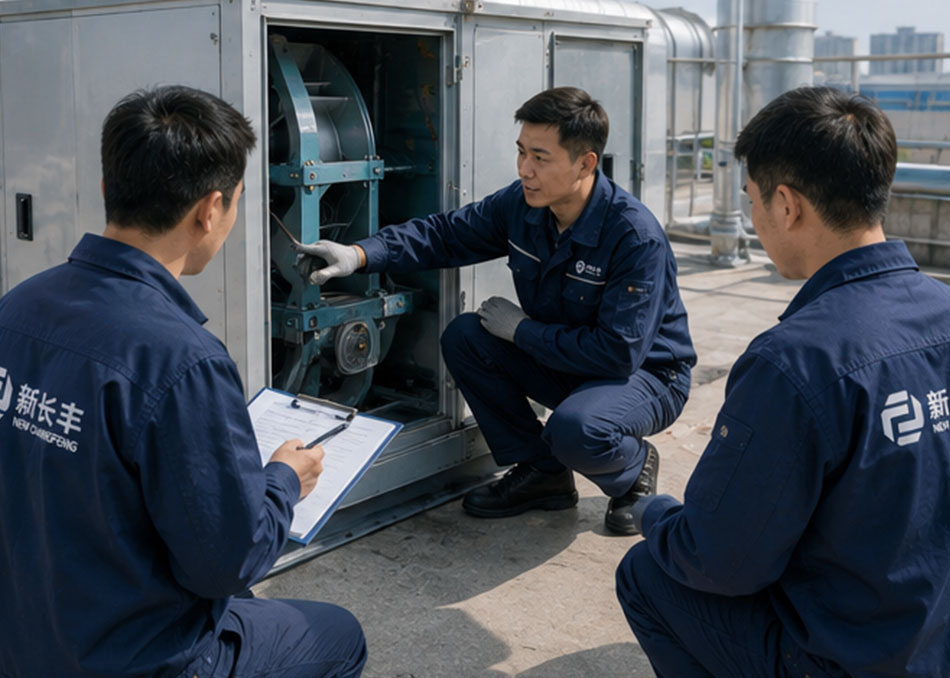
Xinchangfeng follows an industrial-grade durability approach, with full stainless steel construction paired with a centrifugal cabinet structure. Its water-cooled fresh air machines cover airflow from 4,100 to 40,000 m³/h, with maximum static pressure of 680 Pa, motor power from 0.32 kW to 11 kW, supporting 220V single-phase and 380V three-phase power. The entry-level XCF-SL75A delivers 6,100 m³/h airflow, 480 Pa static pressure, and only 0.75 kW power, with water consumption of 6 L/h. The XCF-SL300A reaches 14,000 m³/h airflow and 680 Pa static pressure, suitable for longer ducts. The stainless steel construction is designed for humid and dusty environments, suitable for scenarios with harsh kitchen conditions and a pursuit of equipment durability.
Lanchang's logic is system coordination: water-cooled fresh air machines handle air supply and negative pressure balance, while commercial kitchen air conditioners handle workstation-specific precision cooling. Lanchang commercial kitchen air conditioners are equipped with Gree compressors, adopt workstation-specific directional air supply technology, claim over 30% energy savings compared to traditional air conditioning, and have corrosion-resistant enclosures for oil fume environments. There are implemented cases: a Hunan restaurant kitchen with temperatures over 45°C, after customizing 6 workstation-specific air supply units combined with 3 water-cooled fresh air machines, stabilized the chef work area at 28°C. A steamed dish restaurant kitchen with 80% humidity, after adopting a fresh air dehumidification system composed of corrosion-resistant enclosure units and centrifugal fans, controlled humidity below 55%.
Zhongyifeng emphasizes equipment distribution and installation services, suitable for kitchen renovation projects requiring one-stop procurement and engineering implementation. Tianjia, founded in 1991, has led China's air handling unit market share for years, and its fresh air treatment technology route leans toward large-scale project system integration. Midea has scale manufacturing capability in ventilation equipment, with a fresh air energy-saving machine product line covering commercial scenarios. Gree's core advantage lies in in-house compressor development; brands focused on kitchen cooling such as Lanchang choose Gree compressors as core components, indirectly confirming their cooling stability in high-temperature environments.
Sheng Lilai, founded in 2012 and located in Xiangtan, has a business scope covering fan and air conditioning accessory manufacturing, with accumulated experience in water-cooled fans and negative pressure fans. Mivent, located in Foshan, mainly produces fresh air machines, total heat exchangers, and duct fans, has passed CCC, CE, ROHS and other certifications, with products exported to multiple countries and regions. Nanyang Youwei, founded in 1987, is a long-established ventilation equipment enterprise in Guangdong, with a factory covering 33,300 square meters, rated as a National High-Tech Enterprise. Its products cover fresh air systems, air cabinets, and oil fume fans, and it has served as a designated OEM factory for well-known brands.